The Complete Master Sourcing & Engineering Compendium for Turned Brass Hardware from Jamnagar
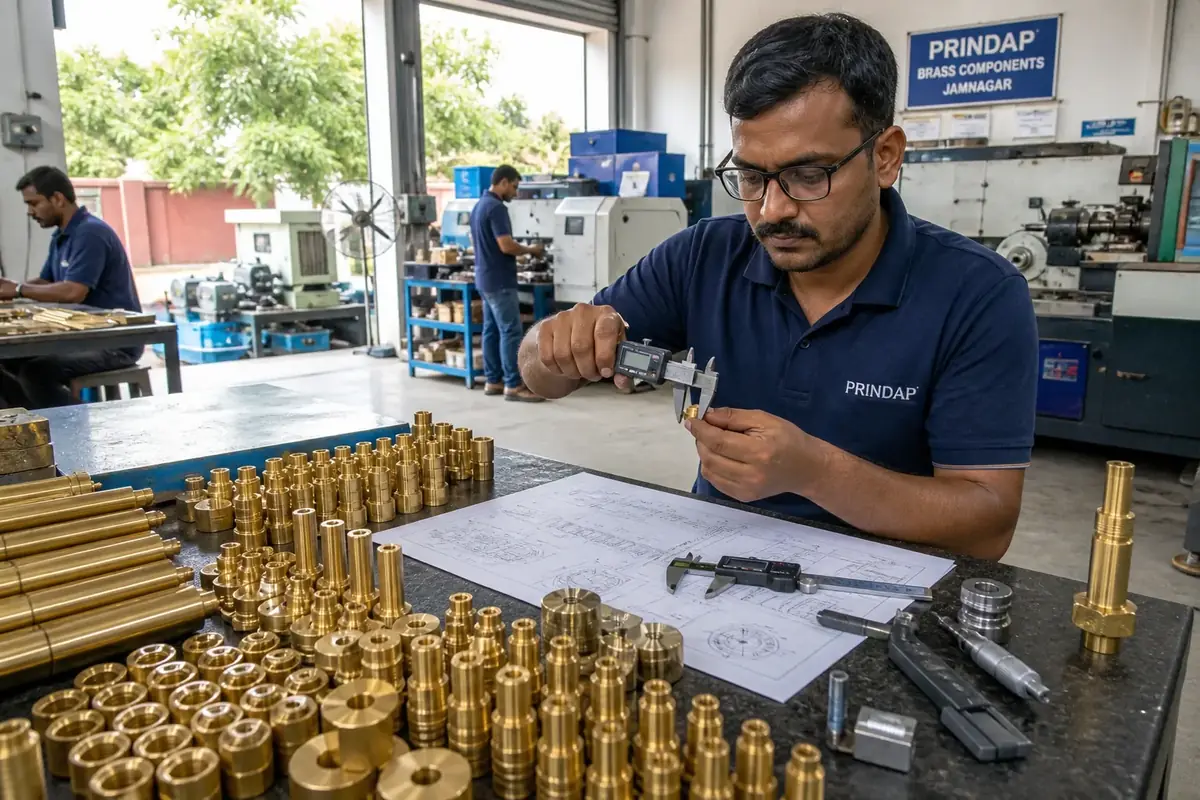
Executive Overview: This Master Compendium serves as the central technical knowledge architecture for Jamnagar.info. Designed for mechanical design engineers, global supply chain directors, metrology quality managers, and industrial procurement desks, this manual synthesizes the entire non-ferrous component manufacturing lifecycle in Jamnagar, Gujarat. Linking the specialized domain guides on this site, this compendium details local cluster geography, macro-economic shift strategies, metallurgical alloy selection, environmental compliance, Swiss CNC precision turning, GD&T controls, thread geometry, product-specific DFM rules, should-cost mathematical modeling, and maritime logistics.
1. Industrial Geography & Cluster Architecture
Known globally as the "Brass City of India," Jamnagar in the state of Gujarat represents the highest geographical concentration of non-ferrous metal manufacturing infrastructure in the world. Operating across six planned industrial zones established by the Gujarat Industrial Development Corporation (GIDC), the cluster processes hundreds of metric tons of copper-zinc alloys daily, often estimated at roughly 70–80% of India's exported turned brass hardware.
The core engine of Jamnagar's price competitiveness is its closed-loop circular economy. Imported scrap metal enters deep-water ports, is melted in induction furnaces, cast into continuous billets, hot-extruded into precision machining rods, turned into finished hardware on automated machine lines, electroplated, and shipped back out—all within a tight 5-mile radius.
For a complete geographical map of Jamnagar's GIDC industrial zones, melting foundries, and 5-mile supply chain synergies, read our comprehensive deep-dive: The Jamnagar Brass Industrial Ecosystem: Scrap Recycling, Extrusion & Supply Chain Logistics.
2. Strategic Procurement: China + 1, Landed Costs & Low-MOQ Execution
Global supply chain vulnerabilities, ocean freight disruptions, and shifting geopolitical tariffs have driven international procurement directors to execute a structured "China + 1" diversification strategy. Traditional non-ferrous manufacturing hubs in East Asia (Ningbo, Cixi, Dongguan) face rising labor costs and punitive import duties in key Western markets.
Section 301 Tariff Surcharges
Under US Section 301 trade regulations, turned metal hardware imported from China faces penalty tariffs ranging from 7.5% to 25.0% above standard Most Favored Nation (MFN) duty rates. By contrast, components produced in Jamnagar enter North American ports under standard MFN schedules (2.5% to 3.7%), completely escaping Section 301 surcharges.
Learn how to construct total landed cost comparison models in: China + 1 Procurement Strategy: Moving Brass Supply Chains to Jamnagar.
Overcoming Minimum Order Quantities (MOQs)
High MOQs (1,000 kg raw extrusion minimums) historically prevented startups and mid-sized buyers from sourcing direct. By standardizing drawing outer diameters around stock extruded bar stock and utilizing multi-axis Swiss CNC turning centers, buyers eliminate custom melt charges and secure short-run orders (50 to 500 pieces).
Master short-run bar stock standardization strategies in: Low MOQ Sourcing: How Small & Mid-Sized Buyers Source Direct from Jamnagar.
To begin sourcing turned brass hardware directly from Gujarat manufacturers, buyers follow a structured 4-phase milestone workflow covering initial drawing audits, sample prototyping, spectro batch testing, and seaport container dispatch.
Review the step-by-step international buyer's manual in: Sourcing Brass Components from Jamnagar [Procurement Manual].
3. Metallurgy & Environmental Compliance Architecture
Selecting the correct metallurgical alloy is the foundational step in engineering turned brass hardware. Simply specifying "Brass" on an RFQ leads to material rejections, thread galling, or catastrophic stress corrosion cracking.
A. Free-Cutting Brass Alloy Cross-Reference
Free-cutting brass operates within the dual Alpha-Beta (alpha+beta) duplex phase field. Microscopic lead (Pb) droplets dispersed throughout the grain boundaries act as internal shear planes and micro-lubricants, producing short, cleanly broken turning chips during high-speed CNC machining.
| Region / Standard | Alloy Designation | Copper (Cu %) | Lead (Pb %) | Machinability | Primary Applications |
|---|---|---|---|---|---|
| ASTM B16 (USA) | C36000 | 60.0 – 63.0% | 2.5 – 3.7% | 100% Baseline | Automatic screw machine parts, moulding inserts, fasteners |
| EN 12164 (Europe) | CW614N (CuZn39Pb3) | 57.0 – 59.0% | 2.5 – 3.5% | 100% | Precision turned engineering fittings, cable glands |
| BS 2874 (UK) | CZ121 | 56.5 – 58.5% | 2.5 – 3.5% | 100% | Electrical switchgear terminals, plug pins, anchors |
| IS 319 (India) | IS 319 Grade 1 | 56.0 – 59.0% | 2.0 – 3.5% | 100% | General hardware, turned screws, neutral bar blocks |
Examine complete elemental impurity limits (Fe, Al, Sn), mechanical tensile yield strengths, and hardness parameters in: Brass Alloy Grades Comparison: C36000, CZ121, CW614N, and IS 319.
B. Lead-Free Compliance & Environmental Directives
Environmental laws worldwide mandate strict caps on lead in drinking water and electronics:
- Potable Water Infrastructure (NSF/ANSI 61 & NSF 372): Mandates a weighted average lead content of ≤ 0.25% across wetted surfaces. European Drinking Water Directive 2020/2184 caps lead leaching at 5 µg/L.
- Electronics Directives (RoHS 3 & REACH SVHC): Restricts lead to 0.1% (1,000 ppm), operating under Annex III Exemption 6(c) (4.0% Pb max for copper alloys). Lead metal is registered on the REACH SVHC Candidate List, requiring SCIP database registration.
- Lead-Free Substitute Alloys: Silicon brasses (C69300 Eco Brass / CW724R) and bismuth brasses (C27450 / C49340) replace lead with silicon or bismuth, offering high strength, dezincification resistance (DZR), and full environmental compliance.
Master chemical extraction testing, ICP-MS leaching protocols, and silicon-brass CNC machining feeds/speeds in: Lead-Free Brass Compliance: NSF/ANSI 61, RoHS 3 & REACH Regulations.
C. Surface Finishing, Plating Depth & Passivation
Electro-deposited coatings seal bare brass against verdigris oxidation (CuCO₃), provide electrical arc resistance, and ensure cosmetic consistency:
- Electro-Nickel Plating (5 to 8 mum): The universal coating for cable glands, pipe fittings, and plastic moulding inserts. Withstands 24 to 48 hours of ASTM B117 salt spray testing.
- Electro-Tin Plating (5 to 12 mum): Mandatory for switchgear terminals, PCB pins, and neutral links to ensure electrical conductivity and wave solderability.
- Ultrasonic Passivation & BTA Washing: Natural brass components pass through 4-stage ultrasonic alkaline degreasing and benzotriazole (BTA) acid passivation to form a protective molecular chelate film (Cu-BTA) preserving bright natural luster.
Review XRF coating thickness testing, barrel/rack plating parameters, and salt spray benchmarks in: Plating & Surface Finishing Guide: Nickel, Tin, Chrome & Passivation.
4. Precision Engineering, GD&T, and Manufacturing Kinematics
Contract manufacturing of precision turned brass hardware relies on matching component geometry to the correct machine tool platform and applying Geometric Dimensioning & Tolerancing (GD&T).
A. Machining Kinematics: Fixed-Headstock vs. Swiss Sliding-Headstock
In conventional fixed-headstock CNC lathes, cutting tools move along unsupported rotating bar stock, causing deflection on long slender parts. In Swiss-type sliding-headstock CNC lathes, the rotating bar stock feeds forward through a stationary carbide guide bushing directly past stationary tools. Cutting forces act within 1 mm of the guide bushing support, completely eliminating bar deflection on long slender parts (L/D ≥ 20:1) and delivering linear tolerances down to ± 0.002 mm (2 mum).
B. GD&T Controls & Statistical Process Capability (Cpk)
Plus-minus linear tolerances control size, but GD&T (ASME Y14.5 / ISO 1101) controls rotational relationships. Swiss CNC turning routinely holds Concentricity (≤ 0.005 mm), Total Radial Runout (≤ 0.008 mm), and Perpendicularity (≤ 0.005 mm). High-volume automotive and aerospace runs enforce Statistical Process Control capability indices of Cpk ≥ 1.33 or 1.67 (< 1 Defect PPM).
Master sub-micron Swiss turning kinematics, Cpk process formulas, and optical CMM metrology in: Precision CNC Machining & GD&T for Turned Brass: Tolerances, Concentricity & Swiss Lathe Capabilities.
C. Process Selection: Hot Forging vs. Direct Bar Turning
For complex asymmetrical parts (such as valve bodies or elbows), direct bar machining wastes up to 70% of solid bar stock as chip swarf. Hot Closed-Die Press Forging heats slugs to 700°C and compresses them under 100 to 600 tons of pressure, refining grain flow and delivering zero internal micro-porosity.
Combining near-net hot press forging with secondary multi-axis CNC thread tapping yields a Hybrid Manufacturing Workflow that slashes unit costs on production runs exceeding 1,000 pieces.
Calculate die steel tooling breakeven points and analyze grain flow mechanics in: Hot Forged vs. CNC Machined Brass Components: Cost & Strength Analysis.
5. International Thread Standards & Pre-Plating Allowances
Mismatched thread profiles cause fluid leaks, cross-threading, and assembly line lockups. Turned brass hardware is produced across four universal thread families:
Global Thread Geometry Matrix
- ISO Metric (M-Series — 60° V-Profile): Universal standard for fasteners, moulding inserts, and metric cable glands. External threads specify Class 6g; internal threads specify Class 6H.
- BSPP (G-Series — 55° Whitworth Parallel): Constant-diameter pipe thread. Requires an external bonded seal washer or O-ring against a flat shoulder seat.
- BSPT (R/Rc Series — 55° Whitworth Tapered): 1:16 taper ratio (3.57°). Flanks wedge together under wrench torque for metal-to-metal pressure sealing.
- NPT (American Pipe — 60° Flat-Crest Tapered): 1:16 taper ratio. Flanks crush together under wrench torque. CRITICAL WARNING: Never force 60° NPT threads into 55° BSPT ports!
- UNC / UNF / UNEF (Unified Inch — 60° Profile): Standard North American inch fastener thread system (Class 2A/2B or 3A/3B fit).
Pre-Plating Thread Allowance Rule: Electroplating deposits T microns of metal onto thread flanks. On a 60° thread, an 8 mum electro-nickel coating increases male pitch diameter by 4 × T = 0.032 mm. Machinists must cut male raw threads 0.032 mm undersized prior to plating so that finished parts pass Go/No-Go Class 6g ring gauges.
Review full thread pitch charts, taper ratios, and pitch diameter allowance formulas in: Threading Standards Demystified: BSP, NPT, Metric, and UNC/UNF.
6. Deep-Dive Product Categories & Engineering Rules
Jamnagar's non-ferrous manufacturing ecosystem specializes across five primary B2B product categories:
A. Threaded Brass Moulding Inserts
Threaded inserts enable reusable, high-torque steel fastener joints inside injection-moulded plastics and CPVC fittings. External Straight Knurling (DIN 82 RAA) provides maximum rotational torque-out resistance (T_q), Diamond Knurling (RGE) provides balanced strength, and circumferential undercut grooves provide axial pull-out resistance (F_p = pi cdot D_o cdot L_g cdot taupolymer).
Explore thermal heat-staking guidelines and plastic boss wall DFM rules (Dboss ≥ 2.0 × D_o) in: Brass Threaded Moulding Inserts: Knurling Dynamics, Pull-Out & Torque-Out Strength.
B. Cable Glands & Termination Accessories
Turned brass cable glands terminate unarmoured and steel wire armoured (SWA) power cables entering electrical enclosures. Classified under BS 6121 / EN 62444 into Type A2, BW, CW, E1W, and Ex-d flameproof glands. Glands utilize a 3-part brass armor cone (15°-30° taper) to achieve mechanical retention and low-resistance earth continuity (<5 mOmega).
Study IP68 continuous submersion sealing, ATEX/IECEx hazardous area codes, and PVC shrouds in: Brass Cable Glands & Termination Accessories: BS 6121, EN 62444 & Hazardous Area Procurement.
C. Electrical Terminals, Neutral Bars & Switchgear Hardware
Turned neutral bars, earth continuity strips, and cage terminals safely route power inside distribution boards and MCB circuit breakers. Sized using a continuous current density benchmark of 1.5 to 2.5 A/mm² to comply with IEC 60947-7-1 temperature rise limits (Delta T ≤ 45K). High screw clamping force deforms microscopic surface asperities, lowering contact resistance below 10 muOmega.
Analyze UL 1059 standards, IEC torque tables, and electro-tin contact plating in: Brass Electrical Terminals, Neutral Links & Switchgear Components: IEC 60947 & Contact Mechanics.
D. Sanitary Plumbing Hardware, Valves & CPVC/PPR Connectors
Plumbing fittings, EN 13828 ball valves, and CPVC/PPR transition adaptors handle fluid distribution under continuous pressure classes (PN10, PN16, PN25, PN40). Hot water lines mandate Dezincification-Resistant DZR brass (CW602N / CZ132) heat-treated to resist selective zinc leaching (≤ 100 mum max corrosion depth under ISO 6509).
Calculate minimum wall thickness using Barlow's Hoop Stress formula (t = P cdot D_o / [2sigma + P]) in: Brass Plumbing Fittings, Valves & CPVC/PPR Connectors: Pressure Ratings, Corrosion & DFM Guide.
E. Fasteners, Machine Screws & Concrete Expansion Anchors
Non-ferrous machine screws, hex head bolts, full-thread rods, and masonry expansion anchors conform to German DIN and ISO standards (DIN 84, DIN 85, DIN 933, DIN 934, DIN 975). High-speed cold heading and flat-die thread rolling produce high-volume screws with zero metal waste, while turned drop-in anchors expand internal brass cones into concrete for high pull-out capacity (F_p ≥ 4.5 kN).
Review tensile proof load calculations (F_p = A_s cdot sigma_p) and galvanic isolation rules in: Brass Fasteners, Screws, Bolts & Expansion Anchors: DIN / ISO Engineering & Procurement Manual.
7. Cost Modeling, RFQ Architecture, and DFM Levers
In non-ferrous contract turning, raw brass bar stock accounts for 60% to 75% of the total component unit price. An accurate B2B should-cost model relies on evaluating net material cost (Cmat) adjusted by swarf scrap recovery credits (80% of virgin rod price):
Unit Cost Estimation Formula
Unit Cost = left[ (Wgross cdot Prod) - (Wscrap cdot Pscrap) right] + ( (Tcycle ÷ 3600) cdot Rmach ) + Cfinish + Cqa\_pkg
By applying Design for Manufacturability (DFM) levers—such as matching outer dimensions to standard stock rod sizes, relaxing non-critical tolerances to ISO 2768-m, and standardizing thread pitches—procurement desks lower unit prices by 18% to 35%.
When issuing Request for Quotation (RFQ) packages to Jamnagar sales desks, submitting a vector 2D PDF control drawing alongside a neutral 3D STEP CAD file ensures fast, accurate 2-hour response times without risk buffer markups.
Master LME/MCX commodity price indexing formulas and DFM cost levers in: Cost Estimation & Price Drivers for Turned Brass Components, and review perfect RFQ creation in: How to Write an Engineering RFQ for Turned Brass Parts That Gets Fast Quotes.
8. Quality Control, Sea Freight Packaging, and Customs Logistics
Before container seal dispatch, every production lot leaving Jamnagar undergoes a 4-pillar pre-shipment quality audit: 1) Chemical composition spectro analysis (OES); 2) Thread pitch gauging (Go/No-Go Class 6g/6H); 3) Coating thickness verification (XRF); and 4) ISO 2859-1 (AQL 1.0/2.5) statistical sampling backed by EN 10204 Type 3.1 Material Test Certificates.
Review AQL sampling tables, EN 10204 3.1 MTC verification, and defect root-cause matrices in: How to Verify Quality & Prevent Defects When Importing Brass Parts.
During 20 to 45 days of ocean container transit, shipments face "Container Rain" condensation and salt air. Exporters deploy Volatile Corrosion Inhibitor (VCI) active polybags and 4-tier packaging architecture (Polybag kitting, inner boxes, 7-ply master cartons, and plastic-strapped ISPM-15 Heat-Treated fumigated wooden pallets).
Containers are routed via Port of Mundra (280 km) or Port of Kandla (260 km) under standard HS codes (7415.33 for fasteners, 7412.20 for fittings, 8481.80 for valves, 8536.90 for electrical terminals) under FOB, CIF, or turnkey DDP Incoterms.
Master VCI corrosion chemistry, ISPM-15 wheat stamps, HS Code tariff matrices, and Mundra seaport logistics in: Export Packaging, Sea Freight Logistics & Customs Clearance for Jamnagar Brass Hardware.
9. Execution Roadmap for Global Importers
To successfully execute a turned brass procurement project through Jamnagar, follow this 6-step engineering roadmap:
Drawing Standardisation & DFM Review
Convert national drawing standards to universal ISO/ASTM callouts. Match outer dimensions to standard extruded bar diameters, apply ISO 2768-m general tolerances, and state post-plating thread requirements.
Submit RFQ Package to Jamnagar.net
Transmit vector 2D PDF drawings and 3D STEP CAD files to Jamnagar.net/contact. Receive an itemized "should-cost" quotation featuring transparent raw material rod rates, scrap credit recovery, and plating breakdowns within 2 to 4 hours.
Prototype Sample Qualification (FAIR)
Order First Article Inspection Report (FAIR) prototypes (5 to 20 pieces) machined on Swiss CNC turning centers. Samples are dispatched via DHL/FedEx accompanied by dimensional micrometer reports for physical fitment testing.
Raw Material Spectro Batch Verification
Extruded bar stock is spark-tested via Optical Emission Spectrometry (OES) to guarantee chemical purity (Cu, Pb, Zn balance) and lead-free compliance (≤ 0.25% Pb) before high-speed CNC turning begins.
Pre-Shipment Quality & Packaging Audit
Finished component lots undergo Go/No-Go thread pitch testing, XRF plating micron verification, VCI polybag heat-sealing, and ISPM-15 fumigated wooden pallet strapping under ISO 2859-1 AQL sampling plans.
Seaport Container Dispatch & Customs Clearance
Container freight is trucked to Port of Mundra or Kandla, cleared through Indian customs under correct HS codes, loaded onto direct ocean vessels, and delivered under FOB, CIF, or turnkey DDP terms.
Access Jamnagar's Complete Non-Ferrous Ecosystem Direct
Whether you require 100 Swiss-turned medical pins, 50,000 lead-free plumbing adaptors, or 500,000 DIN 933 machine screws, Jamnagar.net connects your engineering desk directly to certified Gujarat manufacturing units with zero supply chain friction.