Lead-Free Brass Compliance: NSF/ANSI 61, RoHS 3 & REACH Regulations
Quick Lookup:
- NSF/ANSI 61 & 372 cap weighted average lead at ≤ 0.25% for potable hardware.
- EU Drinking Water Directive targets low lead leaching (e. of 5 µg/L).
- RoHS 3 and REACH still apply to electronics and many industrial parts.
- Jamnagar supplies C27450, C69300, CW724R and similar Pb-free free-machining alloys.
1. Executive Overview: The Global Environmental Regulatory Shift
For over a century, free-cutting yellow brass (ASTM C36000 / EN CW614N) relied on 2.0% to 3.7% lead content to act as an internal chip breaker and micro-lubricant during automatic lathe machining. However, clinical toxicology studies demonstrating the neurological impacts of lead bioaccumulation have triggered a global legislative overhaul across two major industrial sectors:
- Potable Drinking Water Infrastructure: Plumbing components in contact with human drinking water must prevent heavy metal leaching under acidic or alkaline water stagnation conditions.
- Electrical, Electronic & Automotive Hardware: Electronic components, sensor housings, and industrial connectors face strict substance restrictions to eliminate hazardous materials from municipal landfills upon product end-of-life recycling.
Procurement desks sourcing components from Jamnagar must distinguish between Plumbing Leaching Standards (where lead is capped at 0.25% weighted maximum) and Electrical/Electronic Directives (where lead is regulated under RoHS 3 Exemption 6(c)).
2. Potable Water Legislation: NSF/ANSI 61, NSF 372 & CA AB 1953
The transition toward lead-free plumbing began in the United States with California Assembly Bill 1953 (AB 1953) and Vermont Act 193, subsequently codified into federal law under the US Safe Drinking Water Act (SDWA).
Primary Drinking Water Standards Breakdown
- NSF/ANSI/CAN 61 (Health Effects): Evaluates chemical contaminant leaching from water system components. Components are submerged in buffered pH extraction water (pH 5.0, 6.5, and 8.0) at 23°C or 82°C for 19 days. Inductively Coupled Plasma Mass Spectrometry (ICP-MS) measures extracted lead levels against strict Single Product Allowable Concentrations (SPAC).
- NSF/ANSI/CAN 372 (Lead Content Verification): Defines the mathematical formula for calculating the wetted surface area weighted average lead content. Under NSF 372, the total lead content of all internal surfaces contacting water must not exceed a weighted average of 0.25%.
- EU Drinking Water Directive 2020/2184: Lowers the maximum allowable lead concentration at consumer taps in Western Europe from 10 µg/L down to 5 µg/L, forcing water utilities and valve manufacturers to transition exclusively to dezincification-resistant (DZR) lead-free alloys.
NSF 372 Weighted Lead Percentage Calculation Formula
Weighted Lead % = Σ ((Wetted Surface Area of Part i ÷ Total Wetted Surface Area) × Lead % of Part i )
Compliance Rule: If a complete valve assembly consists of a brass body, an internal stem, and an O-ring, the combined sum must yield a result ≤ 0.25% Pb.
3. Electronics Directives: RoHS 3 (2011/65/EU) & Exemption 6(c) Sunset
In the electrical and electronics sector, the Restriction of Hazardous Substances (RoHS 3 / Directive 2015/863/EU) restricts lead in homogeneous materials to a maximum concentration of 0.1% by weight (1,000 ppm).
However, because substituting lead in precision turned copper alloys presented technical hurdles, the European Commission granted Exemption 6(c) under Annex III. Exemption 6(c) permits copper alloys to contain up to 4.0% lead by weight.
Exemption 6(c) Sunset Review & REACH SVHC Alerts
Exemption 6(c) is subject to ongoing review by the European Chemicals Agency (ECHA). Furthermore, Lead metal (Pb, CAS 7439-92-1) was officially added to the REACH Substances of Very High Concern (SVHC) Candidate List. Articles containing more than 0.1% w/w lead must be registered in the SCIP Database (Substances of Concern In articles as such or in complex objects). Forward-thinking OEMs are actively transitioning electrical turned parts to lead-free alloys (<0.1% Pb) to future-proof their supply chains against regulatory bans.
4. Lead-Free Metallurgical Alloys Comparison
To replace lead without sacrificing machinability, tensile strength, or corrosion resistance, Jamnagar extrusion foundries utilize two primary metallurgical substitute strategies: Silicon (Si) Addition or Bismuth (Bi) / Selenium (Se) Addition.
| Alloy Designation | Copper (Cu %) | Lead (Pb %) Max | Key Substitute Element | Machinability Index | Primary Applications |
|---|---|---|---|---|---|
| Standard C36000 (Baseline) | 60.0 – 63.0% | 2.5 – 3.7% | Lead (Pb) Baseline | 100% (Baseline) | Non-potable hardware, general turned fasteners |
| ASTM C27450 / Eco Brass | 62.0 – 65.0% | < 0.25% | Pure Duplex alpha+beta Matrix | 75% | NSF 61 potable water pipe nipples, hose barbs |
| ASTM C69300 / Eco Brass | 73.0 – 77.0% | < 0.09% | Silicon (Si 2.7 – 3.4%) | 80% | High-strength DZR water meter bodies, ball valves |
| EN CW724R (CuZn21Si3P) | 75.0 – 77.0% | < 0.10% | Silicon (Si) + Phosphorus (P) | 80% | European drinking water fittings, commercial valves |
| ASTM C89835 / EnviroBrass | 85.0 – 89.0% | < 0.25% | Bismuth (Bi 1.7 – 2.4%) | 85% | Plumbing castings, heavy pump impellers, flanges |
| ASTM C49340 / Bi-Brass | 61.0 – 63.0% | < 0.09% | Bismuth (Bi 0.5 – 1.5%) | 90% | High-speed turned plumbing inserts and screws |

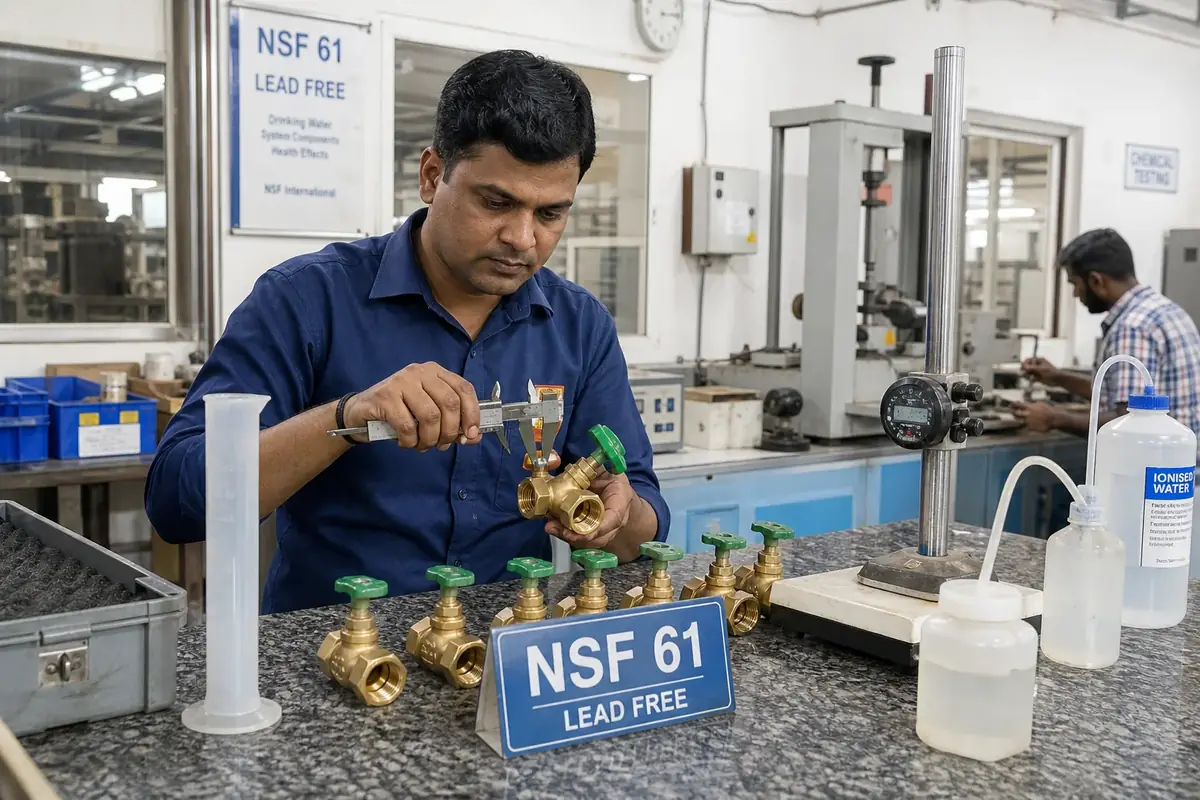
Inductively Coupled Plasma Mass Spectrometry (ICP-MS) analytical testing measuring micro-gram lead leaching levels under NSF 61 protocols.
5. Machining Mechanics of Lead-Free Alloys: Tooling & Feed Adjustments
Transitioning a CNC lathe from standard leaded C36000 to silicon-brass (CW724R / C69300) requires physical tooling and parameter modifications. Because silicon forms hard kappa and gamma phase intermetallic crystals within the brass matrix, silicon brass exhibits twice the tensile strength and hardness of traditional free-cutting brass.
Machining Lead-Free Silicon Brass: DFM Guidelines
- Use Polycrystalline Diamond (PCD) or Coated Carbide Tools: Standard C2 uncoated carbide inserts wear out 4x faster on silicon brass. Specify TiAlN-coated carbide inserts or PCD tooling for high-volume CNC runs.
- Increase Coolant Pressure (High-Pressure Through-Spindle): Silicon brass chips do not shatter as easily as leaded chips. High-pressure coolant (70+ bar) directed at the cutting zone is required to break chips and flush them away from Swiss lathe guide bushings.
- Modify Tool Rake Angles: Utilize positive rake geometries (+6° to +10°) with sharp, polished chipbreaker grooves to prevent built-up edge (BUE) formation.
- Scrap Metal Bin Segregation in Foundries: Machine shops in Jamnagar must strictly segregate silicon-brass chips from leaded brass scrap bins. Contaminating leaded brass furnace melts with silicon causes heavy oxide inclusions in continuous casting mills.
6. Chemical Leaching Qualification & Certification Workflow
To certify turned brass components for international water distribution systems, manufacturers complete a 4-stage testing and audit sequence:
Stage 1: Spectro Elemental Chemical Analysis
Direct-reading Optical Emission Spectrometers verify that raw extruded bar stock contains ≤ 0.25% Pb (or ≤ 0.10% Pb for RoHS 3 compliant lots) before turning operations begin.
Stage 2: Static Chemical Extraction Conditioning (NSF 61 Annex E)
Finished turned parts are conditioned in DI water for 14 days, followed by exposure to aggressive, synthetic pH-controlled test water solutions to simulate real-world municipal water stagnation.
Stage 3: ICP-MS Extraction Analysis
Water samples are analyzed via Inductively Coupled Plasma Mass Spectrometry (ICP-MS) to quantify lead, cadmium, arsenic, and nickel leaching levels down to parts-per-billion (ppb) sensitivity.
Stage 4: Factory Audit & Certification Mark Authorization
Independent auditing bodies (NSF International, IAPMO R&T, or CSA Group) audit Jamnagar foundry production lines and authorize laser-marking of the NSF 61 / NSF 372 compliance mark on export cartons.
7. Cost Impact & Economic Comparison
Procurement desks transitioning from standard leaded C36000 to lead-free alloys must factor in three cost variables:
- Raw Billet Price Premium (+15% to 25%): Silicon and bismuth additives cost significantly more per kilogram than lead scrap inputs.
- Machining Cycle Time Overhead (+10% to 20%): Lower machinability indices (75–80% vs 100%) require lower spindle speeds and feeds.
- Scrap Credit Retention: Machine shops that maintain strict chip segregation retain full scrap credit value when returning turnings to extrusion foundries.
8. Frequently Asked Questions (FAQ)
Q: What lead-free brass alloy is recommended for high-strength water meter bodies?
ASTM C69300 (Eco Brass / CW724R) is highly recommended due to its high tensile strength (600+ MPa), excellent dezincification resistance (DZR), and compliance with NSF 61 lead limits (≤ 0.09% Pb).
Q: How do Jamnagar foundries verify that lead-free lots are not cross-contaminated?
Foundries maintain separate melting furnaces, dedicated extrusion dies, color-coded bar stock storage racks, and strict machine shop chip bin segregation backed by OES spectro testing before continuous casting.
Q: What is the maximum allowable lead percentage for brass fittings under NSF 372?
NSF/ANSI/CAN 372 mandates a maximum weighted average lead content of ≤ 0.25% across all wetted internal surfaces contacting drinking water.
Q: Does EU RoHS 3 allow lead in turned brass electrical components?
Yes, under Annex III Exemption 6(c), copper alloys used in electrical and electronic hardware may contain up to 4.0% lead by weight. However, articles with >0.1% lead must be registered in the EU SCIP database under REACH SVHC rules.
Need Certified Lead-Free Turned Brass Components?
Every lead-free component batch ordered through Jamnagar.net is spectro-verified (≤ 0.25% Pb), certified under NSF 61 / RoHS 3 standards, and backed by EN 10204 3.1 material test certificates. Explore standard catalogue items or submit custom drawings on Jamnagar.net.