Brass Alloy Grades Comparison: C36000, CZ121, CW614N, and IS 319
Quick Lookup:
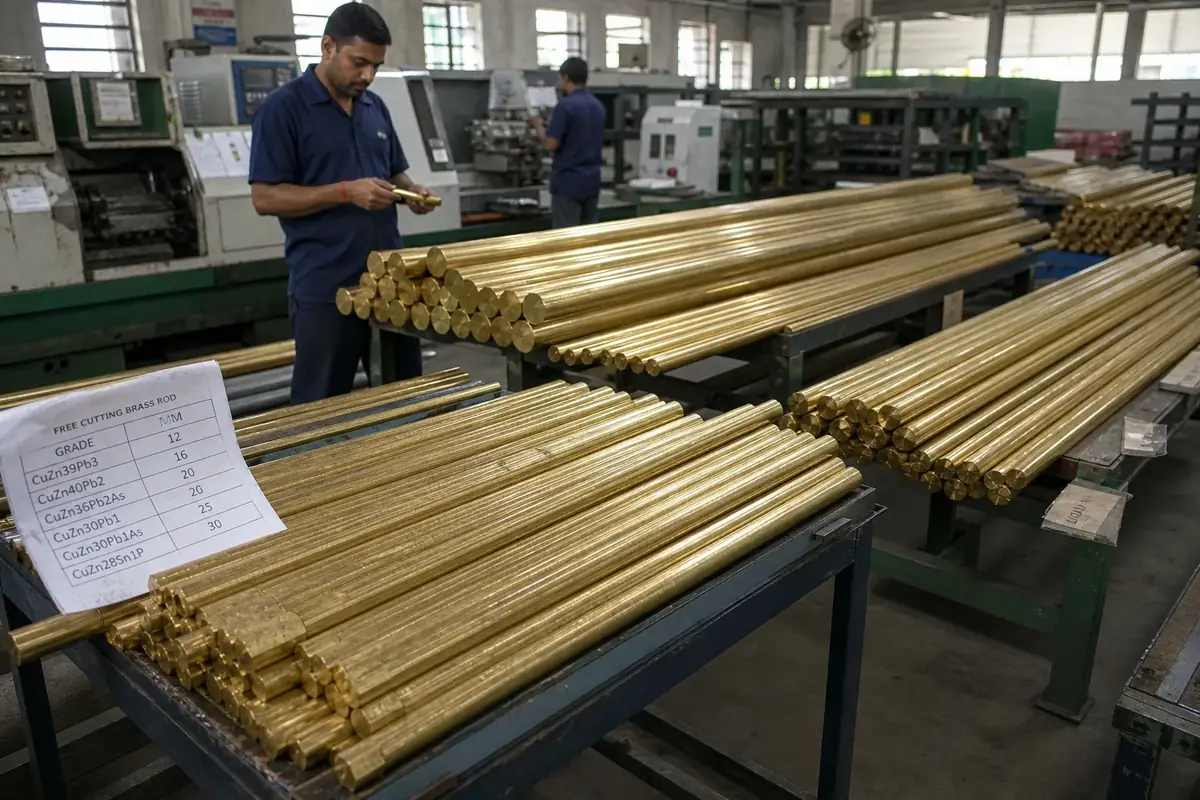
- C36000 / CZ121 / CW614N / IS 319 are the common free-cutting family.
- Compare Cu/Zn/Pb windows, not just commercial grade names.
- Machinability and chip form drive cycle time and tool life.
- Use Pb-free substitutes where NSF, RoHS, or REACH apply.
1. Metallurgy Fundamentals: The Science of Free-Cutting Brass
Brass is a binary alloy composed primarily of Copper (Cu) and Zinc (Zn). When zinc is dissolved into copper, it forms two main crystalline phases: the ductile, cold-workable Alpha (alpha) phase (up to 37% Zn) and the stronger, hot-workable Beta (beta) phase (37% to 45% Zn). Free-cutting brass alloys produced in Jamnagar extrusion mills operate within the dual Alpha-Beta (alpha + beta) duplex phase field.
Pure copper-zinc alloys are naturally gummy during turning, producing long, continuous stringer chips that wrap around rotating spindles, destroy cutting tool inserts, and mar surface finish. To convert duplex brass into a high-speed machining alloy, lead (Pb) is added to the molten furnace charge at levels between 2.0% and 3.7%.
Because lead is completely insoluble in solid copper and zinc, it does not dissolve into the crystal matrix. Instead, lead precipitates as millions of microscopic, finely dispersed droplets distributed throughout the grain boundaries. During high-speed CNC turning, these lead droplets perform two vital mechanical functions:
Internal Shear Disruption (Chip Breaking): Lead particles act as localized shear plane weaknesses, causing turning chips to break cleanly into small, curled fragments rather than long tangled ribbons.
Micro-Lubrication at Tool Tip: Under extreme cutting temperatures at the tool-chip interface, lead melts locally, forming a thin lubricating film that reduces friction, lowers cutting forces, and extends tool carbide life by up to 300%.
2. Master Alloy Cross-Reference & Chemical Composition Matrix
When transferring CAD drawings across international borders, design engineers must verify elemental limits to ensure physical equivalence. Below is the master metallurgical cross-reference table used by Jamnagar foundries:
| Standard / Region | Alloy Designation | Copper (Cu %) | Lead (Pb %) | Iron (Fe %) Max | Zinc (Zn %) Balance | Machinability Index |
|---|---|---|---|---|---|---|
| ASTM B16 (USA) | C36000 (Free Cutting) | 60.0 – 63.0% | 2.5 – 3.7% | 0.35% | Remainder (~35.5%) | 100% (Baseline) |
| EN 12164 (Europe) | CW614N (CuZn39Pb3) | 57.0 – 59.0% | 2.5 – 3.5% | 0.30% | Remainder (~39.0%) | 100% |
| BS 2874 (UK) | CZ121 | 56.5 – 58.5% | 2.5 – 3.5% | 0.30% | Remainder (~39.5%) | 100% |
| IS 319 (India) | IS 319 Grade 1 | 56.0 – 59.0% | 2.0 – 3.5% | 0.35% | Remainder (~39.5%) | 100% |
| JIS H3250 (Japan) | C3604 | 57.0 – 61.0% | 1.8 – 3.7% | 0.50% | Remainder (~38.0%) | 100% |
| Hot Forging Brass | C37700 / CW617N | 57.0 – 59.0% | 1.6 – 2.5% | 0.30% | Remainder (~40.0%) | 75% (Forging Optimized) |
| DZR Plumbing Brass | CW602N / CZ132 | 61.0 – 63.0% | 1.7 – 2.8% | 0.10% | Remainder (+As 0.02-0.15%) | 85% (Dezincification Safe) |
| Lead-Free Eco Brass | C27450 / CW724R | 62.0 – 68.0% | < 0.25% | 0.15% | Remainder (+Si 0.8-1.5%) | 70% (NSF 61 Compliant) |

Optical Emission Spectrometry (OES) laboratory testing to verify exact elemental composition and impurity limits in brass extrusions.
3. Mechanical Properties & Strength Benchmarks
While chemical composition dictates machinability and corrosion resistance, mechanical properties determine whether a turned fastener or fitting will withstand assembly torque, internal fluid pressure, and structural loads.
Jamnagar extrusion mills supply brass bar stock in various temper conditions—primarily As Extruded (M), Half Hard (H02 / 1/2H), and Full Hard (H04 / FH). Cold drawing during rod sizing increases tensile yield strength while slightly reducing elongation ductility.
| Alloy Standard & Temper | Tensile Strength R_m (N/mm² / MPa) | 0.2% Proof Stress Rp₀.₂ (N/mm²) | Elongation A₅ (%) Min | Hardness (HB Brinell) |
|---|---|---|---|---|
| ASTM C36000 (Half Hard) | 380 – 480 MPa | 230 – 310 MPa | 10 – 15% | 110 – 150 HB |
| EN CW614N (R360 / Half Hard) | 360 – 500 MPa | 220 – 350 MPa | 12% | 90 – 135 HB |
| BS CZ121 (Condition H) | 380 – 520 MPa | 240 – 340 MPa | 10% | 120 – 155 HB |
| IS 319 Grade 1 (Half Hard) | 350 – 470 MPa | 200 – 300 MPa | 12% | 100 – 140 HB |
| CW617N Forging Brass (As Forged) | 360 – 440 MPa | 180 – 250 MPa | 20% | 85 – 120 HB |
| DZR CW602N (Annealed / Heat Treated) | 340 – 420 MPa | 170 – 240 MPa | 18% | 80 – 115 HB |
4. Impurity Limits: The Critical Role of Iron, Aluminum, and Tin
While copper, zinc, and lead form the primary bulk of free-cutting brass, trace impurity elements left unmonitored during scrap recycling cause severe machining and metallurgical failures:
Iron (Fe) Limit: Max 0.35%
Excess iron forms hard, insoluble iron-rich intermetallic inclusions (Fe₃Zn₁₀) within the brass matrix. These microscopic hard spots act like sandpaper against cutting tools, blunting carbide inserts, causing tool tip chipping, and creating rough surface finishes during high-speed CNC turning.
Aluminum (Al) Limit: Max 0.05%
Aluminum forms an invisible, tenacious oxide skin on liquid brass during casting. Even tiny traces (>0.05%) cause severe oxide inclusions between grain boundaries, leading to cracking during subsequent hot forging or cold knurling.
Tin (Sn) Limit: Max 0.30% (Standard) / 1.0–1.5% (Naval Brass)
In standard free-cutting brass, tin above 0.3% reduces elongation ductility. However, in specialized Naval Brass (ASTM C46400 / CZ112), 1.0% to 1.5% tin is intentionally added to create a protective tin-rich oxide film that prevents dezincification corrosion in marine saltwater environments.
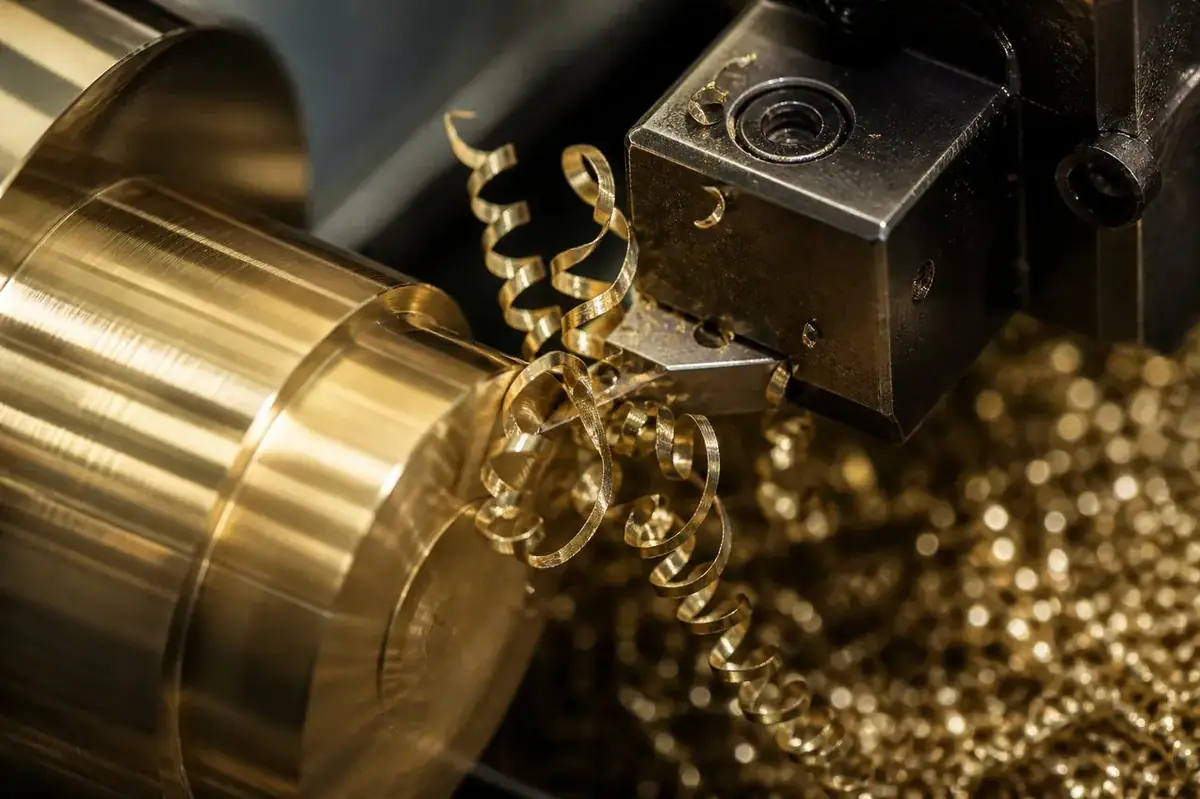
Macro view of short, cleanly broken brass turning chips produced by lead-dispersed ASTM C36000 bar stock on a Swiss CNC lathe.
5. Machinability Mechanics: Feeds, Speeds, and Tool Life Settings
Because ASTM C36000 / CW614N serves as the absolute 100% baseline for metal machinability ratings, high-speed automated lathes operate at aggressive cutting parameters compared to stainless steel or aluminum:
Recommended Cutting Parameters for Free-Cutting Brass
- Cutting Speed (V_c): 150 to 350 meters/min (490 to 1,150 feet/min) using uncoated C2 carbide or TiN-coated carbide inserts.
- Feed Rate (f): 0.08 to 0.35 mm/rev depending on surface finish roughness requirements (Ra).
- Rake Angle: 0° to +5° neutral rake angle (prevents cutting tool digging into ductile brass).
- Coolant Type: Water-soluble emulsifiable oil or neat mineral cutting oil for chip flushing and spindle collet thermal stability.
6. How Selecting the Wrong Alloy Grade Increases Unit Cost
Specifying an over-engineered alloy or an incorrect standard callout creates immediate manufacturing cost penalties:
- Unnecessary Lead-Free Calls for Non-Potable Parts: Specifying lead-free brass (C27450 / Eco Brass) for electrical terminal blocks or cable glands increases raw material costs by 30% and reduces turning speeds by 30%, doubling machine cycle overhead needlessly.
- Using Free-Cutting C36000 for Hot Forgings: C36000 contains ~3% lead and lower copper (~61%). If subjected to hot closed-die forging (700°C), lead segregates along grain boundaries, causing severe hot-shortness cracking. Hot forged components must specify Forging Brass (C37700 / CW617N).
- Using Standard Brass in Saltwater Line Valves: Standard CZ121 or IS 319 zinc-rich brass undergoes selective dezincification in marine environments, leaving a porous, brittle copper sponge that bursts under pressure. Marine valves must specify DZR Brass (CW602N) or Naval Brass (C46400).
7. Frequently Asked Questions (FAQ)
Q: What alloy should be specified for brass components used in drinking water systems?
Potable water components must specify Lead-Free Brass (such as ASTM C27450, C19400, or Eco Brass CW724R) containing less than 0.25% weighted lead to comply with US NSF/ANSI 61 and European drinking water directives.
Q: What document proves chemical alloy compliance before shipment?
An official EN 10204 Type 3.1 Material Test Certificate (MTC) containing Optical Emission Spectrometry (OES) chemical breakdown and tensile strength test data for the exact melt heat batch.
Q: What is the exact Indian Standard equivalent for ASTM C36000 free-cutting brass?
IS 319 Grade 1 is the direct Indian metallurgical equivalent for ASTM C36000 and European EN CW614N, offering 100% machinability rating and identical Cu/Pb/Zn balance.
Q: Why is lead added to turned brass alloys, and is it safe for non-plumbing hardware?
Lead acts as an internal chip-breaker and micro-lubricant during high-speed CNC machining. For non-potable hardware—such as electrical terminals, cable glands, fasteners, and automotive housings—lead-bearing brass (2-3% Pb) is fully compliant under RoHS 3 Exemption 6(c).
Need Material Certified Turned Brass Parts?
Every component batch ordered through Jamnagar.net is spectro-analyzed, certified under EN 10204 3.1, and turned from premium extruded bar stock. Explore standard catalogue items or submit custom drawings on Jamnagar.net.