Plating & Surface Finishing Guide: Nickel, Tin, Chrome & Passivation
Highlights:
- Unplated free-cutting brass still oxidizes in humidity and salt air.
- Nickel for wear; tin for solderability; chrome for sanitary appearance.
- Ultrasonic passivation keeps a bright natural brass look.
- Specify microns and ASTM B117 salt-spray hours on the RFQ.
Related reading: incoming quality inspection and electrical terminal plating needs.
1. Executive Overview: Why Surface Finishing Matters for Brass Parts
Precision turning on automatic lathes and CNC Swiss machines produces parts with clean metallic surfaces. However, as soon as freshly turned brass exits the machining spindle, microscopic cutting oil films, fine metal swarf, and atmospheric oxygen interact with the surface copper atoms.
Over time, unpassivated copper alloys undergo oxidation, forming copper carbonate (CuCO₃ cdot Cu(OH)_2), visible as a dull, greenish-grey tarnish known as verdigris. In electrical switchgear, verdigris buildup increases contact resistance, causing local overheating and arc sparking. In plastic moulding inserts, unplated brass reacts with certain polymer additives, leading to chemical degradation. In plumbing hardware, unplated surfaces discolor, ruining cosmetic appeal.
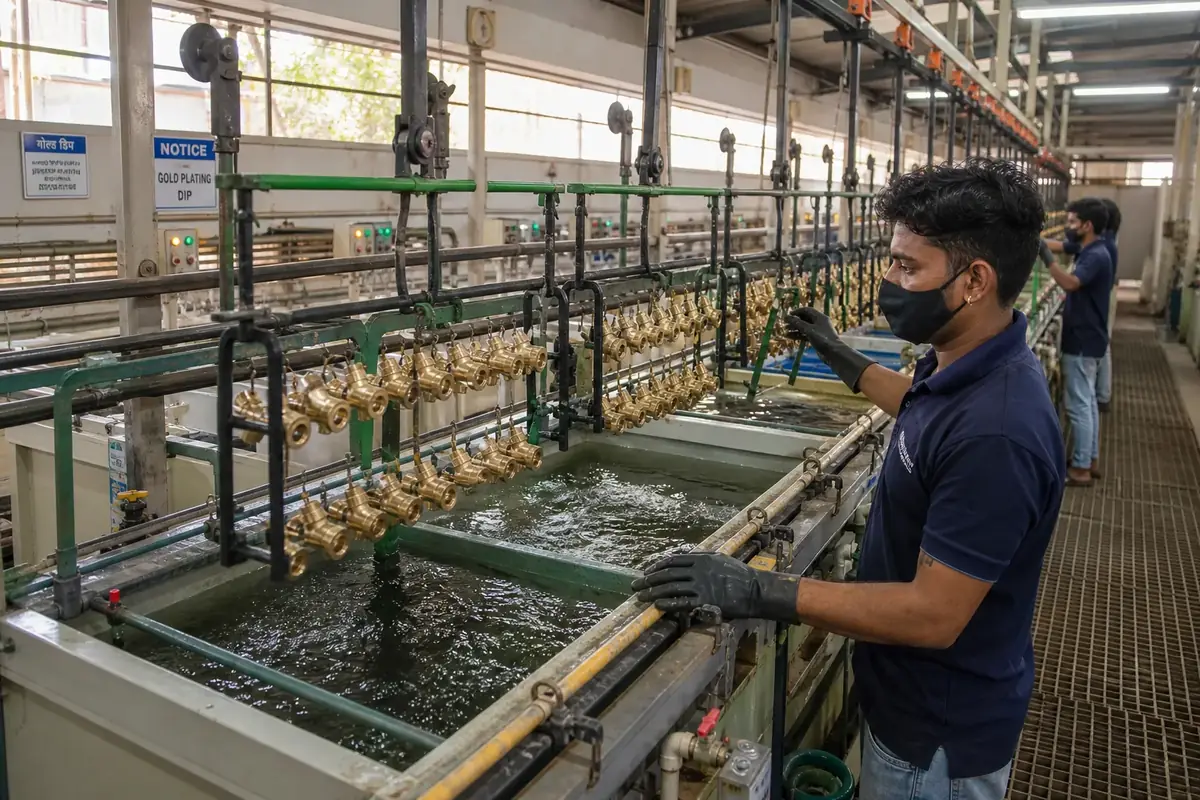
Jamnagar houses a dedicated, highly regulated electroplating sector operating alongside machine shops. Modern electroplating plants utilize chemical pretreatment, multi-stage ultrasonic degreasing, automatic rack and barrel plating lines, X-ray fluorescence (XRF) thickness testers, and neutral salt spray testing chambers to deliver controlled micron coatings that meet stringent ISO and ASTM benchmarks.
2. Electro-Nickel Plating: The Industrial Standard
Electro-deposited nickel is the single most specified surface finish for turned brass hardware, accounting for over 65% of all finished shipments from Jamnagar.
Nickel provides an appealing metallic silver finish, high surface hardness (HV 150 to 500 depending on bath chemistry), low friction, and exceptional resistance to mild acids and atmospheric weathering.
Nickel Plating Classifications & Micron Depths
- Flash / Light Nickel (2 to 4 Microns): Used on indoor threaded inserts, standard fasteners, and electronic standoff pillars where basic tarnish protection during storage is sufficient.
- Standard Engineering Nickel (5 to 8 Microns): The universal standard for cable glands, hose barbs, CPVC pipe inserts, and electrical neutral bars. Offers excellent scratch resistance and passes 24 to 48 hours of neutral salt spray testing.
- Heavy Industrial Nickel (10 to 15 Microns): Specified for outdoor electrical hardware, marine terminal blocks, and industrial valve bodies subjected to aggressive chemical or coastal exposure. Withstands 96+ hours of salt spray testing.
- Electroless Nickel Plating (ENP): Unlike electroplating (which relies on electrical current and creates thicker deposits on sharp edges), ENP relies on an autocatalytic chemical reduction. It deposits an ultra-uniform layer (± 0.5 mum) across complex internal cavities, deep blind holes, and internal threads.
3. Electro-Tin Plating: Electrical Conductivity & Solderability
For electrical engineering applications—such as PCB terminal pins, switchgear busbar blocks, plug pins, and earthing connectors—electro-tin plating is mandatory.
Pure tin (Sn) is a soft, highly conductive non-ferrous metal that forms an excellent electrical contact interface under clamping pressure. Tin coatings protect brass against electrical arc oxidation and allow seamless automated lead-free wave soldering during PCB assembly.
Matte Tin Plating (Non-Reflowed)
Matte tin exhibits a dull, light-grey appearance. It contains microscopic surface inclusions that prevent the formation of "tin whiskers" (spontaneous crystalline conductive filaments that cause electrical short circuits). It is the preferred finish for electronic connectors and PCB pins.
- Thickness Standard: 5 to 10 Microns
- Solderability: Exceptional (IPC/EIA J-STD-002)
- Primary Use: PCB male pins, headers & crimp lugs
Bright Tin Plating
Bright tin uses organic brighteners in the fluoroborate or acid bath to produce a highly reflective, mirror-like silver surface. It provides high cosmetic appeal and good electrical contact conductivity for visible switchgear components.
- Thickness Standard: 5 to 12 Microns
- Cosmetic Finish: Highly reflective silver
- Primary Use: Neutral bars, terminal strips, socket pins
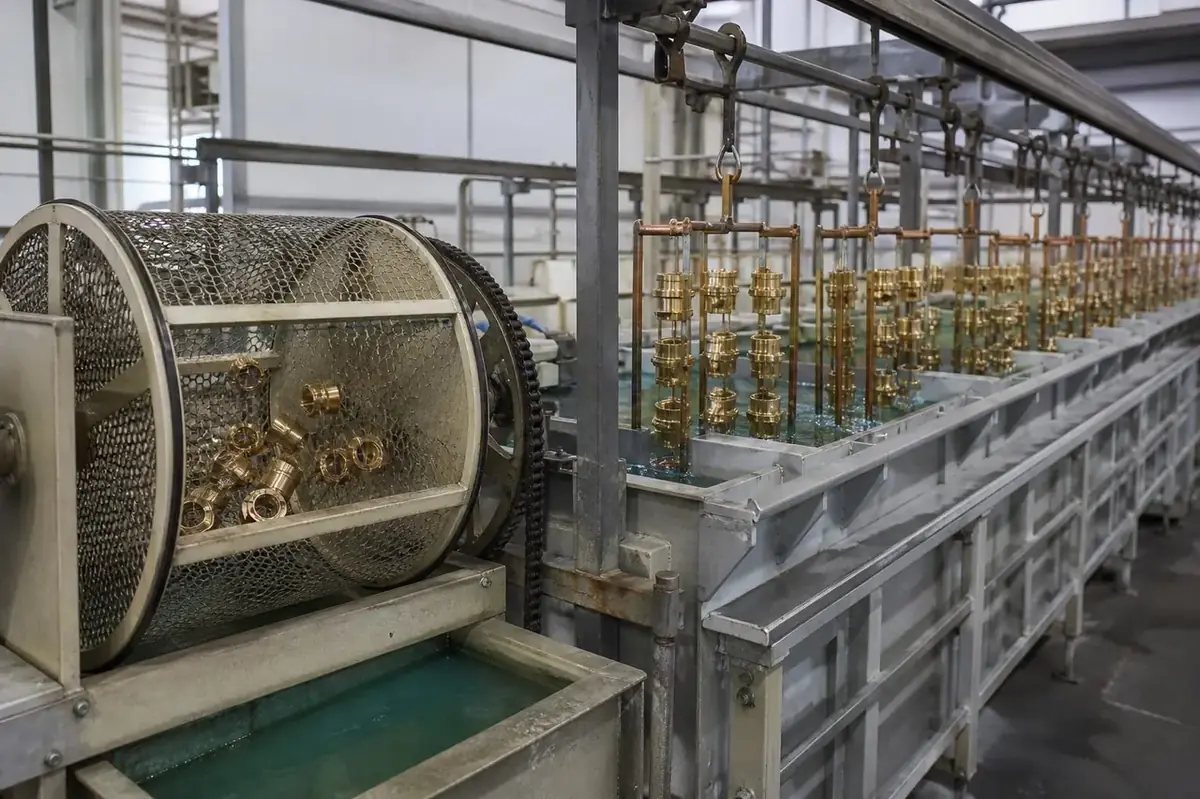
Automated electroplating barrel line transferring turned brass components through alkaline degreasing and acid nickel plating baths.
4. Bright & Satin Chrome Plating: Architectural & Sanitary Finishes
Sanitary plumbing fittings, bathroom faucets, shower valve bodies, architectural pull handles, and luxury hardware rely on multi-layer decorative chrome plating.
Decorative chrome cannot be electroplated directly onto bare brass. Because chromium layers have micro-porous structures, applying chrome directly leads to rapid galvanic corrosion between the zinc-copper base metal and the chromium layer. Instead, a multi-barrier system is applied:
The 3-Layer Decorative Chrome Plating Stack
- Layer 1 — Copper Undercoat (8 to 15 Microns): Acts as a ductile levelling layer that fills microscopic turning tool marks and provides high adhesion to the base brass.
- Layer 2 — Semi-Bright / Bright Nickel Layer (10 to 20 Microns): Provides the primary corrosion barrier and mechanical shock resistance.
- Layer 3 — Micro-Cracked Chromium Topcoat (0.25 to 0.50 Microns): Deposited over the nickel layer to provide ultra-hard (HV 800+), scratch-resistant, tarnish-proof brilliant luster (Bright Chrome) or brushed matte luster (Satin Chrome).
5. Ultrasonic Cleaning, Passivation & Natural Luster Finishes
Not all industrial applications require electroplated metallic coatings. Many technical components—such as internal gas regulator nozzles, pneumatic hose barbs, and brass anchors embedded in plastic—are specified in Natural Bright Brass.
However, "Natural Brass" does not mean unwashed parts fresh off the lathe. Turned components leaving machining spindles are coated in sulfurized cutting oil, fine metallic swarf, and microscopic burrs. Unwashed oil films cause severe mold contamination during plastic injection molding.
To deliver clean natural brass components, Jamnagar processing plants utilize a 4-step automated cleaning and chemical passivation line:
Step 1: Multi-Frequency Ultrasonic Alkaline Degreasing
Components are submerged in an alkaline cleaning solution subjected to 40 kHz ultrasonic transducers. High-frequency cavitation bubbles implode against complex internal threads and blind holes, blasting away cutting oil and fine swarf.
Step 2: Deionized Water Counter-Current Rinsing
Parts pass through cascading deionized water rinse tanks to remove alkaline chemical residues without leaving hard-water mineral spots.
Step 3: Acid Pickling & Benzotriazole (BTA) Passivation
Parts are briefly immersed in a mild citric or chromic acid bath to remove surface oxides, followed by immersion in a benzotriazole (BTA) corrosion inhibitor solution. BTA forms an invisible, molecular-thin chelate complex (Cu-BTA) on the surface, preventing oxidation for up to 12 months in storage.
Step 4: Centrifugal Hot Air Spin Drying
Components are loaded into high-speed perforated centrifugal baskets and spun under forced hot air stream to evaporate all residual moisture instantly.
6. Master Surface Finishing Comparison & Testing Benchmarks
Use this comprehensive surface finishing matrix to select the ideal coating thickness and testing standard for your CAD drawing callout:
| Surface Finish Type | Standard Micron Range (mum) | Corrosion Resistance (ASTM B117 Salt Spray) | Primary Industrial Applications |
|---|---|---|---|
| Natural Passivated Brass | 0 mum (BTA Inhibitor Film) | 12 to 24 Hours | Internal plastic moulding inserts, gas nozzles, internal valves |
| Electro-Nickel (Standard) | 5 to 8 mum Nickel | 24 to 48 Hours | Cable glands, hose fittings, fasteners, CPVC pipe anchors |
| Electro-Nickel (Heavy) | 10 to 15 mum Nickel | 72 to 120 Hours | Outdoor junction boxes, marine hardware, chemical fluid lines |
| Electro-Tin (Matte / Bright) | 5 to 12 mum Tin | 24 to 48 Hours | Electrical switchgear terminals, neutral links, PCB plug pins |
| Decorative Bright Chrome | 10mum Cu + 12mum Ni + 0.3mum Cr | 96 to 200 Hours | Sanitary faucets, bathroom fittings, architectural handles |
| Silver Plating | 3 to 10 mum Silver (Ag) | 24 Hours (Requires Tarnish Bag) | High-voltage electrical contacts, RF coaxial connectors |

Quality inspector measuring electroplated nickel layer depth in microns using a non-destructive X-ray Fluorescence (XRF) analyzer.
7. Critical Dimensional Rule: Pre-Plating Thread Undersizing
When specifying electroplated finishes on threaded brass components, failing to account for material buildup on thread flanks is the leading cause of pitch gauge binding during incoming quality inspection.
Electroplating deposits metal uniformly across exposed geometries. On a 60° V-shaped metric or imperial thread, a plating layer deposit of thickness T microns increases the external male thread pitch diameter by approximately 4 × T.
Pre-Plating Thread Allowance Rule
Example: Target Finish = 8 Micron Nickel Plating (T = 0.008 mm)
Pitch Diameter Allowance Change (Delta PD) = 4 × 0.008 mm = 0.032 mm
Machining Action: Turn male threads 0.032 mm UNDERSIZED relative to standard Class 6g limits prior to nickel bath.
Control Note: Always state on your CAD PDF drawing: "Threads MUST accept standard Class 6g/6H Go/No-Go gauges AFTER final electroplating."
8. Frequently Asked Questions (FAQ)
Q: What is an ASTM B117 Salt Spray Test and how is it conducted?
An ASTM B117 salt spray test places plated brass components inside a sealed chamber maintained at 35°C with a continuous 5% sodium chloride fog. Inspection technicians check parts every 24 hours for signs of base metal corrosion or white zinc spots.
Q: How is electroplating thickness measured and verified on small turned brass parts?
Plating thickness is non-destructively verified using X-ray Fluorescence (XRF) coating analyzers calibrated to ISO 3497. For critical aerospace components, destructive cross-sectional microscopic measurement (ASTM B487) is performed.
Q: What is the difference between Barrel Plating and Rack Plating?
Barrel plating tumbles small parts (such as moulding inserts or terminal screws) in a rotating perforated polypropylene drum inside the bath, making it ultra-cost-effective for high volumes. Rack plating manually mounts individual larger or delicate parts (like sanitary faucets or long threaded rods) onto copper spring racks to prevent cosmetic scratches.
Q: Why is electro-tin plating preferred over nickel for electrical switchgear terminals?
Tin is significantly softer than nickel and provides lower electrical contact resistance under mechanical screw pressure. Additionally, tin exhibits superior solderability and does not oxidize during electrical arcing cycles.
Need Plated & Surface Finished Turned Brass Parts?
Every component lot ordered through Jamnagar.net is ultrasonically degreased, XRF micron-verified, and backed by EN 10204 Type 3.1 quality inspection reports. Explore standard catalogue items or submit drawings on Jamnagar.net.