Threading Standards Demystified: BSP, NPT, Metric, and UNC/UNF
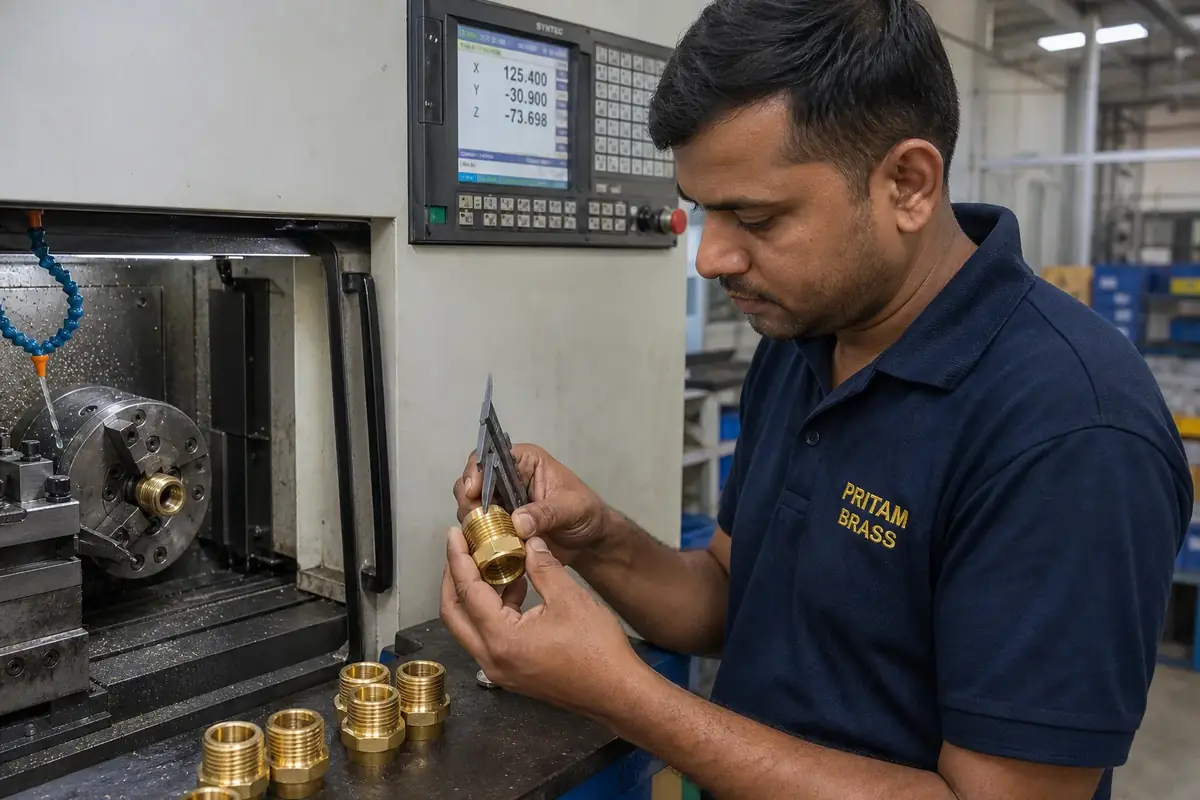
Highlights:
- ISO Metric (60°) for electronics, anchors, and metric plumbing.
- BSP Whitworth (55°): parallel BSPP/G vs tapered BSPT R/Rc.
- NPT (60°, 1:16 taper) for North American fluid seals.
- UNC/UNF for inch fasteners — never mix 55° and 60° flanks.
Related reading: cable gland thread entries and fastener thread classes.
1. Introduction: The Critical Role of Thread Geometry in Turned Brass
In non-ferrous hardware manufacturing, turned brass is the material of choice for threaded fittings, cable glands, moulding anchors, valve bodies, and pneumatic couplers. Free-cutting brass (ASTM C36000 / EN CW614N) offers clean chip-breaking mechanics, allowing automatic screw machines and Swiss CNC lathes in Jamnagar to cut external and internal thread profiles at cutting speeds exceeding 200 meters per minute.
However, because turned brass components are shipped globally, design engineers and procurement desks must navigate a complex maze of regional threading standards. A 1/2-inch brass pipe fitting manufactured for a European hydraulic line will fail to thread into a North American manifold due to subtle differences in flank angle (55° Whitworth vs 60° NPT) and threads per inch (14 TPI vs 14 TPI with different root/crest radii).
Understanding the core geometry parameters—major diameter, minor diameter, pitch diameter, flank angle, thread pitch, and taper ratio—is essential for specifying correct Go/No-Go thread inspection gauges on your engineering CAD drawings.
2. ISO Metric Screw Threads (M-Series)
ISO Metric threads are the global standard for general-purpose mechanical fasteners, moulding inserts, electrical terminals, and metric cable glands.
ISO Metric Thread Geometry Key Specs
- Thread Flank Angle: 60° symmetric V-profile.
- Thread Pitch Definition: Distance between crests measured directly in millimeters (e.g., M6 × 1.0 has a 1.0 mm pitch).
- Coarse vs Fine Pitch: Coarse pitch is default (e.g., M8x1.25). Fine pitch (e.g., M8x1.0 or M12x1.5) is specified for thin-walled brass turned parts, electronic enclosures, and fluid adjusting needles requiring fine axial control.
- Standard Tolerance Classes: Male external threads specify Class 6g fit (accounts for 3–5µm electro-nickel plating buildup); female internal threads specify Class 6H fit.
3. British Standard Pipe Threads (BSP: BSPP vs BSPT)
British Standard Pipe (BSP) threads are the dominant fluid and pneumatic standard across Europe, the United Kingdom, Asia, Australia, and India. Unlike metric threads, BSP profiles are based on the 55° Whitworth thread form with rounded crests and roots.
BSP threads are strictly divided into two distinct functional categories based on their sealing mechanics:
BSPP (G-Series) — Parallel Pipe Threads
BSPP (designated by the letter G, such as G 1/2") has parallel constant-diameter male and female threads. Because the threads remain parallel, the thread flanks do not wedge together to create a fluid seal. Sealing is achieved by compressing an external soft washer, bonded seal (Dowty washer), or elastomeric O-ring against a machined shoulder face.
- Profile: Constant Diameter Parallel Pipe
- Flank Angle: 55° Whitworth Profile
- Sealing Mechanism: External O-Ring or Bonded Seal Washer
BSPT (R / Rc Series) — Tapered Pipe Threads
BSPT utilizes a 1:16 taper ratio (3.57° included angle) along the thread length. Male external threads are designated as R (e.g., R 1/2") and female internal tapered threads as Rc. As the male fitting is wrench-tightened into the female port, the tapered flanks wedge together, creating a tight mechanical metal-to-metal seal assisted by PTFE sealant tape or liquid thread sealant.
- Profile: 1:16 Tapered Profile
- Flank Angle: 55° Whitworth Profile
- Sealing Mechanism: Flank-to-Flank Wedge + Thread Sealant
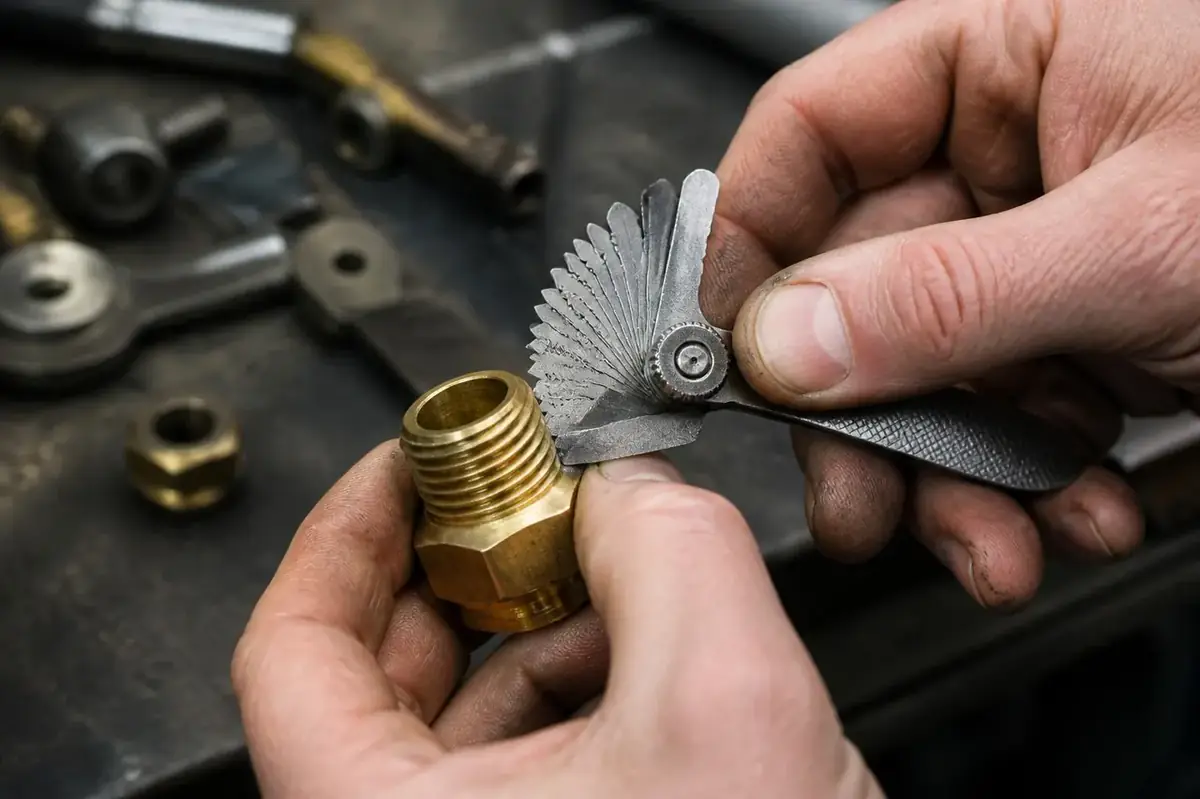
Optical profile projector measurement verifying the 55° Whitworth flank angle and pitch diameter of a turned brass BSPT fitting.
4. American National Pipe Threads (NPT vs NPSM)
National Pipe Tapered (NPT) is the standard pipe thread profile used throughout North America (USA, Canada, Mexico) for plumbing fittings, gas lines, and industrial hydraulic valves.
NPT & NPSM Architectural Rules
- Thread Flank Angle: 60° symmetric flat-crested profile (differs fundamentally from BSP's 55° rounded Whitworth profile).
- NPT (Tapered Pipe): Features a 1:16 taper ratio (3.57°). Male and female thread roots and crests crush together under wrench torque, forcing sealant paste into spiral root gaps to achieve zero-leak pressure tightness up to 5,000 PSI.
- NPSM (National Pipe Straight Mechanical): Parallel constant-diameter pipe thread (60° angle). Used for mechanical joint connections where fluid sealing is accomplished by an internal seat gasket rather than thread interference.
CRITICAL WARNING: Never Force-Thread NPT and BSPT Together!
While 1/2-inch NPT and 1/2-inch BSPT both share 14 Threads Per Inch (TPI) and a 1:16 taper ratio, THEIR FLANK ANGLES ARE DIFFERENT (60° NPT vs 55° BSPT). Attempting to wrench a male 1/2" NPT brass nipple into a 1/2" BSPT female port will deform the brass thread flanks, gall the metal, leave a continuous spiral leakage gap, and permanently destroy the fitting. Always verify whether your destination system uses NPT or BSP!
5. Unified Inch Screw Threads (UNC, UNF, UNEF)
Unified Inch Screw Threads are the standard fastener thread system used across North American industrial machinery, automotive electronics, and electrical enclosures.
- UNC (Unified Coarse): The general-purpose fastener thread (e.g., 1/4"-20 UNC). Ideal for rapid assembly in cast metals and turned brass anchors where high resistance to thread stripping is required.
- UNF (Unified Fine): Fine pitch thread system (e.g., 1/4"-28 UNF). Offers larger pitch diameter core strength, finer axial adjustment, and higher resistance to vibration loosening in automotive sensor housings.
- UNEF (Unified Extra Fine): Specified for thin-walled turned brass couplings, optical instrument tubes, and micro-electronic connectors (e.g., 1/2"-28 UNEF).
- Fit Class Designations: Male external threads specify Class 2A (commercial baseline) or Class 3A (tight precision fit). Female internal threads specify Class 2B or Class 3B.
6. Master International Thread Comparison & Reference Matrix
Use this comprehensive engineering reference table to compare major global thread families before issuing production CAD drawings to a Jamnagar sales desk:
| Thread Designation | Profile Form | Flank Angle | Taper Ratio | Sealing Mechanism | Primary Geographic Market |
|---|---|---|---|---|---|
| ISO Metric (M) | Parallel Constant Dia. | 60° Flat Crest | None (Parallel) | Mechanical / O-Ring Face Seal | Global (ISO Standard) |
| BSPP (G-Series) | Parallel Constant Dia. | 55° Rounded Crest | None (Parallel) | Bonded Washer / O-Ring Shoulder | Europe, UK, Asia, India |
| BSPT (R / Rc) | Tapered Pipe Profile | 55° Rounded Crest | 1:16 Taper (3.57°) | Flank Wedging + Sealant Tape | Europe, UK, Asia, Australia |
| NPT (US Pipe) | Tapered Pipe Profile | 60° Flat Crest | 1:16 Taper (3.57°) | Flank-to-Flank Metal Crush + Paste | USA, Canada, Mexico |
| NPSM (US Straight) | Parallel Straight Pipe | 60° Flat Crest | None (Parallel) | Internal Seat Gasket Seal | North America |
| UNC / UNF / UNEF | Parallel Fastener Thread | 60° Flat Crest | None (Parallel) | Mechanical Fastener Clamp Load | USA, Canada, Aerospace |
7. Machining & Quality Inspection Protocols for Threaded Brass
Precision thread cutting in Jamnagar machine shops is executed using three distinct tooling methods based on volume and wall thickness:
Method 1: Single-Point CNC Thread Turning
Multi-axis Swiss CNC lathes utilize indexable carbide threading inserts to cut external or internal threads in multiple synchronized passes. Ideal for custom thread pitches, tapered NPT/BSPT profiles, and thin-walled brass components requiring zero radial wall deformation.
Method 2: Thread Chaser Dies & Taps (Cam Automats)
High-speed automatic screw machines utilize self-opening die heads fitted with high-speed steel (HSS) chaser sets to cut external threads in a single 2-second stroke. Ideal for mass-production moulding inserts, pipe nipples, and cable gland locknuts.
Method 3: Cold Roll Thread Forming
Rather than cutting chip metal away, thread rolling dies displace ductile brass cold metal under extreme hydraulic pressure. Roll-formed threads exhibit 20% higher fatigue strength, mirror-smooth burnished thread flanks (Ra < 0.4 mum), and zero chip burrs.
Quality Inspection with Go / No-Go Thread Gauges
Every threaded shipment leaving Jamnagar is subjected to 100% thread pitch sampling using calibrated Class 6g/6H (Metric), Class 2A/2B (UNC/UNF), or L1/L2 Taper Ring/Plug Gauges (NPT/BSPT).
- GO Gauge Test: The Go ring/plug gauge must thread fully onto the component under smooth finger pressure, verifying that major diameter, pitch diameter, and lead angle do not exceed upper material limits.
- NO-GO Gauge Test: The No-Go ring/plug gauge must NOT enter or thread more than 1.5 to 2 turns, confirming that pitch diameter is not undersized or loose.
8. Frequently Asked Questions (FAQ)
Q: How are internal threads inspected on blind holes in turned brass inserts?
Internal threads are inspected using calibrated Go/No-Go thread plug gauges. Additionally, optical borescope cameras inspect the bottom of blind tapped holes to verify thread tap lead depth and clean burr evacuation.
Q: What is the main difference between BSPP (G) and BSPT (R) pipe threads?
BSPP (G) threads are parallel and require an external sealing washer or O-ring. BSPT (R/Rc) threads are tapered (1:16 ratio) and achieve a mechanical fluid seal as the thread flanks wedge together with thread tape.
Q: Why can't a 1/2" NPT male fitting seal properly into a 1/2" BSPT female port?
Although both share 14 TPI and a 1:16 taper, NPT has a 60° flat-crested flank angle while BSPT has a 55° rounded Whitworth flank angle. The angular mismatch prevents uniform flank contact, resulting in thread galling and pressure leaks.
Q: What tolerance class should be specified for metric male brass threads receiving electro-nickel plating?
Specify Class 6g fit. Class 6g provides an intentional pre-plating pitch allowance (0.020 mm to 0.035 mm undersized) so that after depositing 5 to 8 microns of nickel plating, the finished component passes standard Go thread ring gauges.
Need Custom Threaded Brass Fittings & Hardware?
Every threaded component batch ordered through Jamnagar.net is 100% gauge-tested for exact BSP, NPT, Metric, or UNC/UNF compliance. Explore standard catalogue items or submit custom drawings on Jamnagar.net.