Brass Cable Glands & Termination Accessories: BS 6121, EN 62444 & Hazardous Area Procurement
Quick Lookup:
- Match gland type (A2, BW, CW, E1W) to armour and cable construction.
- Confirm IP rating, thread (metric/NPT), and sealing washer materials.
- Specify plating and corrosion class for outdoor/marine installs.
- Request dimensional drawings and type-test references with the RFQ.
1. Executive Overview: Jamnagar's Global Dominance in Cable Termination
Electrical cable glands—also referred to as cable mechanical strain reliefs, sealing hubs, or cable connectors—are mechanical termination devices attached to the ends of electrical power, instrumentation, and telecommunication cables.
When a heavy armored power cable enters an explosion-proof terminal box or an outdoor transformer enclosure, it cannot simply pass through an open unsealed hole. Doing so invites moisture, dust, and corrosive industrial gases, while leaving the cable vulnerable to mechanical strain that pulls live conductor wires away from terminal blocks.
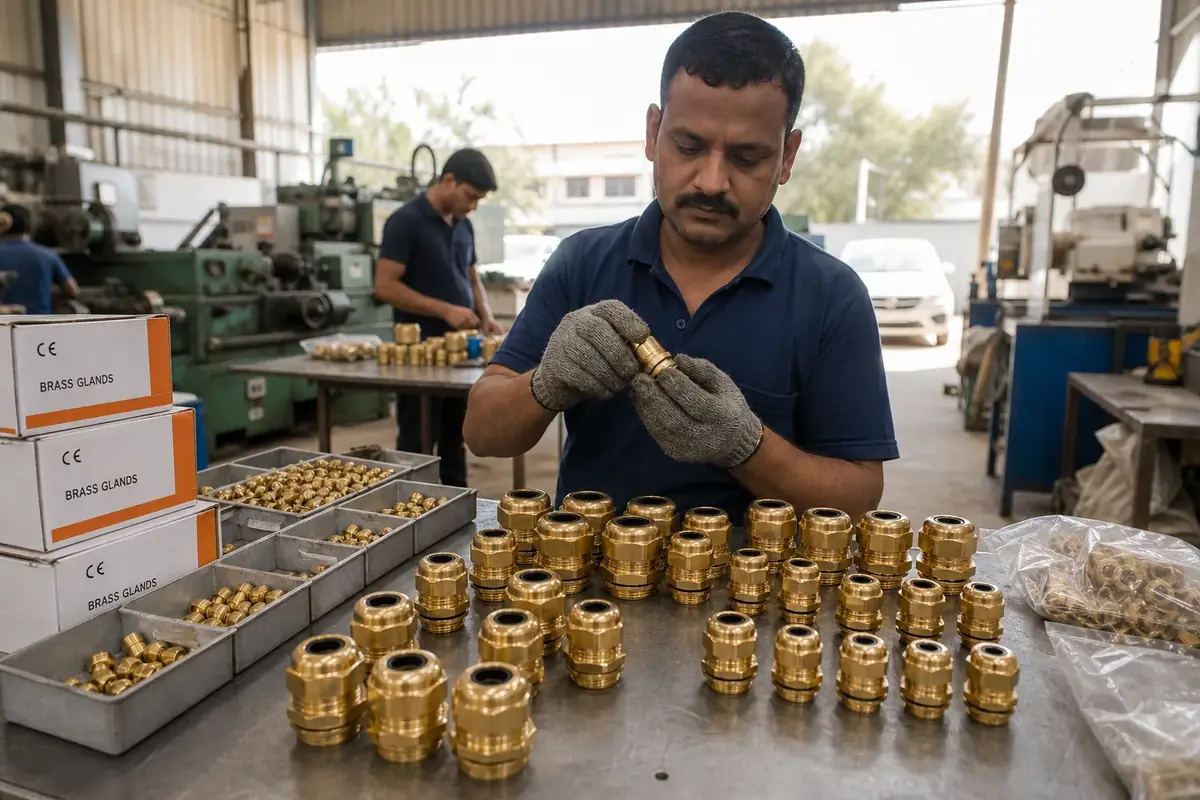
Jamnagar's automatic lathe machine shops and high-capacity CNC turning centers produce millions of turned brass cable glands monthly. Manufactured from high-tensile, free-cutting brass (ASTM C36000 / EN CW614N) or lead-free brass, Jamnagar cable glands provide three non-negotiable safety functions:
Mechanical Cable Retention & Strain Relief: Clamps securely onto the cable's outer sheath or internal steel wire armor (SWA), preventing axial pull forces from damaging internal electrical screw connections.
Electrical Earth Continuity (Fault Protection): Establishes a low-resistance metallic bridge (< 5 mOmega) between the cable's steel wire armor and the grounded metal enclosure, safely conducting fault currents to earth during electrical short circuits.
Environmental Ingress Sealing (IP66 / IP68): Compresses elastomeric seals (Neoprene, EPDM, or Silicone) around the cable bedding and outer sheath to prevent water, oil, and dust ingress.
2. Cable Gland Typology & Mechanical Classification Matrix
Cable glands are classified globally according to standard designation codes established under British Standard BS 6121-1 and European Standard BS EN 62444 / IEC 62444. Below is the master engineering classification matrix used by Jamnagar suppliers:
| Gland Type Code | Cable Compatibility | Sealing Mechanism | Armour Clamping Style | Environment & IP Rating |
|---|---|---|---|---|
| Type A2 (Unarmoured) | Unarmoured flexible rubber/PVC cables | Single elastomeric seal on outer sheath | None (N/A) | Indoor/Outdoor Industrial (IP66 / IP68) |
| Type BW (Indoor SWA) | Single Wire Armoured (SWA) cables | None (Mechanical grip only) | Two-part brass cone & armor clamping ring | Dry Indoor Enclosures (IP20 / IP30) |
| Type CW (Outdoor Weatherproof) | Single Wire Armoured (SWA) cables | Single outer elastomeric seal on outer sheath | Precision three-part brass armor cone & ring | Outdoor Weatherproof (IP66) |
| Type E1W (Double Seal SWA) | Single Wire Armoured (SWA) cables | Double Seal: Inner seal on bedding + Outer seal on sheath | Three-part brass armor cone & clamping ring | Heavy Industrial / Submersible (IP67 / IP68) |
| Type E1X (Braided / STA) | Steel Tape (STA), Wire Braid (SWB), or Screened cables | Double Seal: Inner seal on bedding + Outer seal on sheath | Universal reversible armor cone for tape/braid | Heavy Industrial / Submersible (IP67 / IP68) |
| Type Al2 / Marine Wiping | Aluminum armoured or lead-sheathed marine cables | Inner sealing ring or solder wiping gland body | Aluminum wire clamping cone | Shipyards & Marine Vessels (IP66) |
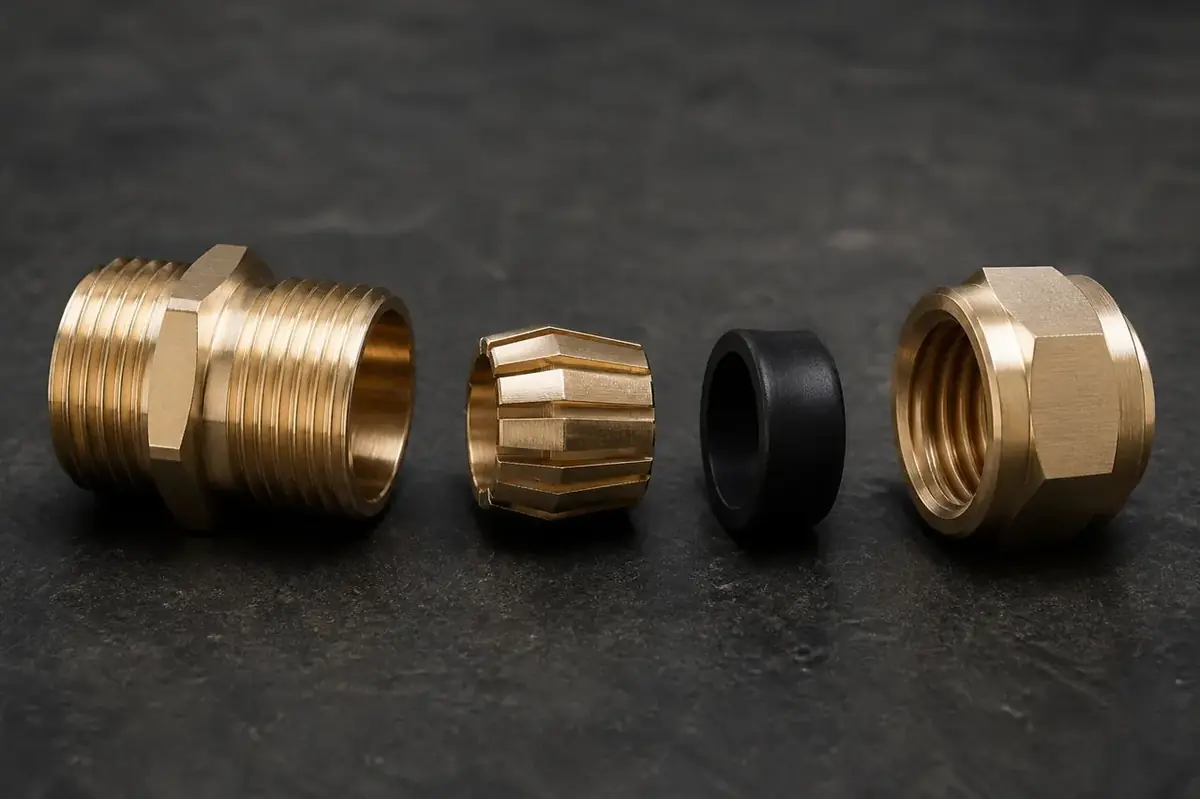
Exploded assembly view of a turned brass CW outdoor cable gland showing entry thread body, elastomeric seal ring, armor clamping cone, and compression nut.
3. Armoured Cable Clamping Mechanics: Cone & Ring Dynamics
Armoured electrical power cables utilize an internal layer of galvanised steel wire armor (SWA) or steel tape armor (STA) positioned beneath the outer PVC/LSZH sheath.
To achieve reliable mechanical cable retention and earth continuity, turned brass glands utilize a precision-machined two-part or three-part armor clamping assembly:
How Armor Clamping Cones Work
- Armor Stripping & Splaying: The outer PVC sheath of the cable is stripped back to expose 20–30 mm of galvanised steel armor wire. Individual wire strands are splayed outwards slightly like an inverted umbrella.
- Tapered Cone Engagement: The splayed steel wires are draped over a solid turned brass armor cone featuring a 15° to 30° outer taper angle.
- Armor Ring Compression: As the outer gland compression nut is torqued into the main entry body, a matching internal armor clamping ring is driven axially over the cone. The steel wires are pinched in a metal vise-grip between the inner brass cone and outer brass ring.
- Low Electrical Contact Resistance: The extreme mechanical clamping pressure cuts through surface oxidation on the steel armor wire, establishing a gas-tight, vibration-proof electrical earth bridge (< 5 mOmega) capable of conducting 10 kA short-circuit fault currents for 1 second without overheating.
4. Ingress Protection (IP) Sealing Mechanics: IP66 vs. IP67 vs. IP68
Selecting the correct Ingress Protection rating under IEC 60529 prevents water jet damage and dust ingress into terminal boxes:
IP66 — Heavy Sea & Dust Jet Tightness
Glands are subjected to high-pressure water jets (100 kPa pressure at 100 liters/min) from a 12.5 mm nozzle at a 3-meter distance for 3 minutes. Mandatory for outdoor industrial plants, chemical factories, and washdown areas.
IP67 — Temporary Water Immersion (1 Meter Depth)
Glands are submerged under 1 meter of water for 30 minutes. Prevents water ingress during flood conditions or temporary submersion in outdoor cable trenches.
IP68 — Continuous Underwater Submersion (Continuous Bar Hydrostatic Pressure)
Glands are tested in pressurized hydrostatic water chambers (typically 5 bar / 50 meters depth for 7 to 30 days or 10 bar continuous). Uses dual-elastomeric sealing rings (Neoprene, EPDM, or Silicone) compressed by precision turned brass compression nuts.
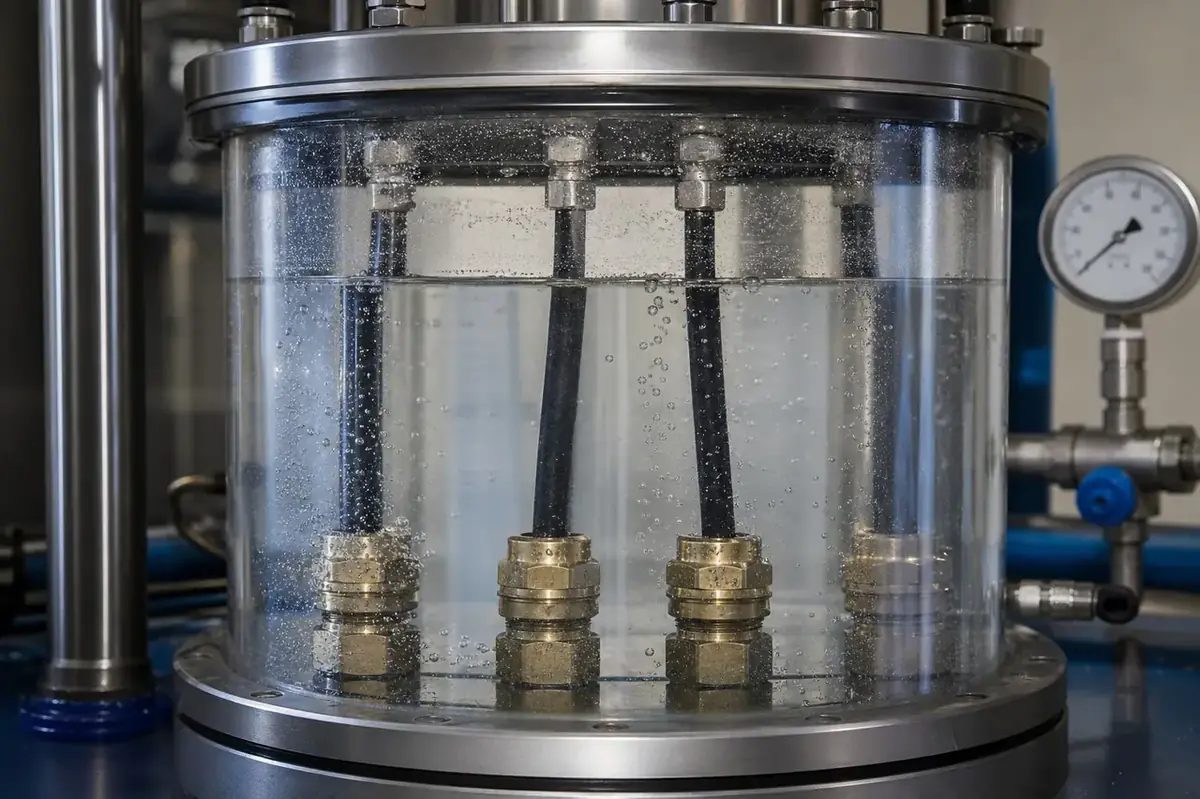
Hydrostatic pressure chamber in a Jamnagar testing lab verifying 5-bar (50 meters depth) continuous IP68 water tightness on turned brass E1W double-seal glands.
5. Hazardous Area Termination: Ex-d Flameproof vs. Ex-e Increased Safety
In oil refineries, offshore drilling rigs, chemical processing plants, and grain silos, explosive gases (methane, propane, hydrogen) or combustible dust atmospheres are present.
Cable glands installed in classified explosive zones must comply with ATEX (Directive 2014/34/EU) and IECEx (IEC 60079-0, IEC 60079-1, IEC 60079-7) standards. Jamnagar manufactures two primary hazardous area gland designs:
| Protection Concept | Standard Code | Operational Safety Philosophy | Machining & Construction Requirements |
|---|---|---|---|
| Ex-d (Flameproof / Explosion-Proof) | IEC 60079-1 / EN 60079-1 | Withstands an internal explosion inside the enclosure without igniting the surrounding external flammable gas atmosphere. | Requires long threaded flamepath gaps (min 5 to 8 full threads engaged) and compound barrier resin seals around individual cable cores. |
| Ex-e (Increased Safety) | IEC 60079-7 / EN 60079-7 | Prevents arcs, sparks, or excessive temperatures from occurring internally on electrical connections during normal operation. | Requires IP66/IP68 elastomeric inner sealing rings, IP entry thread washer seals, and high-impact brass body construction. |
| Ex-tb / Ex-tc (Dust Ignition) | IEC 60079-31 / EN 60079-31 | Prevents combustible dust clouds (coal, flour, grain) from entering the electrical enclosure and contacting hot surfaces. | Requires certified IP66/IP68 outer seals and high thermal stability Silicone/EPDM O-rings. |
6. Entry Thread Options & Accessories: Locknuts, Earth Tags, PVC Boots
When ordering turned brass cable glands from Jamnagar, specifying the correct entry male thread and installation accessories is vital for site mounting:
Entry Thread Profiles & Accessories Breakdown
- ISO Metric Entry Threads (M16 x 1.5 to M75 x 1.5): The universal standard under BS EN 62444. Metric threads feature a 1.5 mm pitch across all sizes (M20 × 1.5, M25 × 1.5, M32 × 1.5, M40 × 1.5).
- PG Entry Threads (PG 7 to PG 48): German Panzer-Gewinde steel conduit threads (80° flank angle). Used extensively in European industrial machinery and control panel enclosures.
- NPT Entry Threads (1/2" NPT to 3" NPT): Tapered 60° American pipe threads for North American oil & gas refineries and explosion-proof junction boxes.
- Brass Locknuts: Hexagonal turned brass nuts used to secure cable glands into unthreaded clearance holes on sheet metal distribution boards.
- Brass Earth Tags (Earth Rings): Stamped or turned brass rings fitted over the gland entry thread inside the enclosure. Features a terminal lug hole for attaching an earthing conductor wire to main ground busbars.
- PVC Shrouds (Weather Boots): Molded push-on PVC covers fitted over the assembled gland body to shield the armor clamping ring from corrosive acid rain and salt spray.
7. Printable Pre-Shipment Quality Control Checklist for Cable Glands
Supply chain managers should enforce this 6-point quality audit checklist before authorizing container loading of cable gland shipments from Jamnagar:
Raw Material Certification: Verify EN 10204 3.1 Spectro report confirms free-cutting brass alloy (Cu 57-59%, Pb 2.5-3.5%, Zn balance) with zero iron inclusion defects.
Entry Thread Pitch Audit: Check 100% of sampled gland entry threads using calibrated Go/No-Go thread ring gauges (Class 6g for Metric, Class 2A for NPT).
Armor Cone Fitment Test: Verify that SWA steel armor wires clamp firmly between the inner brass cone and outer ring without slippage under 1,000 N axial pull force.
Elastomeric Seal Durometer Check: Audit Shore A hardness (60 ± 5 Shore A) of Neoprene/EPDM sealing rings to guarantee cold-temperature elasticity without cracking.
Plating Micron Test: Verify 5 to 8 microns electro-nickel coating thickness via XRF analyzer on nickel-plated gland variants.
Kitted Packaging Audit: Confirm glands are fully assembled or individual components (entry body, cone, ring, nut, locknut, earth tag, PVC shroud) are polybagged in complete installation kits.
8. Frequently Asked Questions (FAQ)
Q: Why are brass earth tags (earth rings) essential for armoured cable installations?
Earth tags slip over the gland's entry thread inside the electrical enclosure to establish a low-resistance metallic bond between the cable's steel wire armor and the enclosure ground busbar, safely discharging high-voltage fault currents during short circuits.
Q: Can turned brass cable glands be certified for ATEX / IECEx hazardous explosion-proof areas?
Yes. Jamnagar manufacturers produce certified Ex-d (Flameproof) and Ex-e (Increased Safety) brass glands with long threaded flamepaths and resin compound barrier seals compliant with IEC 60079-0 and IEC 60079-1 standards.
Q: What is the main structural difference between BW and CW cable glands?
BW glands are two-part unsealed glands intended for dry indoor Steel Wire Armoured (SWA) cable terminations (IP20/IP30). CW glands feature an additional outer elastomeric sealing ring and compression nut, providing outdoor IP66 weatherproof protection against rain and dust.
Q: What standard entry thread is most widely specified for European industrial cable glands?
ISO Metric threads with a 1.5 mm pitch (M20 × 1.5, M25 × 1.5, M32 × 1.5, M40 × 1.5) are the primary standard under BS EN 62444 / IEC 62444.
Need Industrial Brass Cable Glands & Termination Kits?
Explore our complete range of A2, BW, CW, E1W, and Ex-d turned brass cable glands, locknuts, earth tags, and PVC shrouds available with direct factory pricing and zero minimum order restrictions on Jamnagar.net.