Brass Plumbing Fittings, Valves & CPVC/PPR Connectors: Pressure Ratings, Corrosion & DFM Guide
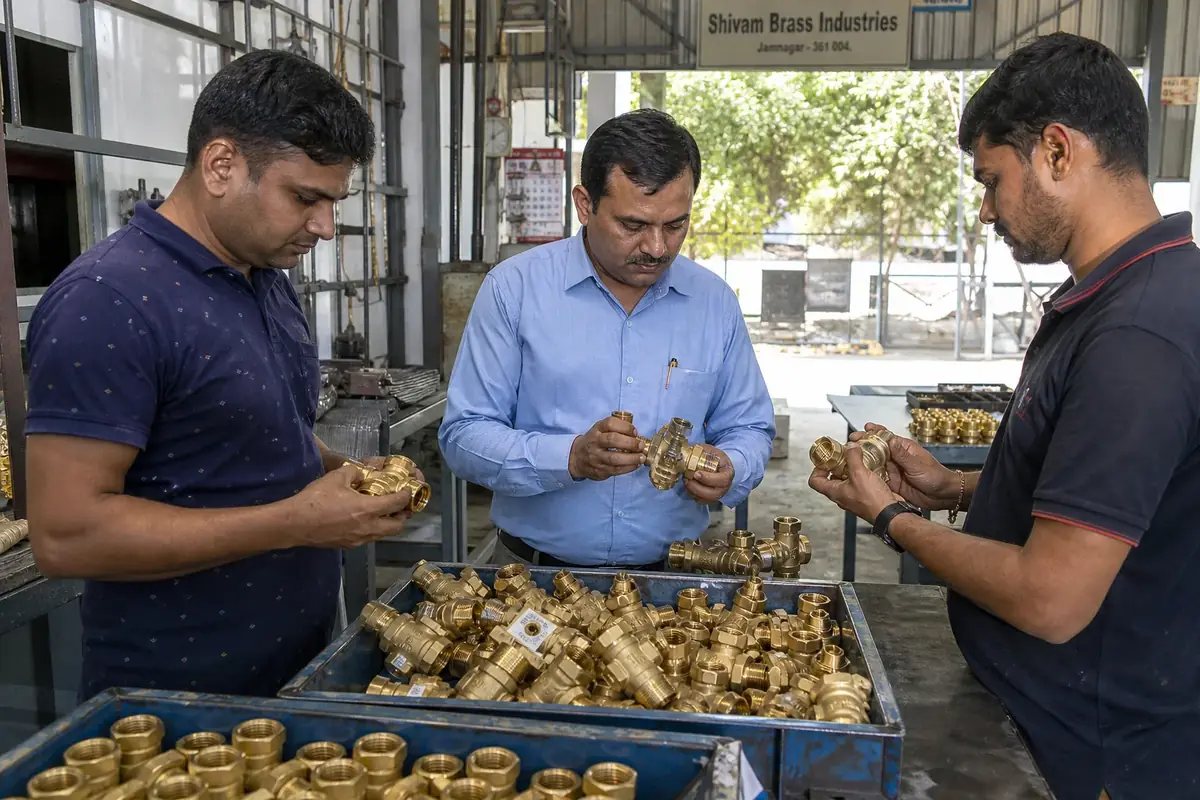
Highlights:
- Specify DZR/DR brass (e.g. CW602N) where water chemistry risks dezincification.
- Match PN ratings and hydrostatic safety factors to system pressure.
- Choose BSPT/NPT/BSPP sealing correctly — never mix flank angles.
- Forge valve bodies; CNC-turn hex nipples and precision adaptors.
Related reading: threading standards (BSP / NPT) and lead-free compliance for potable water.
1. Executive Overview: Jamnagar's Global Footprint in Sanitary & Fluid Control Hardware
In the global plumbing and heating industry, non-ferrous metals are unmatched for domestic water lines and industrial fluid networks. While plastic piping materials like Chlorinated Polyvinyl Chloride (CPVC), Polypropylene Random (PPR), and Cross-linked Polyethylene (PEX) have replaced rigid iron pipes for straight runs, metal fittings remain essential wherever lines transition, branch, shut off, or connect to water heaters, pumps, and sanitary fixtures.
Jamnagar's industrial ecosystem operates thousands of dedicated hot press forging shops, extrusion mills, and high-speed CNC finishing workshops producing turned nipples, reducers, union nuts, compression fittings, check valves, and CPVC transition inserts.
To guarantee leak-free performance over a 50-year service life, design engineers and procurement desks must specify appropriate metallurgical alloys, wall thickness safety margins, and thread sealing profiles to prevent water hammer bursts, stress corrosion cracking (SCC), and dezincification failure.
2. Corrosion Metallurgy: Dezincification-Resistant (DZR) Brass & Stress Corrosion Cracking
The primary failure mode for standard yellow brass (such as high-zinc ASTM C36000 / EN CW614N) exposed to continuously flowing or stagnant water is dezincification.
Dezincification is a selective electrochemical corrosion process occurring in soft, acidic water (pH < 7.0) or warm, chloride-rich domestic water supplies. Water leaches zinc out of the dual Alpha-Beta (alpha+beta) brass crystal structure, leaving behind a weak, porous framework of brittle metallic copper (Cu). Over time, the affected fitting develops white zinc oxide crusts, pinhole weeping leaks, or structural fracture under normal line pressure.
How DZR / DR Brass (CW602N / CZ132) Prevents Dezincification
- Higher Copper Ratio (61.0% to 63.0% Cu): Elevates the copper content to maximize the corrosion-resistant, ductile Alpha (alpha) phase in the metallurgical grain matrix.
- Arsenic Addition (0.02% to 0.15% As): Trace amounts of arsenic act as an electrochemical inhibitor, forming a protective barrier that stops zinc atom migration at grain boundaries.
- Heat Treatment (Post-Forging Annealing): Hot forged DZR components undergo a specialized 2-hour stress-relieving heat treatment at 500°C - 550°C. This converts remaining zinc-rich Beta (beta) phase grains into stable Alpha (alpha) phase grains, meeting ISO 6509 dezincification depth testing requirements (≤ 100 mum max corrosion depth).
- Stress Corrosion Cracking (SCC) Immunity: Heat-treated DZR brass eliminates residual internal manufacturing stresses caused by cold thread cutting, preventing sudden longitudinal splits when exposed to ammonia traces or soil fertilizers.
3. Pressure Classes & Hydrostatic Burst Pressure Calculation
Sanitary valves and pipe fittings are categorized into standard Nominal Pressure (PN) classes under European standard EN 1333. The PN designation defines the maximum continuous working pressure in bars at a benchmark operating temperature of 20°C:
| Pressure Class | Continuous Working Pressure (20°C) | Working Pressure (90°C Hot Water) | Minimum Hydrostatic Shell Test (1.5 × PN) | Primary Application Field |
|---|---|---|---|---|
| PN 10 | 10 Bar (145 PSI) | 6 Bar (87 PSI) | 15 Bar (217 PSI) | Gravity-fed domestic water tanks, drainage adapters |
| PN 16 (Standard) | 16 Bar (232 PSI) | 10 Bar (145 PSI) | 24 Bar (348 PSI) | Mains municipal water distribution, HVAC hydronic heating |
| PN 25 (Heavy Duty) | 25 Bar (362 PSI) | 16 Bar (232 PSI) | 37.5 Bar (543 PSI) | High-rise commercial plumbing, steam lines, compressed air |
| PN 40 (Industrial) | 40 Bar (580 PSI) | 25 Bar (362 PSI) | 60 Bar (870 PSI) | Industrial LPG gas, hydraulic lines, high-pressure refrigeration |
Hydrostatic Hoop Stress & Minimum Wall Thickness Formula
To calculate the minimum cylindrical wall thickness (t) required for a turned or forged brass fitting body to withstand internal hydraulic fluid pressure without permanent plastic deformation, mechanical engineers utilize Barlow's Hoop Stress Equation:
t = fracP cdot D_o2 cdot sigmaallow + P
- t: Minimum Required Body Wall Thickness (mm)
- P: Internal Hydrostatic Design Pressure (N/mm² or MPa)
- D_o: Outer Diameter of the Fitting Body (mm)
- sigmaallow: Allowable Tensile Design Stress of Brass Alloy (MPa), equal to Yield Strength (Rp₀.₂) / Safety Factor (N = 3.0)
Safety Rule: Under EN 1254-2, brass compression fitting walls must incorporate a 3.0 × safety factor against ultimate material tensile strength (R_m) to absorb water hammer shockwaves caused by fast-closing solenoid valves.
4. Plumbing Typology & CPVC/PPR Transition Adaptors
Jamnagar contract manufacturers turn and forge five major categories of sanitary hardware:
1. Threaded Pipe Fittings (Nipples, Bushings, Reducers, Couplings, Tees & Elbows)
Symmetrical round components (hex nipples, reducing bushings, locknuts, hose tails) are turned directly on CNC lathes from solid extruded hexagonal bar stock. Asymmetrical shapes (female 90° elbows, equal tees, 3-way manifolds) are hot closed-die forged into near-net blanks and finished on 4-axis CNC turning centers.
2. CPVC & PPR Plastic Transition Inserts (Male & Female Adaptors)
Transition adaptors connect plastic piping systems to metal valves and faucets. Turned brass male/female inserts feature heavy external hexagonal flanges with deep circumferential undercut grooves (45° angle). When over-moulded with CPVC or PPR resin, these deep undercut grooves prevent rotational torque-out and longitudinal thermal expansion separation under 80°C hot water cycles.
3. Metallic Compression Fittings (Olive & Nut Style — EN 1254-2)
Compression fittings join soft copper or PEX tubing without soldering. As the turned brass compression nut is tightened onto the fitting body, it forces a soft brass or copper compression ring (olive) to swage inward, biting into the outer tube wall to create a 16-bar mechanical fluid seal.
4. Sanitary Ball Valves & Gate Valves (EN 13828)
Full-bore shut-off valves feature hot-forged brass bodies (CW617N or CW602N), hard-chrome plated brass balls, PTFE (Teflon) valve seats, blowout-proof brass stems, and NBR/FKM double O-ring stem seals. Designed for 10,000+ manual open/close cycles under PN25 continuous pressure.
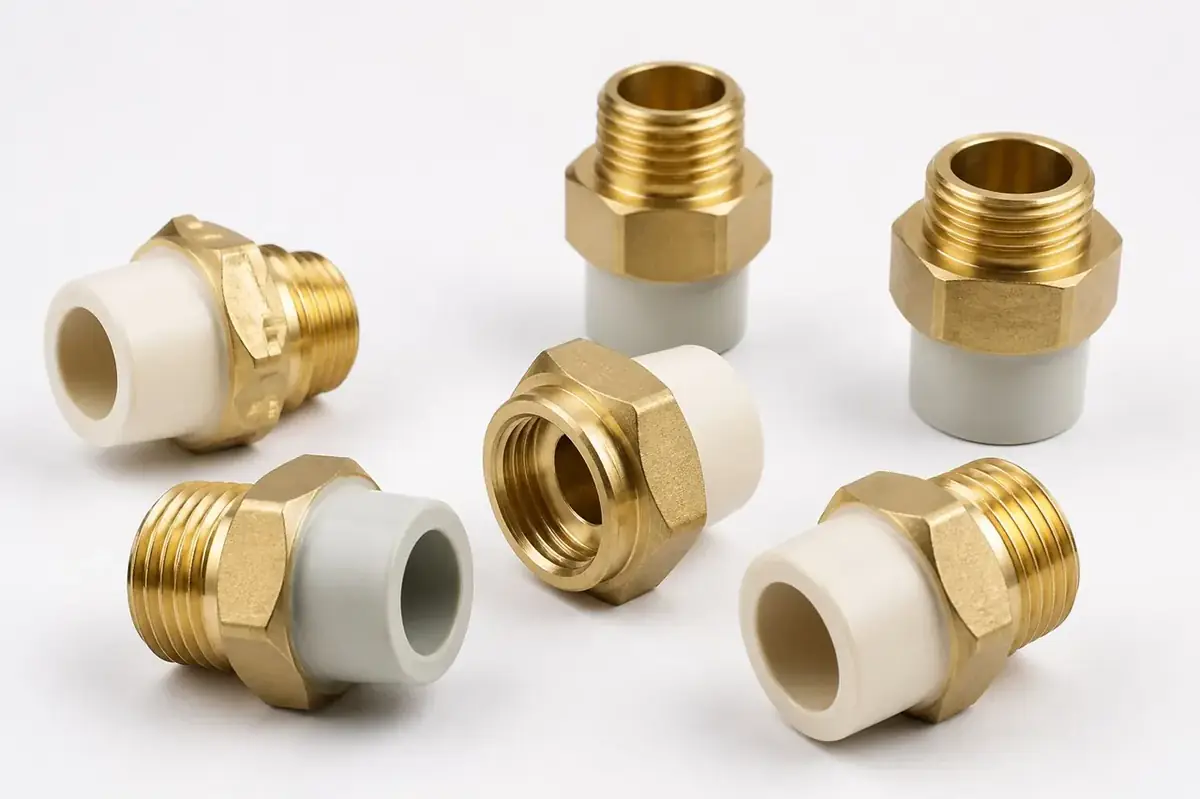
Heavy hexagonal turned brass transition inserts featuring deep undercut anchor grooves, designed for over-moulding into high-pressure CPVC and PPR plumbing fittings.
5. Thread Sealing Mechanics: Tapered Pipe vs. Parallel Shoulder Seats
Preventing spiral thread leaks in fluid handling systems requires selecting the correct thread mating configuration:
Tapered Thread Sealing (BSPT / NPT)
Male tapered pipe threads (1:16 taper) wedge into female ports. The thread flanks crush together under wrench torque. Sealing is achieved along the thread spiral using PTFE (Teflon) tape or anaerobic liquid thread sealant paste. Ideal for permanent, high-pressure pipe connections up to PN40.
Parallel Thread Sealing (BSPP / G-Series)
Parallel threads (G 1/2", G 3/4") serve purely as mechanical clamping fasteners. Fluid sealing is achieved by compressing an elastomeric EPDM/NBR O-ring, flat fiber washer, or captive bonded seal against a flat machined shoulder face. Ideal for removable connections, water meters, and sanitary faucets.
6. Manufacturing Workflows: Hot Forged Valve Bodies vs. CNC Bar Turning
Jamnagar processing plants select manufacturing pathways based on component geometry and material efficiency:
Pathway A: Hot Closed-Die Press Forging (Valve Bodies & Tees)
CW617N or CW602N heated slugs (700°C) are pressed in 300-ton friction screw presses. Hot closed-die forging refines grain structures, collapses internal micro-voids, and achieves near-net-shape hollow valve bodies. This eliminates internal porosity weeping and saves up to 50% in raw brass metal compared to solid bar milling.
Pathway B: Direct Multi-Axis CNC Turning (Hex Nipples & Bushings)
Symmetrical hexagonal fittings (hex nipples, reducing bushings, hose tails, union nuts) are turned directly from cold-drawn extruded CW614N / C36000 hex bar stock on multi-spindle automatic lathes. Cycle times range from 4 to 12 seconds per piece with zero die tooling charges.
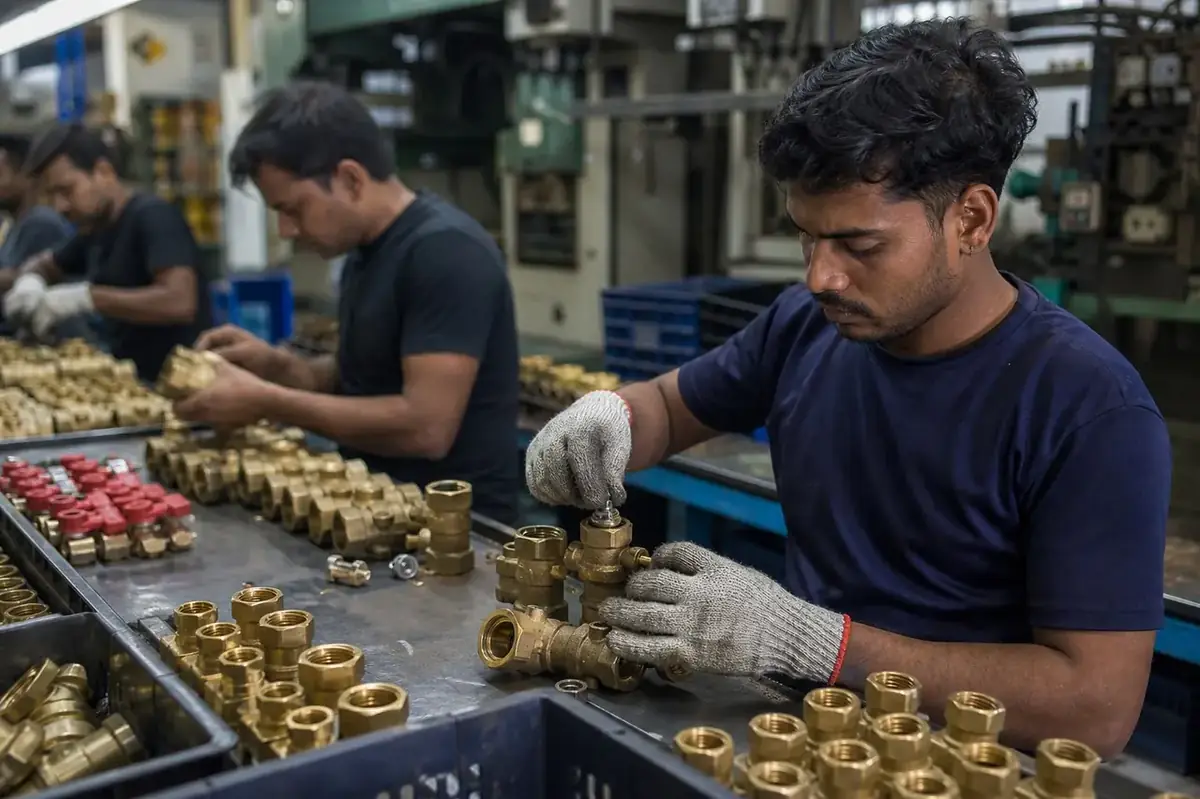
Automated valve assembly line in Jamnagar inserting PTFE seats, chrome-plated brass balls, and stems into hot forged PN25 valve bodies.
7. International Certification & Quality Control Benchmarks
To export sanitary and plumbing hardware to global markets, components must comply with four international testing standards:
Primary Sanitary Standards Compliance
- BS EN 1254-2 (Copper & Copper Alloy Compression Fittings): Regulates wall thickness, compression nut thread dimensions, olive deformation profiles, and pressure tightness for plumbing fittings.
- BS EN 13828 (Manual Ball Valves for Drinking Water): Mandates 10,000 cycle mechanical endurance testing, torque resistance on valve handles, shell hydrostatic pressure testing (1.5 × PN), and seat tightness testing (1.1 × PN).
- ASTM F1970 (Special Engineered Fittings for Plastic Piping): Regulates metal-to-plastic transition fittings, specifying thermal cycling tests (alternating between 20°C and 80°C water under 10 bar pressure for 1,000 cycles).
- NSF/ANSI/CAN 61 & NSF 372 (Lead Leaching & Content): Mandates lead leaching limits (≤ 5 µg/L) and maximum weighted lead content (≤ 0.25% Pb) for all potable water contact surfaces.
8. Printable Quality Inspection Checklist for Plumbing Shipments
Enforce this 6-point quality audit checklist prior to authorizing container dispatch for plumbing and valve orders from Jamnagar:
Chemical Alloy Spectro Verification: Verify EN 10204 3.1 MTC confirms DZR CW602N alloy (Cu 61-63%, As 0.02-0.15%, Pb ≤ 1.8%) or Lead-Free C27450 (Pb ≤ 0.25%).
Hydrostatic Shell Pressure Test: Test 100% of ball valves and forged fittings at 1.5 × PN pressure (24 bar for PN16, 37.5 bar for PN25) for 60 seconds with zero body pinhole weeping.
Pneumatic Seat Leakage Test: Test closed ball valve seats using 6 bar dry compressed air under water to detect micro-bubbles across PTFE seat seals.
Thread Pitch & Profile Audit: Check 100% of sampled male and female threads using Go/No-Go thread ring and plug gauges (BSPT, NPT, or BSPP Class 6g/6H).
Chrome & Nickel Plating Thickness: Audit electro-plated chrome layer (10 mum Cu + 12 mum Ni + 0.3 mum Cr) on valve balls and decorative tap bodies via XRF analyzer.
CPVC/PPR Undercut Depth Check: Measure outer undercut anchor groove depth (1.2 mm min depth) on transition inserts to guarantee torque-out resistance.
9. Frequently Asked Questions (FAQ)
Q: What thread standard should be specified for brass plumbing fittings shipped to North America versus Western Europe?
North American plumbing systems specify 60° NPT (National Pipe Tapered) threads. Western European, UK, and Asian plumbing systems specify 55° BSPT (R/Rc tapered) or BSPP (G-series parallel) Whitworth threads.
Q: What is DZR brass (CW602N / CZ132) and why is it mandatory for European plumbing fittings?
DZR (Dezincification Resistant) brass contains 61-63% copper and 0.02-0.15% arsenic. It undergoes post-forging stress-relief heat treatment to prevent selective zinc leaching in soft or acidic water, preventing pinhole leaks and stress corrosion cracking.
Q: What is the hydrostatic test pressure required for a PN16 rated brass ball valve?
Under EN 13828, a PN16 rated valve must undergo a shell hydrostatic pressure test at 1.5 × PN = 24 Bar (348 PSI) and a seat seal test at 1.1 × PN = 17.6 Bar (255 PSI).
Q: How do turned brass transition adaptors prevent CPVC pipe connection leaks?
Brass transition adaptors feature heavy hexagonal outer bodies with deep circumferential undercut grooves (45° angle). Over-moulding CPVC plastic resin into these undercut grooves creates a permanent mechanical lock that withstands thermal expansion and 80°C hot water pressure cycles.
Need High-Integrity Brass Plumbing Fittings & Ball Valves?
Explore our complete range of turned nipples, bushings, CPVC/PPR transition inserts, compression fittings, and PN25 hot-forged ball valves available with direct factory net pricing and zero minimum order restrictions on Jamnagar.net.