Hot Forged vs. CNC Machined Brass Components: Cost & Strength Analysis

Quick Lookup:
- Hot closed-die forging builds strength and cuts porosity for valves and elbows.
- CNC bar turning wins on precision, tooling cost, and short runs.
- Hybrid forge-then-machine often yields the lowest landed cost for manifolds.
- Choose process from geometry, volume, and mechanical duty — not habit.
Related reading: CNC tolerances and GD&T and cost drivers for turned parts.
1. Introduction: Two Manufacturing Paths for Precision Brass
Jamnagar's GIDC industrial estates host two distinct yet complementary manufacturing ecosystems: continuous rod extrusion mills feeding automated Swiss CNC turning shops, and heavy press forging plants operating automated induction slug heaters and friction screw presses.
When a mechanical engineer submits a CAD drawing for a brass elbow, valve housing, plumbing tee, or electrical clamp, the fundamental manufacturing question arises: Should the component be machined directly from solid extruded hex/round bar stock, or should it be hot-pressed into a near-net blank first and then CNC finished?
Making the wrong choice directly impacts your financial bottom line. Choosing direct CNC machining for a complex asymmetrical valve body leads to high material scrap rates (wasting up to 70% of solid bar stock turning chips). Conversely, choosing hot closed-die forging for a low-volume order (under 1,000 pieces) burdens your project with unamortized die steel tooling costs.
2. Process Mechanics: How Hot Forging vs. Direct Machining Works
Understanding the physical transformations that occur within the non-ferrous metal during each manufacturing path provides the baseline for engineering evaluation:
Hot Closed-Die Press Forging
A continuous extruded brass bar is sheared into precise billet slugs. Slugs pass through an automated electric induction furnace, reaching a plastic state at 650°C to 750°C. The glowing slug is placed into a hardened tool steel closed die set (H13 grade) on a high-tonnage mechanical press.
Under extreme pressure, plastic brass fills the mold cavity, forcing excess material into a narrow flash channel. After cooling, the flash ring is trimmed in a secondary clipping die, leaving a dense, near-net-shape blank ready for CNC finishing.
- Operating Temp: 650°C - 750°C (Plastic State)
- Primary Alloy: Forging Brass (ASTM C37700 / EN CW617N)
- Material Savings: High (Near-Net-Shape geometry)
Direct Bar Stock CNC Machining
Cold-drawn solid extruded round, square, or hex brass bar stock is loaded directly into the bar feeder of a high-speed automatic lathe or Swiss CNC turning center at room temperature (23°C).
Carbide cutting inserts, drills, and end-mills selectively shave away unwanted metal as turning chips until the final drawing geometry is achieved. The raw material volume that exceeds the finished part weight is entirely converted into swarf scrap chips.
- Operating Temp: Room Temperature (Cold Subtrative)
- Primary Alloy: Free Cutting Brass (ASTM C36000 / EN CW614N)
- Material Savings: Low on complex non-round shapes
3. Microstructure, Tensile Strength & Porosity Analysis
The mechanical superiority of hot forged brass over direct bar turning stems from directional grain flow refinement and internal void elimination.
When a solid brass slug is compressed at elevated temperatures within a closed die cavity, the crystalline grain boundaries align continuously along the external contours of the part geometry. This unbroken, continuous grain flow eliminates microscopic stress risers and enhances resistance to mechanical impact fatigue and pressure surges.
Microstructural Engineering Benchmarks
- Zero Internal Micro-Porosity: Direct sand casting or continuous bar stock can occasionally harbour micro-shrinkage voids or centerline gas porosity. Under high-tonnage closed-die forging pressure (300+ tons), any internal gas pockets or micro-voids are completely collapsed and pressure-welded shut. This makes hot forgings 100% leak-proof for high-pressure LPG gas regulators, refrigeration manifolds, and hydraulic lines.
- Higher Tensile & Yield Strength: Hot forged CW617N / C37700 brass exhibits an ultimate tensile strength of 380 - 450 MPa with high elongation (20% A₅), compared to cold-drawn turned bar stock which may exhibit higher hardness but lower ductility (10% A₅).
- Structural Integrity under Burst Pressure: High-pressure ball valve bodies forged in Jamnagar withstand burst safety pressures exceeding 100 bar (1,450 PSI) without body wall distortion or catastrophic pinhole weeping.
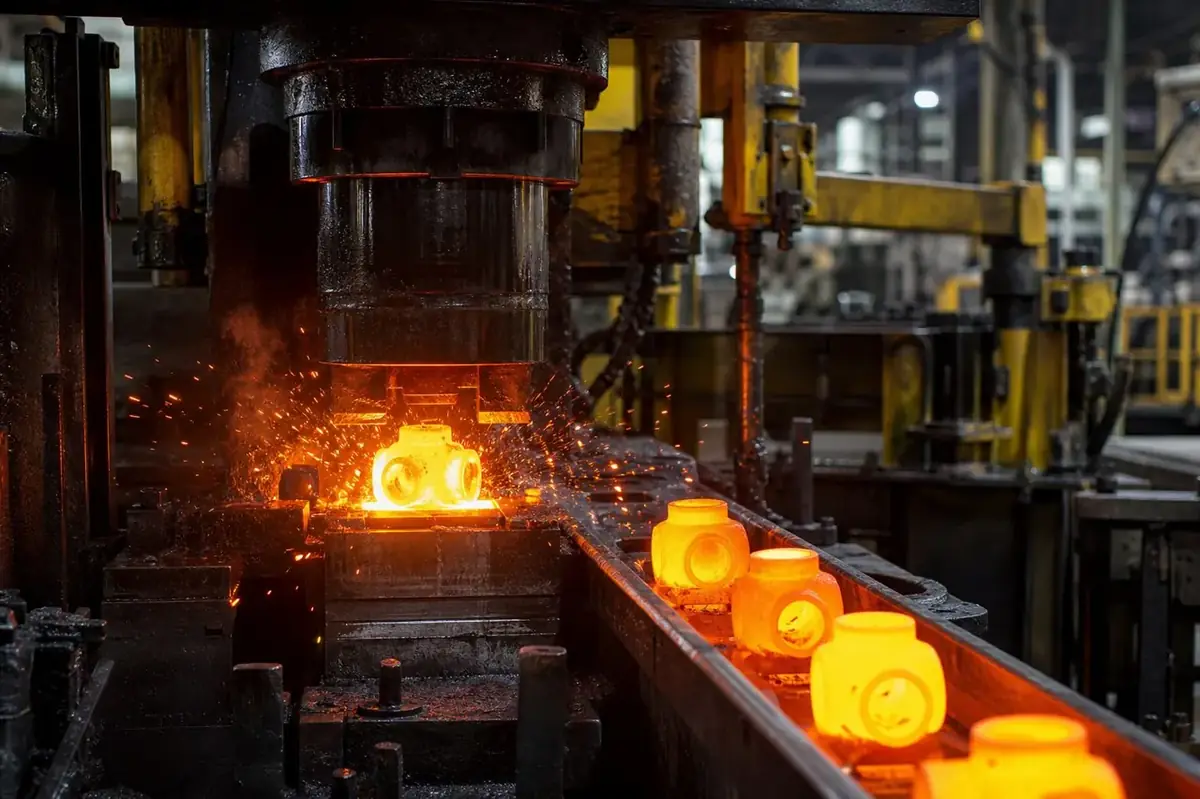
Automated 400-ton friction screw press closed-die forging line forming near-net-shape brass valve bodies in a Jamnagar industrial workshop.
4. Comprehensive Technical & Financial Comparison Matrix
Evaluate these twelve core operational parameters when choosing between hot closed-die forging and direct CNC machining for your CAD drawings:
| Parameter | Hot Closed-Die Forging + CNC Finish | Direct CNC Bar Stock Machining |
|---|---|---|
| Primary Metallurgical Alloy | Forging Brass (ASTM C37700 / EN CW617N) | Free Cutting Brass (ASTM C36000 / EN CW614N) |
| Grain Flow Alignment | Continuous contoured grain flow (High Fatigue Resistance) | Parallel linear bar grain (Cut across contours during machining) |
| Internal Porosity & Leak Risk | Absolute Zero Porosity (100% Pressure Tight) | Low, but occasional bar centerline micro-voids possible |
| Material Utilization Efficiency | 75% to 90% (Minimal trim flash waste) | 30% to 50% on non-round complex shapes (High Chip Waste) |
| Initial Hard Tooling Expense | Higher (800 –2,500 for H13 Steel Press Dies) | Zero (₹0 — Standard chuck collets & CNC G-code) |
| Tooling Setup Time | 7 to 12 Days (Die machining & trial clipping) | 1 to 3 Days (G-code digital CAM program setup) |
| Unit Production Cycle Time | Ultra-Fast (3–6 sec press stroke + quick CNC thread finish) | Slower on heavy material removal (30–120 sec per part) |
| Best Economic Volume Threshold | Medium to High Volume (>3,000 to 100,000+ Pieces) | Low to Medium Volume (10 to 2,500 Pieces) |
| Dimensional Precision As-Formed | Medium (± 0.2 mm - ± 0.5 mm on raw forged unmachined faces) | Ultra-High (± 0.005 mm to ± 0.02 mm across all surfaces) |
| Geometric Design Flexibility | Requires press draft angles (1° - 3°) and flash lines | Complete freedom for deep undercuts, bores & sharp profiles |
| Surface Roughness As-Formed | Ra 3.2 mum - 6.3 mum (Requires shot blasting or plating) | Ra 0.8 mum - 1.6 mum (Mirror turned surface finish) |
| Burst Pressure Capacity | Extreme (100+ bar / 1,500+ PSI) | Medium to High (40 - 70 bar) |
5. Financial Breakeven Model: When Does Forging Pay Off?
To calculate whether your order volume justifies investing in ₹1,200 closed-die forging die steel, procurement managers evaluate the Total Cost Amortization Equation:
Forging vs. Machining Breakeven Formula
Total Cost (Machined) = Q × ( MaterialBar + Machining Overhead )
Total Cost (Forged) = Die Tooling Cost + Q × ( MaterialSlug + Forging Press Charge + Finish CNC Overhead )
Breakeven Quantity (Q^* ) = fracDie Tooling CostDelta Variable Unit Savings
Real-World Example: For an asymmetrical 250-gram brass valve body, raw bar machining wastes 1.80 of metal per part, whereas hot press forging uses a near-net 280-gram slug. The variable savings per forged unit is1.20. With die tooling costing 1,200 in Jamnagar, the financial breakeven quantity (Q^*$) is exactly 1,000 pieces. Every piece produced beyond 1,000 units yields a direct 35% unit cost reduction!
6. The Hybrid Workflow: Best of Both Worlds
In modern industrial manufacturing, high-performing Jamnagar suppliers do not treat hot forging and CNC machining as mutually exclusive options. Instead, they execute a Hybrid Manufacturing Workflow:
Step 1: Hot Closed-Die Pressing (Near-Net Primary Shape)
The complex asymmetrical outer body, internal fluid cavities, and mounting flanges are hot-pressed on friction screw presses to near-net dimensions (± 0.3 mm). This seals internal grain structures and eliminates raw material chip waste.
Step 2: Automated Flash Trimming & Shot Blasting
Forging flash rings are clipped in secondary press dies. Blanks pass through automated stainless steel shot-blasting chambers to remove thermal scale, leaving a smooth matte surface.
Step 3: Secondary Multi-Axis CNC Finishing & Tapping
The near-net blank is loaded into specialized pneumatic rotary index chucks on a 4-axis CNC turning center. Precision thread ports (BSP/NPT), O-ring sealing grooves, and valve seat faces are turned to micron tolerances (± 0.01 mm).
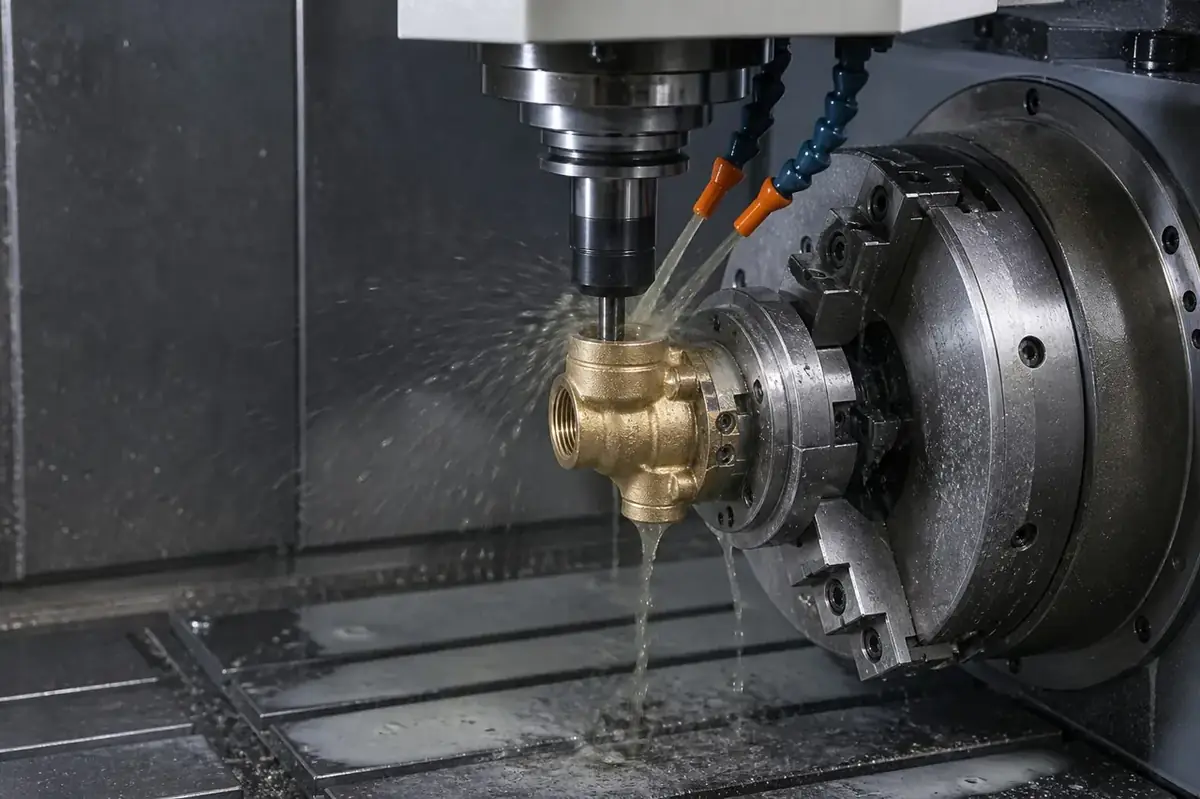
Secondary 4-axis CNC finish machining and thread tapping on a hot pressed brass valve blank held in custom pneumatic clamping jaws.
7. Design for Manufacturability (DFM) Rules for Forged Parts
When designing a CAD model intended for hot closed-die forging, design engineers must incorporate key forging DFM features into the 3D model prior to die steel cutting:
- Press Draft Angles (1° to 3°): All vertical walls parallel to press stroke direction must feature a 1° to 3° draft angle to allow the hot brass blank to eject cleanly from the die steel mold without sticking.
- Fillet and Corner Radii (R ≥ 1.5 mm): Avoid sharp internal corners (R0 mm). Generous fillet radii (R 1.5 mm to R 3.0 mm) allow hot plastic metal to flow smoothly into die cavities without forming cold-shuts or internal fold cracks.
- Flash Line Location: Position the parting flash line along a non-critical geometric plane where secondary clipping punches can remove excess flash without scarring visible sealing faces.
- Machining Stock Allowances (0.8 mm to 1.2 mm): Provide a 1.0 mm extra wall material allowance on functional faces (like internal thread bores and valve seats) that will undergo secondary CNC finish turning.
8. Frequently Asked Questions (FAQ)
Q: Can hot forged brass components achieve the same tight tolerances as CNC turned parts?
Raw unmachined hot forgings achieve tolerances of ± 0.3 mm to ± 0.5 mm. However, through secondary CNC finish turning on functional features (threads, sealing faces), forged components achieve identical tight tolerances (± 0.005 mm).
Q: What is the typical minimum order quantity (MOQ) for hot forged brass orders?
The economic minimum threshold for hot press forging in Jamnagar is typically 2,000 to 3,000 pieces. For smaller quantities (under 1,000 pieces), direct bar stock CNC machining is usually more cost-effective due to zero die tooling costs.
Q: What is the typical tooling die cost for hot brass closed-die forging in Jamnagar?
Hardened H13 tool steel closed-die sets for small to medium brass components (such as valve bodies, elbows, or pipe tees) cost between ₹80,000 to ₹1,80,000 in Jamnagar, which is 50% to 70% lower than Western die-making overhead.
Q: Why is ASTM C37700 (CW617N) preferred over free-cutting C36000 for hot forging?
C37700 contains ~58% copper and lower lead (~1.6-2.5%), optimizing it specifically for high hot-plasticity (650-750°C) without hot-shortness cracking. C36000 contains higher lead (~3.5%), which melts at forging temperatures and causes internal grain boundary tearing during pressing.
Need Advice on Forged vs. Machined Component Costs?
Submit your 2D PDF and 3D STEP drawing package to our direct factory sales desk. Our engineering team will analyze your part geometry, calculate material scrap savings, and provide comparative quotes for both direct CNC turning and hybrid hot forging on Jamnagar.net.