Cost Estimation & Price Drivers for Turned Brass Components: Raw Metal Index, Machine Cycle Times & DFM Cost Reduction
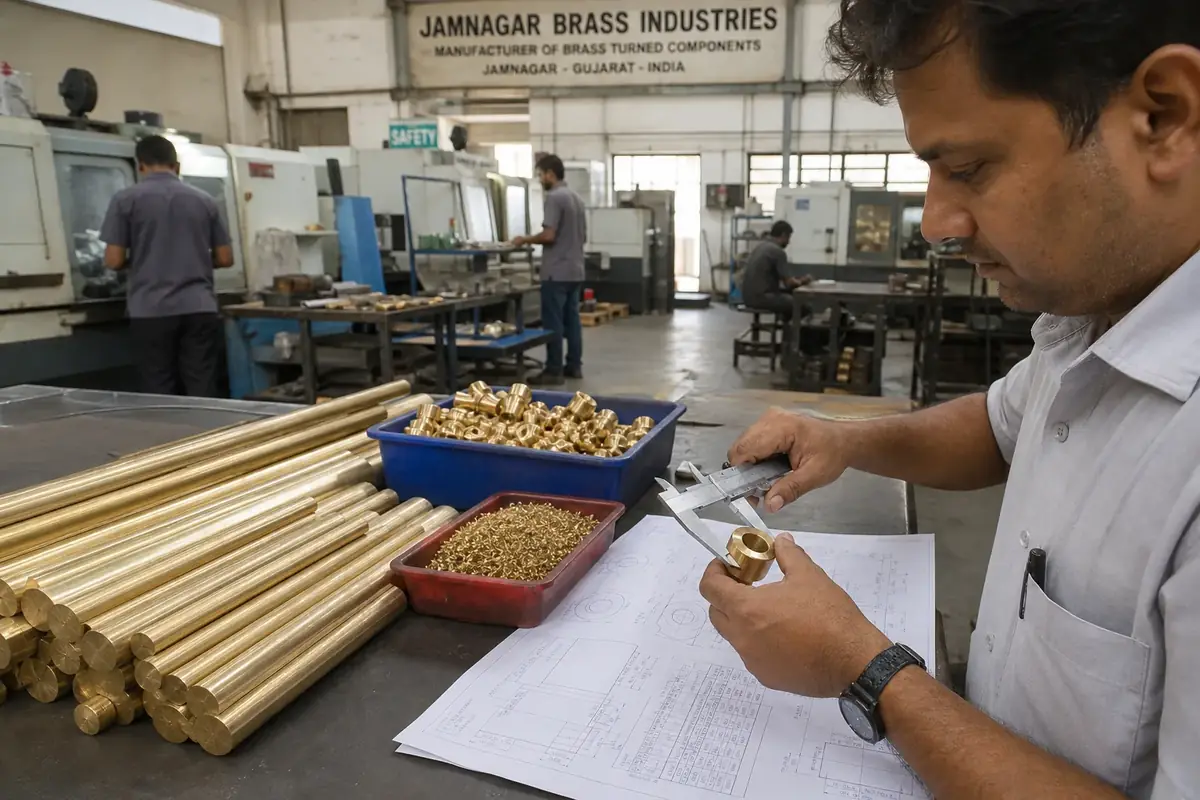
Highlights:
- Raw brass bar typically drives 60–75% of unit cost.
- Model gross bar weight vs net part weight with swarf scrap credit.
- Index rod prices to LME/MCX copper–zinc moves.
- Add machine cycle time plus plating, sorting, and packing overhead.
1. Executive Overview: Demystifying the Cost Structure of Turned Brass
When procurement managers submit a 2D PDF engineering drawing to Jamnagar machine shops, quotation prices between different vendors can vary significantly. Buyers often wonder: *How do estimating engineers calculate unit prices down to fractions of a cent, and why does raw material price volatility directly impact PO totals?*
Because copper (Cu) and zinc (Zn) are high-value non-ferrous commodities, turned brass manufacturing is uniquely material-heavy. In a typical turned component—such as an M6 moulding insert, a cable gland entry body, or a neutral link block—raw metal bar stock represents the largest single cost driver.
By mastering the mathematical formulas that estimating engineers use in Jamnagar, procurement desks can conduct "should-cost" audits, evaluate scrap recovery value, avoid hidden vendor markups, and re-engineer CAD drawings to achieve the absolute lowest landed unit cost.
The 5 Core Components of a Turned Brass Unit Price
1. Net Material Cost (60% - 75%): Gross raw bar stock weight minus scrap swarf credit recovery.
2. Machining Overhead (15% - 25%): Machine cycle time, operator labor, cutting tool wear, and power consumption.
3. Plating & Surface Finish (3% - 8%): Electro-nickel, electro-tin, ultrasonic degreasing, or passivation.
4. Quality Inspection & Packaging (2% - 5%): Gauge checking, optical sorting, polybag kitting, and export cartoning.
+ Factory Margin & Tooling Amortization (5% - 10% depending on order quantity).
2. Raw Material Cost Modeling: Gross Weight, Net Weight & Scrap Credit Economics
The most critical step in calculating turned brass component costs is determining the Net Material Cost (Cmat).
When turning a component from a solid extruded brass bar, the machine tool removes metal in the form of fine chips, turnings, and drill swarf. In Jamnagar's closed-loop 5-mile ecosystem, these swarf chips are not discarded; they are collected daily and returned directly to local GIDC Phase I induction foundries for re-melting into continuous billets.
Foundries grant machine shops a Scrap Credit Value (typically 75% to 85% of the virgin extruded rod rate per kilogram). Estimating engineers pass this scrap credit back to the buyer in their costing model!
1. Net Material Cost Formula (Cmat)
Wgross = fracpi4 cdot Dbar² cdot (Lpart + Lcut₋off + Lfacing) cdot rhobrass
Wscrap = Wgross - Wnet
Cmat = ( Wgross × Prod ) - ( Wscrap × Pscrap_credit )
- Wgross: Gross Weight of raw extruded bar required per piece (grams)
- Wnet: Net Finished Weight of the completed turned component (grams)
- Wscrap: Weight of swarf chips generated during turning (grams)
- Dbar: Outer Diameter or Across-Flat Hex size of raw bar stock (mm)
- Lpart: Finished Part Length (mm)
- Lcut₋off: Width of parting/cut-off blade tool (typically 1.5 mm to 2.5 mm)
- rhobrass: Density of Free-Cutting Brass (8.50 g/cm³ or 0.0085 g/mm³)
- Prod: Raw Extruded Brass Rod Market Price (INR/kg)
- Pscrap_credit: Swarf Scrap Recovery Price (INR/kg), usually 80% of Prod
Worked Example: A turned brass bushing has a Gross Bar Weight Wgross = 50g and a Net Finished Weight Wnet = 20g (Scrap Wscrap = 30g). At a rod price Prod = ₹7.00/kg}and scrap creditP_{scrap}} = ₹5.60/kg (80%):
Raw Bar Input = 0.050kg × ₹7.00 = ₹0.350
Scrap Recovery Credit = 0.030kg × ₹5.60 = ₹0.168
Net Material Cost (Cmat) = ₹0.350 - ₹0.168 = mathbf\0.182 per piece}}$.
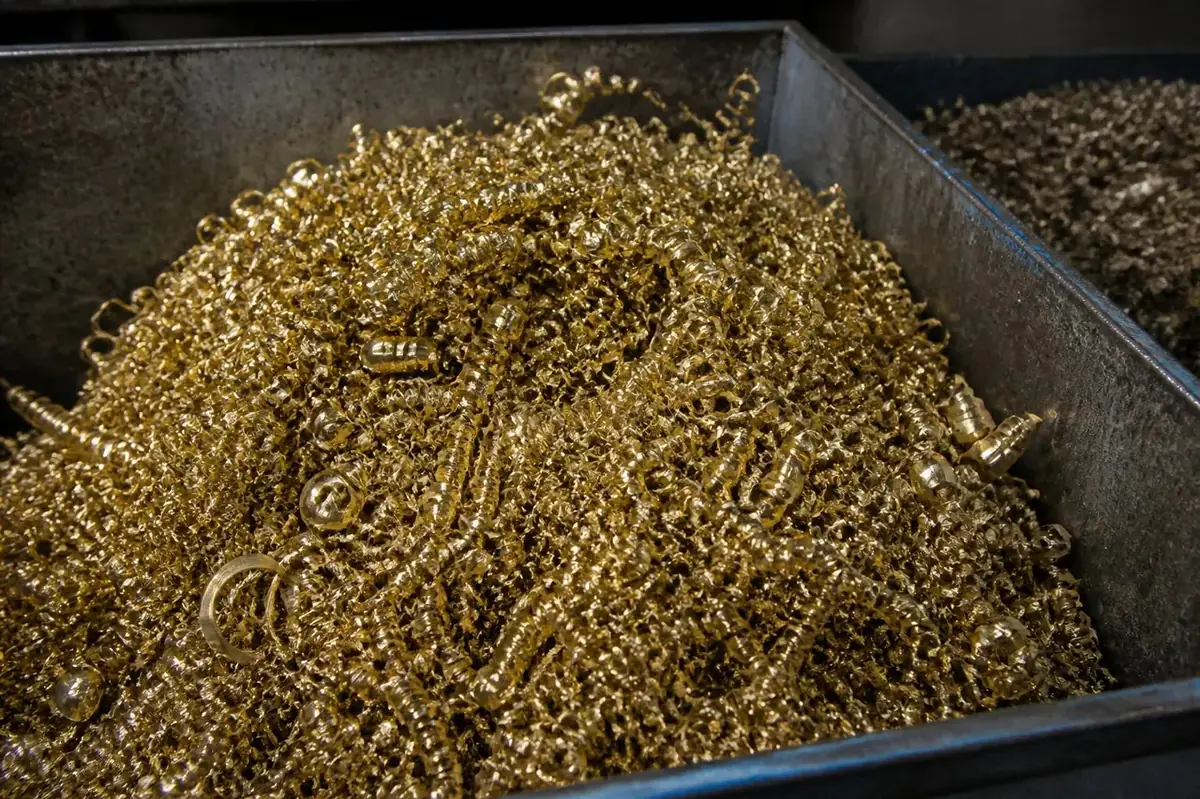
Brass turning swarf chips collected directly beneath CNC lathes in Jamnagar, ready for transport to GIDC Phase I foundries for 80%+ scrap credit value.
3. Machine Cycle Time Calculation & Tooling Overhead
The second major cost component is Machining Overhead (Cmach).
Machining overhead is directly proportional to Machine Cycle Time (Tcycle) and the Machine Hourly Operating Rate (Rmach) of the chosen machine tool platform in Jamnagar:
2. Machining Overhead Formula (Cmach)
Tcycle = Tturning + Tdrilling + Ttapping + Tparting + Tindex
Cmach = ( (Tcycle ÷ 3600) ) × Rmach
- Tcycle: Total Machine Cycle Time per completed component (seconds)
- Rmach: Hourly Operating Rate of the machine tool (INR/hour), incorporating power, operator labor, machine depreciation, and cutting tool wear
| Machine Tool Platform | Average Cycle Time (Tcycle) | Operating Rate (Rmach) | Machining Cost / Piece | Best Economic Volume Threshold |
|---|---|---|---|---|
| Cam-Driven Automatic Lathe | 3 to 10 Seconds | 4.00 –7.00 / Hour | 0.005 –0.015 / Pc | High Volume (>10,000 to 500,000 Pcs) |
| Fixed-Headstock CNC Lathe | 15 to 45 Seconds | 10.00 –16.00 / Hour | 0.040 –0.150 / Pc | Medium Volume (500 to 10,000 Pcs) |
| Swiss Sliding-Head CNC Lathe | 8 to 25 Seconds | 14.00 –22.00 / Hour | 0.030 –0.100 / Pc | High Precision Sub-Micron Runs |
4. Commodity Market Indexing: Linking Unit Prices to LME & MCX Metal Rates
Because raw brass accounts for over 60% of total component cost, fluctuations on global metal exchanges—specifically the London Metal Exchange (LME) and India's Multi Commodity Exchange (MCX)—directly influence PO pricing.
When copper prices surge by 1,000 per metric ton on the LME, raw brass extrusion mills in Jamnagar adjust their daily rod prices (INR/kg}orINR/kg}$) immediately. To protect both buyers and suppliers from commodity price swings on long-term annual supply contracts ( blanket POs ), enterprise procurement desks utilize Commodity Index-Linked Pricing Clauses:
Commodity Price Adjustment Formula (Pnew)
Pnew = Pbase + [(Mcurrent − Mbase) × Wnet_kg × Kfactor]
- Pnew: Revised Unit Price per completed component (INR)
- Pbase: Baseline Unit Price established at contract execution (INR)
- Mcurrent: Current LME / MCX Raw Brass Rod Index Rate (INR/kg)
- Mbase: Baseline Raw Brass Rod Index Rate at contract signing (INR/kg)
- Wnet_kg: Net weight of the finished brass component (kg)
- Kfactor: Material Recovery Coefficient (1.15 to 1.30, accounting for uncredited turning chip losses)
B2B Contracting Rule: Price adjustments are triggered only when the raw metal commodity index fluctuates beyond an agreed neutral band (e.g., ± 3.0% LME variance threshold).
5. 6 High-Impact DFM Levers to Reduce Unit Price by 18% to 35%
Design for Manufacturability (DFM) is the single most powerful tool an engineering procurement team possesses. Modifying CAD drawing details during quotation reviews eliminates non-value-added machining steps and lowers unit costs dramatically:
Lever 1: Match Geometry to Standard Extruded Bar Stock Sizes (Save 10%–15%)
If your CAD drawing specifies an outer collar diameter of 11.2 mm, the machine shop must turn down a standard 12.0 mm raw rod, generating 25% chip waste. By modifying the drawing outer collar dimension to match off-the-shelf extruded bar diameters (10.0 mm, 12.0 mm, or standard hex sizes A/F 8, 10, 12 mm), you eliminate raw metal waste and shorten turning cycle times.
Lever 2: Avoid Over-Specifying Tight Linear Tolerances (Save 8%–12%)
Applying a tight ± 0.005 mm tolerance across non-critical dimensions (like overall length or external chamfers) forces the factory to slow machine feed rates and perform 100% manual micrometer checks. Reserve tight ± 0.005 mm limits strictly for critical bearing fits or sealing journals, allowing general features to conform to standard ISO 2768-m (± 0.10 mm).
Lever 3: Standardize Thread Pitches & Add Entry Chamfers (Save 5%–8%)
Non-standard or extra-fine thread pitches require purchasing custom tapping tools or programming multi-pass single-point thread turning. Specifying standard metric coarse threads (M4 × 0.7, M6 × 1.0, M8 × 1.25) allows shops to use standard high-speed taps already installed in machine turrets.
Lever 4: Relax Internal Blind Hole Corner Radii (Save 4%–7%)
Sharp internal corners (R 0 mm) inside turned bores require slow micro end-milling operations. Specifying an internal corner radius of R ≥ 0.4 mm allows standard carbide turning inserts to machine internal contours in a single high-speed pass.
Lever 5: Optimize Electroplating Micron Callouts (Save 3%–5%)
Requesting 15-micron heavy nickel plating on internal electronic standoffs used in dry indoor enclosures adds unnecessary chemical bath costs. Match plating micron depth strictly to environmental exposure requirements (3–5 mum for indoor storage, 5–8 mum for general industrial, 12 mum for marine outdoor).
Lever 6: Consolidate Order Quantities to Amortize Setups (Save 15%–25%)
Placing four separate monthly purchase orders for 2,500 pieces forces the factory to absorb four individual machine setup cycles (4 × ₹150 = ₹600). Issuing a single annual scheduled blanket PO for 10,000 pieces allows the factory to run one continuous production batch, passing setup savings directly back to you.
6. Master Cost Estimation & DFM Optimization Matrix
Evaluate how component geometry, machine selection, and DFM modifications impact final unit pricing in this real-world cost estimation comparison:
| Cost Evaluation Parameter | Unoptimized CAD Drawing (Non-DFM) | DFM Optimized CAD Drawing | Net Unit Cost Savings |
|---|---|---|---|
| Raw Material Bar Stock Selected | Non-standard varnothing 13.5 mm round rod (Custom extrusion) | Standard varnothing 12.0 mm off-the-shelf rod | Save 14% on Raw Material Input |
| Scrap Swarf Ratio (Wscrap / Wgross) | 65% Metal Removed as Chips (32g scrap) | 35% Metal Removed as Chips (14g scrap) | Save 18% Net Metal Overhead |
| Linear Tolerance Callout | Tight ± 0.005 mm across all 12 dimensions | ± 0.005 mm on 2 bearing fits; ISO 2768-m on rest | Save 12% Machining Cycle Time |
| Thread Specification | Non-standard M6 × 0.65 Fine Pitch Thread | Standard ISO Metric M6 × 1.0 Coarse Thread | Save 100% tooling surcharge Tooling Surcharge |
| Order Batch Structure | 4 separate POs for 2,500 Pcs each | 1 Scheduled Annual Blanket PO for 10,000 Pcs | Save 75% Setup Amortization |
| Estimated Unit Price Result | ₹0.42 per piece FOB | ₹0.29 per piece FOB | Total 31% Landed Cost Reduction! |
7. Printable RFQ Cost Audit Checklist for Procurement Managers
Enforce this 6-point cost audit checklist during vendor quotation evaluations to guarantee fair, transparent factory pricing:
Raw Metal Rate Transparency: Verify the baseline raw brass rod price (INR/kg or INR/kg) stated in the quote against current LME / MCX market benchmarks.
Scrap Recovery Credit Audit: Confirm the quotation explicitly credits swarf chip recovery (Wscrap) at 75% to 85% of the virgin rod rate.
Gross vs. Net Weight Check: Audit the estimated gross bar weight (Wgross) to ensure the vendor is not over-estimating bar cut-off width or bar end-piece scrap allowances.
Machining Platform Alignment: Confirm high-volume standard parts (>10,000 pcs) are quoted on high-speed Cam-Automats or Swiss lathes rather than slow, high-rate VMCs.
Plating & Secondary Service Unbundling: Request separate line-item breakdowns for electroplating, heat treatment, ultrasonic washing, and packaging.
DFM Optimization Review: Request the factory's engineering desk to submit DFM recommendations before final PO release to capture design savings.
8. Frequently Asked Questions (FAQ)
Q: What single DFM modification yields the largest unit cost reduction?
Modifying outer collar diameters or hex sizes to match standard off-the-shelf extruded bar stock dimensions yields immediate 10% to 20% savings by eliminating raw metal chip waste and reducing turning passes.
Q: Why does raw brass material account for up to 75% of a turned component's unit cost?
Copper and zinc are valuable non-ferrous commodities traded globally on the LME and MCX. Because free-cutting brass can be turned at ultra-high cutting speeds (3-10 seconds per part), machine labor time is minimal compared to the intrinsic commodity value of the metal bar input.
Q: What is a swarf scrap recovery credit and how does it reduce component pricing?
When turning brass components from solid bars, 30% to 60% of the bar weight is removed as turning chips (swarf). Jamnagar machine shops return these swarf chips to local foundries for re-melting, receiving 75% to 85% of the virgin rod value. Reputable suppliers credit this scrap recovery value back to the buyer, lowering the net material cost.
Q: How do annual blanket purchase orders lower unit manufacturing costs?
Issuing an annual scheduled blanket PO allows the factory to order raw extruded bar stock in bulk at lower mill volume rates and run one continuous production batch, amortizing physical machine setup costs (150-300 per setup) across the entire annual volume.
Want a Transparent "Should-Cost" Audit on Your Turned Brass Parts?
Submit your 2D PDF and 3D STEP CAD files to our cost engineering desk. We provide transparent raw material calculations, scrap credit breakdowns, and DFM optimization recommendations for direct factory pricing on Jamnagar.net.