Low MOQ Sourcing: How Small & Mid-Sized Buyers Source Direct from Jamnagar

Quick Lookup:
- Design around standard extruded bar stock sizes to cut MOQ friction.
- Prefer multi-axis Swiss CNC over cam automats for small batches.
- Group part families that share thread profiles and tool setups.
- Use FAIR prototypes, then scale via aggregation portals when needed.
Related reading: cost estimation model and China +1 sourcing strategy.
1. The High-MOQ Dilemma in Contract Metal Turning
When a small or mid-sized enterprise (SME), hardware startup, or specialized repair house attempts to source a custom turned brass component—such as 200 pieces of a custom sensor housing or 500 specialized threaded inserts—they frequently encounter a brick wall. Traditional foundries and machine shops in Jamnagar routinely demand minimum order quantities of 500 to 1,000 kilograms of extruded bar stock or batch minimums of 10,000 to 50,000 finished pieces.
To understand how to overcome these barriers, buyers must first understand why factories enforce high MOQs. High MOQs are not arbitrary penalties; they are driven by the physical economics of metal melting, extrusion die setup, and cam-lathe sharpening:
Induction Furnace Melt Charges: Extrusion foundries operate electric induction furnaces with minimum liquid charge capacities (typically 500 kg to 2,000 kg). Melting a custom non-standard alloy for a 50 kg order creates massive energy waste and scrap loss.
Extrusion Press Die Setup: Pushing a heated billet through a hydraulic press to produce custom profile rod stock requires changing heavy tungsten carbide dies, taking 2 to 4 hours of foundry downtime.
Cam-Automat Machine Setup Overhead: Cam-driven automatic lathes require grinding custom steel control cams, setting up tool chasers, and adjusting mechanical stops. Setting up a cam automat can take 4 to 8 hours for a job that takes only 30 minutes to turn 200 parts.
2. Machine Economics: Cam-Automats vs. Swiss CNC Turning for Short Runs
The single most significant technological shift enabling low-MOQ procurement in Jamnagar is the widespread adoption of multi-axis CNC lathes and Swiss sliding-head automatic turning centers.
| Operational Attribute | Cam-Driven Automatic Lathe | Swiss CNC Turning Center |
|---|---|---|
| Tooling Setup Method | Manual cam grinding, steel levers & stops | Digital G-code programming & standard inserts |
| Physical Setup Time | 4 to 8 Hours | 15 to 45 Minutes |
| Fixed Setup Amortization Cost | 150 –300 per setup change | 25 –50 per setup change |
| Economic Order Quantity (EOQ) | 10,000 to 100,000 Pieces | 50 to 2,000 Pieces |
| Linear Machining Tolerances | ±0.03 mm to ±0.05 mm | ±0.005 mm (5 Microns) |
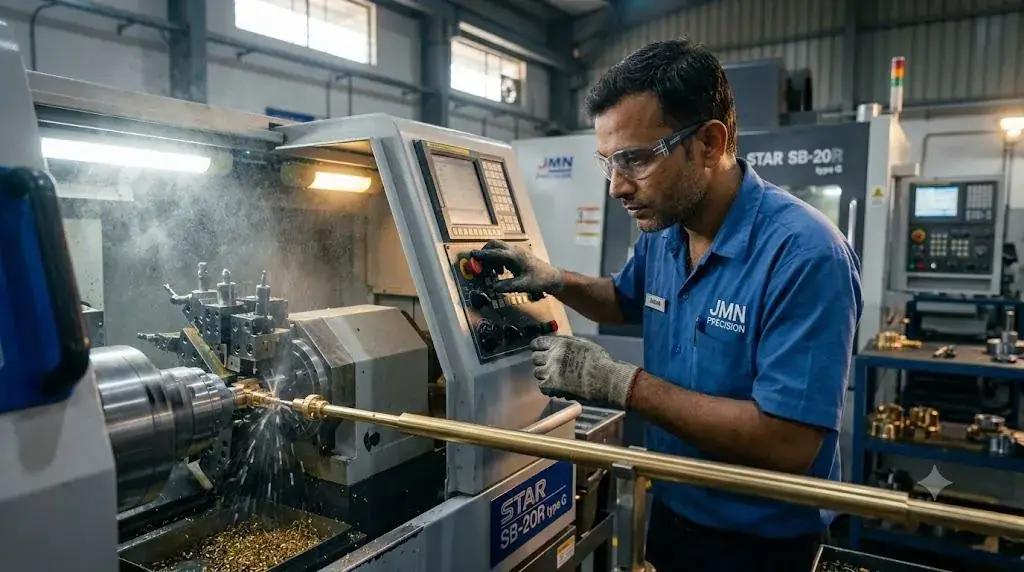
Multi-axis Swiss CNC turning lathe executing a small-batch short run of complex brass components with zero custom cams.
3. 5 Proven Strategies to Eliminate MOQs in Jamnagar
SME procurement desks can immediately apply five practical engineering and purchasing strategies to secure small-batch orders without paying exorbitant per-piece penalties:
Strategy 1: Standardize Around Off-the-Shelf Bar Stock Dimensions
The #1 reason a factory demands a 1,000 kg minimum order is because the CAD drawing specifies an unusual raw stock diameter (e.g., 11.3 mm round rod) that requires a dedicated extrusion melt charge. By modifying your drawing outer diameter to standard stock sizes—such as 10.0 mm, 12.0 mm, 14.0 mm, or standard hex dimensions (A/F 8 mm, 10 mm, 12 mm)—the factory can pull raw material directly from their existing warehouse inventory, completely bypassing extrusion minimums.
Strategy 2: Specify Standard Free-Cutting Alloy Grades
Always specify widely stocked alloys such as ASTM C36000, EN CW614N (CuZn39Pb3), or IS 319 Grade 1. Jamnagar foundries continuously extrude these standard free-cutting grades daily. Requesting niche alloys (like specialized marine naval brass C46400 or phosphor bronze) for a small order forces a custom melt, whereas standard free-cutting stock is always available off the shelf.
Strategy 3: Group Component "Families" Under Shared Raw Material
If your product line requires three different brass fittings (e.g., an M6 male nipple, an M6 female sleeve, and a blank cap), design all three components to be turned from the exact same 12 mm hex rod bar stock. Combining three small 200-piece requirements into a single 600-piece raw bar stock order meets machine shop thresholds while keeping individual SKU inventories lean.
Strategy 4: Leverage First Article Inspection Report (FAIR) Prototypes
Before placing a full production order, issue a prototype sample PO for 10 to 25 pieces. CNC workshops treat prototype runs as First Article Inspection Report (FAIR) qualification jobs. While the per-piece sample price is higher due to setup costs, it allows complete physical fitment and laboratory testing with minimal capital exposure.
Strategy 5: Source via Digital Order Aggregation Portals
Digital supply portals like Jamnagar.net act as central demand aggregators. By pooling short-run orders from multiple global buyers who share identical bar stock profiles and alloy specifications, the portal places consolidated volume orders with partner machine shops. This allows individual small buyers to purchase 100 or 500 pieces at rates approaching high-volume factory pricing.
4. Cost Structure & Unit Price Break-Even Model
Understanding how fixed machine setup costs amortize across different order quantities helps purchasing managers select the optimal order size for their working capital budget:
| Order Batch Quantity | Machining Technology Used | Amortized Setup Overhead | Estimated Unit Price Index | Primary Cost Driver |
|---|---|---|---|---|
| 10 to 50 Pcs (Prototype) | Swiss CNC Lathe | 1.00 –3.00 / Pc | 350% (Baseline Peak) | Machine setup time & G-code programming |
| 250 to 1,000 Pcs (Short Run) | Multi-Axis CNC Lathe | 0.05 –0.15 / Pc | 140% (Optimal SME Zone) | Raw bar stock material & cycle time |
| 5,000 to 25,000 Pcs (Medium Run) | Cam-Automat / CNC Bank | < ₹0.02 / Pc | 105% | Raw material melt weight per kilogram |
| 50,000+ Pcs (Mass Production) | Rotary Transfer / Automats | Negligible | 100% (Minimum Net Floor) | Pure scrap brass melt commodity rate |
5. Design for Manufacturability (DFM) Rules for Small Batches
When designing a brass part for a short production run, applying key Design for Manufacturability (DFM) rules significantly cuts machine cycle times and eliminates secondary operations:
- Avoid Non-Standard Thread Pitches: Stick to standard coarse metric (e.g., M4x0.7, M6x1.0, M8x1.25) or standard imperial (UNC/UNF, NPT, BSP). Standard thread taps and dies are already installed in machine turrets, saving custom tap costs.
- Minimize Deep Internal Boring: Deep internal holes with depth-to-diameter ratios exceeding 5:1 cause drill deflection and require specialized long-series carbide drills. Keep internal blind holes shallow whenever possible.
- Use Standard Hex Bar Stock for Fasteners: If your component features a wrench flat, turn it directly from hex bar stock rather than turning round bar stock and performing a secondary milling operation to cut flats.
- Allow Generous Corner Fillets: Internal sharp corners (R0 mm) require micro end-mills. Specifying an internal corner radius of R 0.4 mm or larger allows standard turning inserts to cut contours in a single pass.
6. Frequently Asked Questions (FAQ)
Q: How does standardizing raw bar stock eliminate extrusion minimums?
Extrusion mills require 1,000 kg minimums to cast and press custom rod diameters. When your drawing uses standard off-the-shelf stock sizes (like 12 mm hex or 10 mm round rod), the machine shop pulls raw material directly from stock inventory without placing a new mill melt order.
Q: What is the best way to request short-run prototype samples?
Submit your 2D PDF drawing and 3D STEP CAD file to our direct factory sales desk at Jamnagar.net/contact, indicating that you require First Article Inspection Report (FAIR) sample prototypes prior to production.
Q: Can I order just 50 or 100 custom turned brass components from Jamnagar?
Yes. By utilizing CNC Swiss-turning setups and standard stock bar diameters, workshops and digital portals like Jamnagar.net execute small batch orders from 50 pieces upwards without requiring raw material extrusion charges.
Q: Is short-run CNC brass machining significantly more expensive per piece than high-volume cam turning?
On small quantities (250 to 1,000 pieces), CNC turning is actually cheaper total cost because you save 200–500 in physical cam grinding and tooling setup overhead. Cam automats only become cheaper on quantities above 10,000 pieces.
Need Small-Batch or Prototype Turned Brass Parts?
Submit your engineering drawing or browse standard catalog items with zero minimum order restrictions on Jamnagar.net.