Sourcing Brass Components from Jamnagar [2026 Procurement Manual]
Quick Lookup:
- Jamnagar concentrates most of India's exported turned-brass hardware capacity.
- Melting, extrusion, turning, plating, and packing sit within a few kilometres.
- Landed cost beats many EU/East Asia options when RFQ, alloy, and inspection are clear.
- Specify standards, tolerances, plating, and Incoterms up front to avoid requotes.
Related reading: quality inspection protocol and writing a clear engineering RFQ.
1. Why buyers start in Jamnagar
Jamnagar, on Gujarat's coast, is widely known as India's brass hardware hub. Across GIDC Phase I–III, Naghedi, and Shankar Tekri, thousands of MSME workshops turn everything from moulding inserts and cable glands to valve bodies and electrical terminals for OEMs and distributors in 100+ countries.
The cost edge is less about cheap labour alone and more about scrap-based melting. Foundries import yellow brass scrap (ISRI "Honey") through Mundra and Kandla, balance chemistry to ASTM/EN targets, extrude bar, and turn parts locally. When that loop stays inside one city, you avoid multi-state freight and keep swarf recycling simple — but you still need to specify grade, threads, plating, and AQL the same way you would with any serious supplier.

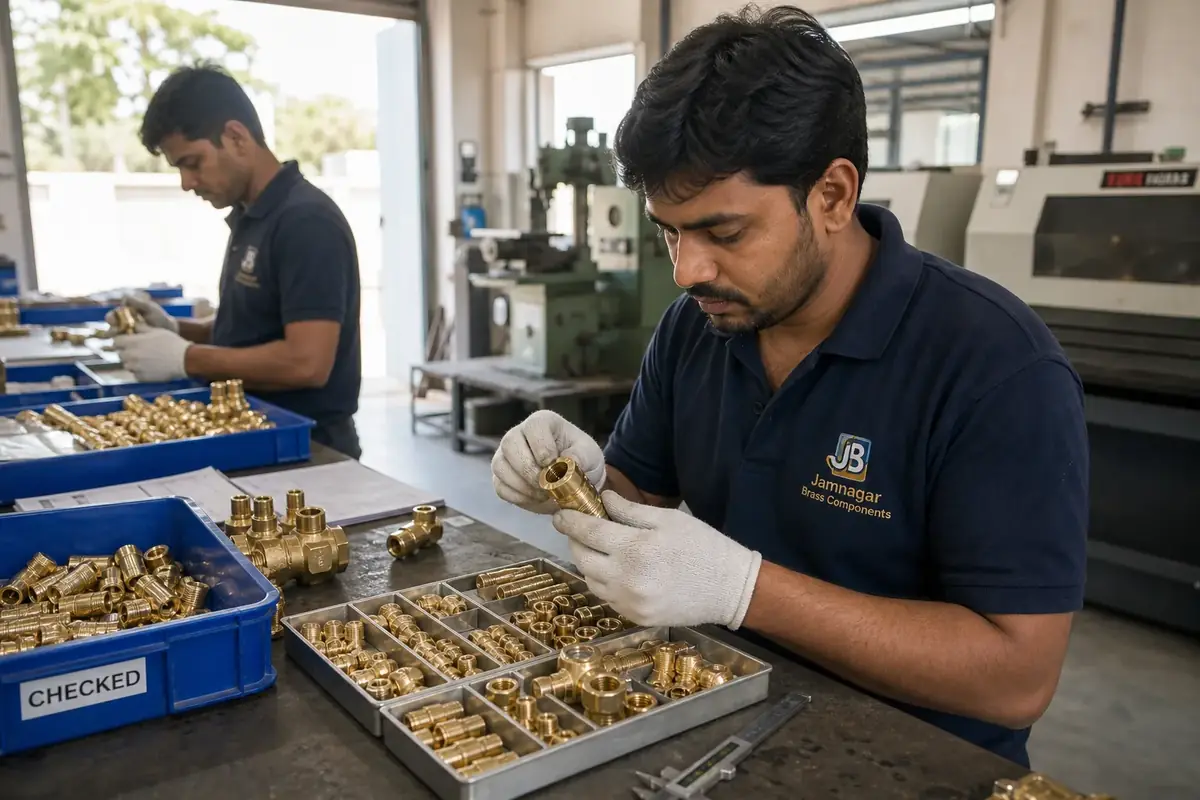
High-speed automatic lathe turning of free-cutting extruded brass bar stock in a Jamnagar production unit.
2. International Material Standards & Metallurgical Alloys
When issuing a Request for Quotation (RFQ) to a Jamnagar supplier, simply specifying "Brass" is the single most common cause of quotation misunderstandings, material rejections, and dimensional failures. Free-cutting brass alloys rely on carefully controlled percentages of Copper (Cu), Zinc (Zn), and Lead (Pb) to achieve chip-breaking properties during high-speed turning without causing tool chatter or micro-cracks.
| Standard / Region | Alloy Designation | Copper (Cu %) | Lead (Pb %) | Machinability | Primary Applications |
|---|---|---|---|---|---|
| ASTM (USA) | C36000 (Free Cutting) | 60.0 – 63.0% | 2.5 – 3.7% | 100% (Baseline) | Automatic screw machine parts, moulding inserts, nipples |
| EN / DIN (Europe) | CW614N (CuZn39Pb3) | 57.0 – 59.0% | 2.5 – 3.5% | 100% | Precision turned engineering fittings, cable glands |
| BS (UK) | CZ121 | 56.5 – 58.5% | 2.5 – 3.5% | 100% | Electrical switchgear terminals, plug pins, anchors |
| IS (India) | IS 319 Grade 1 | 56.0 – 59.0% | 2.0 – 3.5% | 100% | General hardware, brass screws, neutral links |
| Forging Brass | C37700 / CW617N | 57.0 – 59.0% | 1.6 – 2.5% | 75% | Hot pressed valve bodies, elbows, tees, manifolds |
| DZR Brass | CW602N / CZ132 | 61.0 – 63.0% | 1.7 – 2.8% | 85% | Dezincification resistant potable water fittings |
| Lead-Free Brass | C27450 / Eco Brass | 62.0 – 68.0% | < 0.25% | 70% | NSF 61 compliant drinking water components |
3. Sourcing Channel Comparison: How Global Buyers Purchase
When navigating Jamnagar's industrial market, buyers encounter three distinct supply options: direct extrusion foundries, regional merchant exporters, or unified digital catalog portals like Jamnagar.net.
| Parameter | Direct Foundry / Extruder | Merchant Trading House | Jamnagar.net Direct Supply Desk |
|---|---|---|---|
| Unit Pricing Structure | Raw Melt Rate + Extrusion Charge | +15% to 30% Trader Markup | Factory Net Direct Pricing |
| Minimum Order (MOQ) | Very High (1,000+ kg Rod Order) | Medium (5,000 to 10,000 Pcs) | No Minimum Order Restriction |
| Quality Control Protocols | Basic In-House Visual Check | Variable / Often Uninspected | Pre-Shipment Spectro & Thread Gauge QC |
| Drawing & CAD Support | Requires Hard Tooling Samples | None | Full 2D PDF & 3D STEP CAD Review |
| Response Lead Time | 3 to 7 Days | 2 to 4 Days | Same-Day / 4-Hour Response Guarantee |
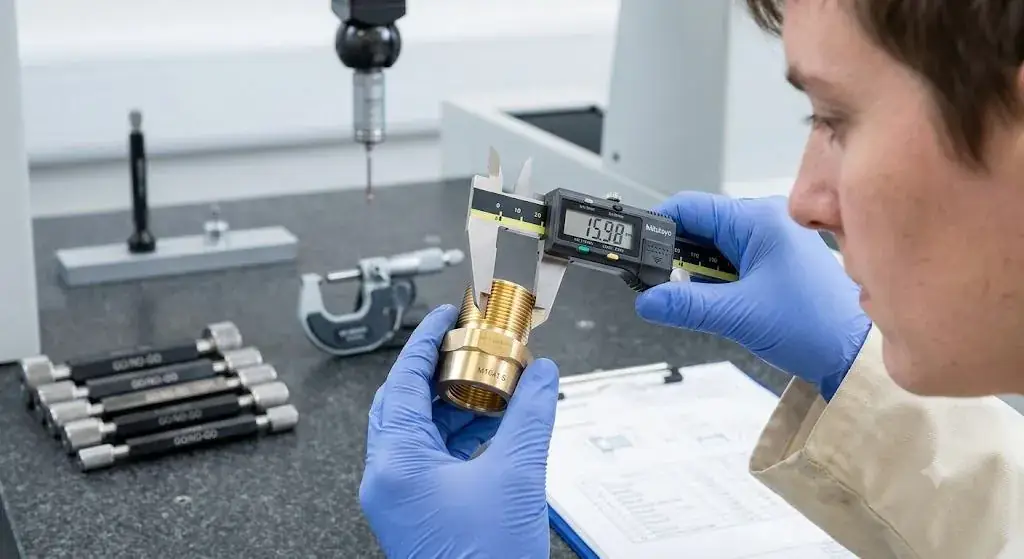
Precision dimensional measurement and thread tolerance checking on custom turned brass hardware.
4. Manufacturing Technology: Cam-Automats vs. CNC Swiss Turning
Jamnagar workshops deploy two main machinery platforms to execute turned component orders. Matching your production run volume and tolerance requirements to the correct machine style avoids paying unnecessary machining penalties:
Cam-Driven Automatic Lathes (Cam-Automats)
Cam automats utilize mechanical steel cams to guide cutting tools into high-speed rotating brass bar stock. They are ideal for high-volume standard components like threaded moulding inserts, terminal screws, and cable gland locknuts due to ultra-fast cycle times (3 to 10 seconds per piece).
- Linear Tolerances: ±0.03 mm to ±0.05 mm
- Best Suited For: High-volume orders (>10,000 pieces)
- Tooling Setup: High initial setup time (custom cam grinding)
Multi-Axis CNC & Swiss Sliding Head Lathes
Swiss-type CNC turning centers feed guide bushings right next to live cutting tools. They excel at complex geometries requiring multi-surface cross-drilling, off-center milling, deep knurling, and ultra-tight tolerances without needing secondary manual deburring.
- Linear Tolerances: ±0.005 mm (5 microns)
- Best Suited For: Complex CAD drawings & short runs
- Tooling Setup: Digital G-code setup with zero custom cams
5. Surface Finishing, Plating Microns & Corrosion Testing
Raw turned brass parts react with atmospheric humidity and oxygen over time, resulting in a dull greenish-brown verdigris tarnish. Electroplating seals the non-ferrous surface, provides electrical arc resistance, prevents galling on threaded connections, and ensures cosmetic consistency:
- Electro-Nickel Plating (3 to 12 Microns): The dominant industry coating for plastic moulding inserts, CPVC pipe fittings, and industrial fasteners. Nickel provides high wear resistance and shields brass from harsh environmental acids.
- Electro-Tin Plating (5 to 15 Microns): Mandatory for electrical switchgear terminals, PCB standoffs, and neutral link blocks. Tin plating provides high electrical conductivity, prevents electrical arc tarnishing, and allows clean soldering.
- Electro-Chrome Plating (Bright & Satin): Primarily applied to sanitary hardware, CP bathroom fittings, and architectural handles for a scratch-resistant, mirror-like silver finish.
- Ultrasonic Degreasing & Passivation: Natural unplated brass components pass through 3-stage alkaline ultrasonic wash tanks to remove cutting oils and swarf, followed by acid passivation to preserve bright natural brass luster.
6. The 4-Phase B2B Procurement Workflow
To ensure seamless execution from initial drawing submission to final warehouse delivery, successful procurement managers follow a structured 4-phase milestone process:
Phase 1: Technical Drawing & Specification Review
Submit your 2D PDF engineering drawing specifying linear tolerances (ISO 2768-m), thread pitch profile (BSP, NPT, Metric), material grade, and surface plating microns, accompanied by a 3D STEP CAD file.
Phase 2: First Article Inspection Report (FAIR) Prototyping
Sample prototypes (5 to 10 pieces) are produced on CNC Swiss-turning centers and dispatched via express air courier (DHL/FedEx) alongside full dimensional inspection reports for physical fitment testing.
Phase 3: Spectro Analysis & Batch Manufacturing
Extruded bar stock is sampled and verified via Optical Emission Spectrometry (OES) to ensure chemical purity before high-speed production begins on automated lathe lines.
Phase 4: Export Packaging & Seaport Logistics
Components are coated with anti-corrosion VCI oil, packed in heavy-duty 25 kg inner boxes, stacked on ISPM-15 fumigated wooden pallets, and loaded into ocean containers at Mundra or Kandla ports.
7. Port Transit Routes & Ocean Freight Lead Times
Jamnagar is directly connected via dedicated national highway freight corridors to two major international deep-water seaports: Port of Mundra (280 km) and Port of Kandla / Deendayal Port (260 km).
| Destination Region | Primary Disembarkation Seaports | Average Ocean Transit Time |
|---|---|---|
| Western Europe | Rotterdam, Hamburg, Antwerp, Felixstowe | 18 to 22 Days |
| North America (East Coast) | New York / New Jersey, Savannah, Houston | 26 to 32 Days |
| North America (West Coast) | Los Angeles, Long Beach, Seattle | 32 to 38 Days |
| Middle East & Gulf (GCC) | Jebel Ali (Dubai), Dammam, Hamad (Qatar) | 4 to 7 Days |
| Southeast Asia & Australia | Singapore, Port Klang, Sydney, Melbourne | 14 to 24 Days |
8. Frequently Asked Questions (FAQ)
Q: Can Jamnagar foundries manufacture lead-free brass components?
Yes, local foundries extrude silicon-brass and bismuth-brass alloys (such as C27450) compliant with US NSF/ANSI 61 and EU RoHS 3 drinking water standards.
Q: What payment terms are standard for international B2B orders?
Standard terms are 30% advance deposit upon drawing confirmation and 70% balance against copy of Bill of Lading (B/L) or Irrevocable Letter of Credit (L/C at sight).
Q: What is the typical production lead time for custom turned brass parts?
Sample prototypes take 5 to 7 days. Full production runs (10,000 to 50,000 pieces) typically ship within 14 to 21 days from drawing and sample confirmation.
Q: How do I ensure raw material chemical purity when importing from India?
Always request an EN 10204 Type 3.1 Material Test Certificate backed by Optical Emission Spectrometry (OES) testing with every shipment batch.
Looking for Custom Brass Components Direct from Jamnagar?
Browse standard production items or submit your 2D/3D engineering drawing to receive direct factory pricing with no minimum order restriction on Jamnagar.net.