Brass Threaded Moulding Inserts: Knurling Dynamics, Pull-Out & Torque-Out Strength
Highlights:
- Choose in-mould, ultrasonic/heat-stake, or cold press-in install methods.
- Match knurl (diamond vs straight) to pull-out vs torque-out loads.
- Keep boss wall thickness adequate (often t ≥ 0.8 × outer diameter).
- Control hole taper and pilot diameter for consistent melt/press fit.
Related reading: insert manufacturers in Jamnagar and alloy selection for free-cutting inserts.
1. Introduction: Why Engineering Plastics Require Threaded Brass Anchors
Modern engineering thermoplastics—such as Polycarbonate (PC), Polyamide (PA66-GF30), Acrylonitrile Butadiene Styrene (ABS), and Polypropylene (PPR)—offer exceptional strength-to-weight ratios and design flexibility. However, polymers exhibit relatively low shear strength and poor resistance to creep under sustained mechanical thread loads.
Cutting threads directly into plastic boss holes with self-tapping screws works for single-use consumer products. However, if the joint requires repeated disassembly during maintenance, high assembly tightening torque, or exposure to elevated fluid pressures (such as CPVC plumbing manifolds), plastic threads rapidly strip, gall, and fail catastrophically.
Precision turned brass moulding inserts bridge this material gap. By embedding a hard, corrosion-resistant, high-precision brass insert (ASTM C36000 or EN CW614N) into the polymer structure, the assembly combines the lightweight advantages of plastic with the high torque capacity and infinite thread cycle life of precision-machined brass.
2. External Knurling Geometry: Diamond, Straight, and Undercut Flanges
The external surface geometry of a brass insert is engineered specifically to lock into the surrounding plastic matrix when subjected to operational forces. The two main forces attempting to dislodge an insert are Rotational Torque (T_q) during screw tightening and Axial Tensile Pull-Out (F_p) under clamp loads.
Different external turned features resist specific force vectors:
Straight / Parallel Knurling (DIN 82 RAA)
Straight longitudinal teeth run parallel to the insert axis. As molten plastic or heat-softened polymer fills the vertical tooth valleys, it forms a high-strength mechanical keyway that provides maximum resistance against rotational torque-out (T_q).
- Primary Resistance: Rotational Torque
- Pitch Range: 0.5 mm to 1.2 mm
- Best For: High assembly screw torque
Diamond Cross Knurling (DIN 82 RGE)
Intersecting diagonal ridges (30° or 45° angles) form a raised pyramidal diamond grid. Diamond knurling provides balanced resistance against both rotational torque-out and axial pull-out forces.
- Primary Resistance: Combined Torque & Pull
- Pattern: Male or Female Diamond Grid
- Best For: General-purpose heat-staking
Annular Grooves & Undercut Flanges
Deep circumferential turned grooves (90° or 45° undercuts) perpendicular to the axis force plastic to flow into solid ring barriers. Annular undercut grooves provide maximum resistance against axial tensile pull-out (F_p).
- Primary Resistance: Axial Pull-Out Force
- Geometry: Deep turned neck grooves
- Best For: High tensile bolt loads
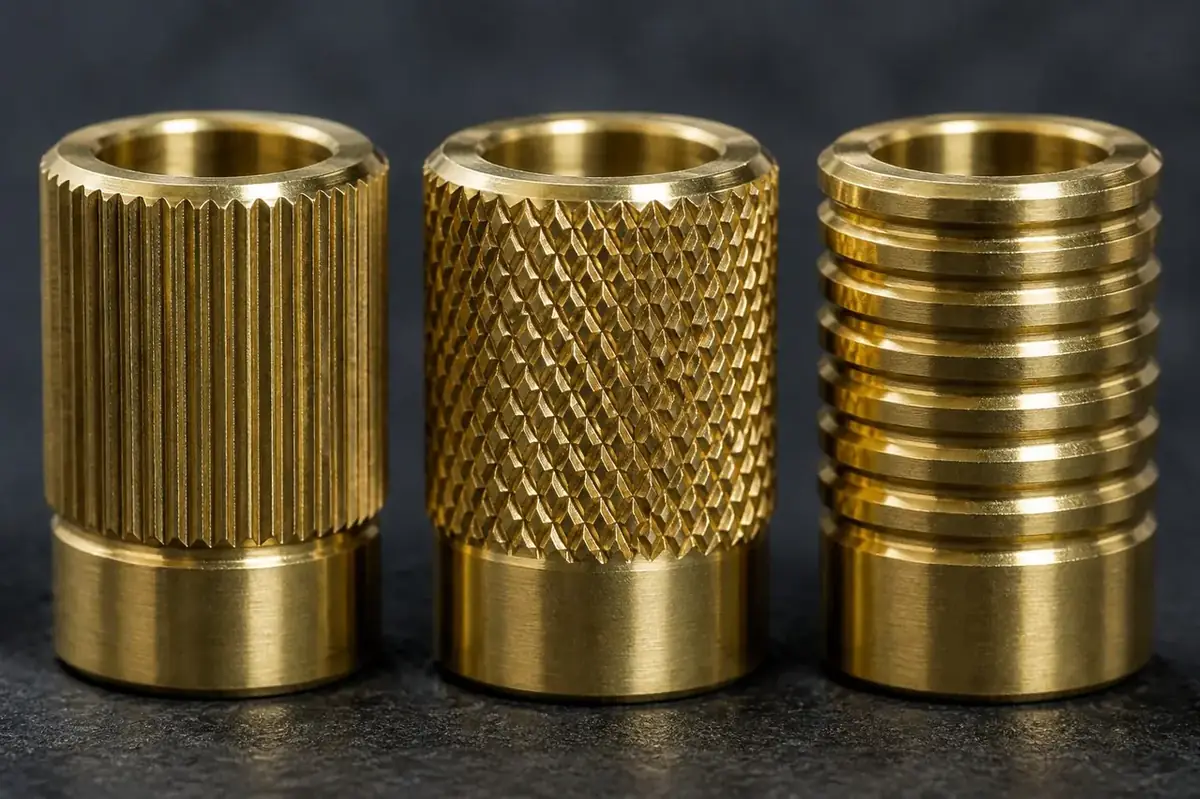
Macro view of high-precision turned brass inserts in Jamnagar illustrating straight knurling (RAA), male diamond knurling (RGE), and deep axial undercut grooves.
3. Calculation Models for Pull-Out Force and Torque-Out Resistance
When engineering a plastic boss housing for a brass insert, structural engineers calculate theoretical mechanical failure limits using polymer shear strength equations:
1. Axial Pull-Out Force Calculation (F_p)
Axial pull-out failure occurs when the applied tensile bolt load exceeds the shear strength of the polymer trapped within the insert's undercut groove flanges:
F_p = pi cdot D_o cdot L_g cdot taupolymer
- F_p: Ultimate Tensile Pull-Out Force (Newtons, N)
- D_o: Major Outer Diameter over Knurl/Flange (mm)
- L_g: Total Effective Contact Engagement Length of Undercut Grooves (mm)
- taupolymer: Ultimate Shear Strength of the Host Polymer (N/mm² or MPa)
2. Rotational Torque-Out Resistance Calculation (T_q)
Torque-out failure occurs when screw tightening torque shears the vertical plastic keys interlocking with the straight or diamond knurl teeth:
T_q = fracpi cdot D_o² cdot L_k cdot taupolymer cdot K_f2000
- T_q: Ultimate Torque-Out Resistance (Ncdotm)
- L_k: Axial Length of the Knurled Section (mm)
- K_f: Knurl Profile Efficiency Factor (0.85 for Diamond, 1.15 for Deep Straight Knurls)
4. Installation Technologies: Ultrasonic vs. Heat-Staking vs. In-Mould
Selecting the installation method depends on polymer type (Thermoplastic vs. Thermoset), production volume, and internal stress tolerance:
| Method | Process Mechanics | Best Polymer Compatibility | Internal Stress Level | Cycle Time per Part |
|---|---|---|---|---|
| Heat-Staking (Thermal) | A heated metal probe heats the brass insert (150°C-300°C). The warm insert melts surrounding plastic as it is pressed into the boss hole. | All Amorphous & Crystalline Thermoplastics (ABS, PC, PA66) | Low (Uniform stress-relieved melt zone) | 2 to 5 Seconds |
| Ultrasonic Insertion | An ultrasonic horn vibrates the insert at 20 kHz or 40 kHz. Frictional heat at the brass-plastic interface localized-melts polymer during insertion. | Rigid Thermoplastics (PC, ABS, Acrylic, Polystyrene) | Medium (Frictional acoustic resonance) | < 1.0 Second (Ultra-Fast) |
| In-Mould (Insert Moulding) | Inserts are placed directly onto core pins inside the open injection mold. High-pressure molten plastic encapsulates the insert during moulding. | Thermosets (Bakelite, Epoxy) & Heavy Thermoplastics (CPVC, PPR) | High (Mould shrinkage stresses around brass) | Integrated with Injection Cycle (0 sec extra) |
| Cold Press-In / Expansion | Cold insert with sharp barb knurls is pressed mechanically into pre-moulded hole. Screw insertion expands the insert body, biting into plastic. | Soft Ductile Plastics (Polyethylene, Polypropylene, Foams) | Very High (Hoop stress can crack thin bosses) | 1 Second |
5. Polymer Compatibility & Annular Boss Design Rules
Even the highest-quality turned brass insert will fail or crack the host product if the plastic boss housing is incorrectly proportioned.
When plastic cools and shrinks around a brass insert, high circumferential tensile stress (hoop stress) develops within the plastic wall. If the boss wall is too thin, hoop stress exceeds the polymer yield point, causing environmental stress cracking (ESC) weeks after assembly.
Design for Manufacturability (DFM) Rules for Plastic Bosses
- Boss Outer Diameter Ratio (Dboss): The boss outer diameter should equal at least 2.0 × D_o (twice the insert major diameter). For stress-sensitive unfilled polymers (like Polycarbonate), use 2.5 × D_o.
- Pre-Moulded Hole Taper (1° to 2°): Holes for heat-staking or ultrasonic insertion should feature a 1° to 2° draft angle to assist core pin ejection during moulding. The top diameter of the hole should equal the insert major knurl diameter (D_o), while the bottom hole diameter matches the body pilot root diameter (D_p).
- Boss Hole Depth (Hhole): Always make the boss hole depth deeper than the insert length (Hhole ge Linsert + 1.0 mm). This extra space accommodates melted plastic flash overflow and prevents screw bottoming.
- Counter-Bore Pilot Chamfer: Specify an unknurled pilot guide lead-in (0.5 mm length) at the bottom of the brass insert to align the insert vertically in the hole before heating or vibration begins.
6. Standard Insert Styles & Engineering Dimensions
Jamnagar contract machine shops produce eight standardized insert configurations recognized across international CAD libraries:
| Insert Style Code | Geometry Features | Primary Installation Method | Typical Applications |
|---|---|---|---|
| Type I1 (Symmetrical Straight) | Dual diamond knurl bands with central undercut ring. Symmetrical (no top/bottom orientation required). | Ultrasonic / Thermal Heat-Staking | High-speed automated bowl-feed assembly lines |
| Type I2 (Head Flanged) | Large top collar flange with diamond body knurling. Provides massive reverse axial pull-through area. | Heat-Staking / In-Moulding | Electrical terminal blocks, high-load structural joints |
| Type I3 (Opposed Opposing Knurl) | Two distinct knurl bands with opposing 45° helical angles separated by a central neck ring. | Thermal Heat-Staking | Automotive engine sensors & computer enclosures |
| Type I4 (CPVC / PPR Heavy Male) | Heavy turned hexagonal outer body with multiple deep anchor undercuts and external BSP/NPT threads. | In-Mould Insert Moulding (High Pressure) | CPVC / PPR hot and cold water pipe fittings and elbows |
| Type I5 (Expansion Slotted) | Split flexible body with sharp external directional barbs and internal expansion taper. | Cold Mechanical Press-In | Thermoset Bakelite hardware & soft elastomeric plastics |
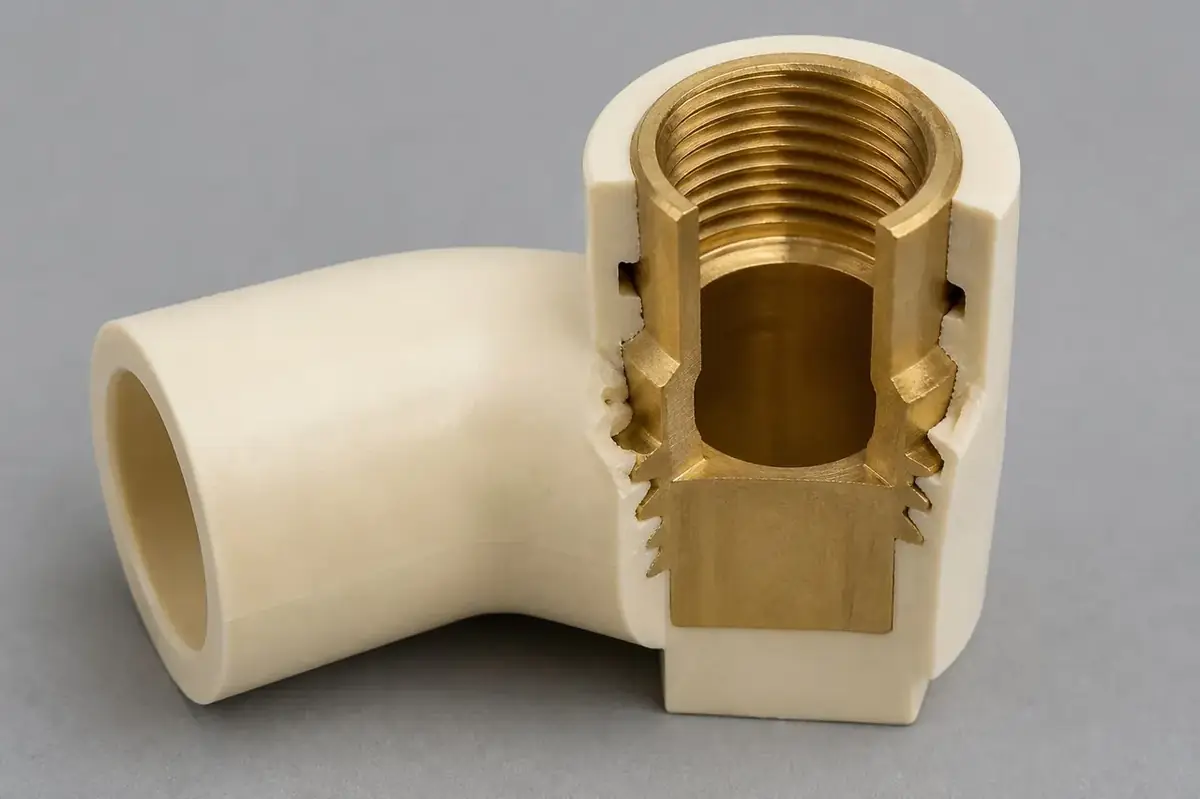
Heavy-duty turned brass male fitting insert with deep circumferential undercuts over-moulded inside a high-pressure CPVC plumbing elbow.
7. Common Insert Defects & Quality Control Protocols
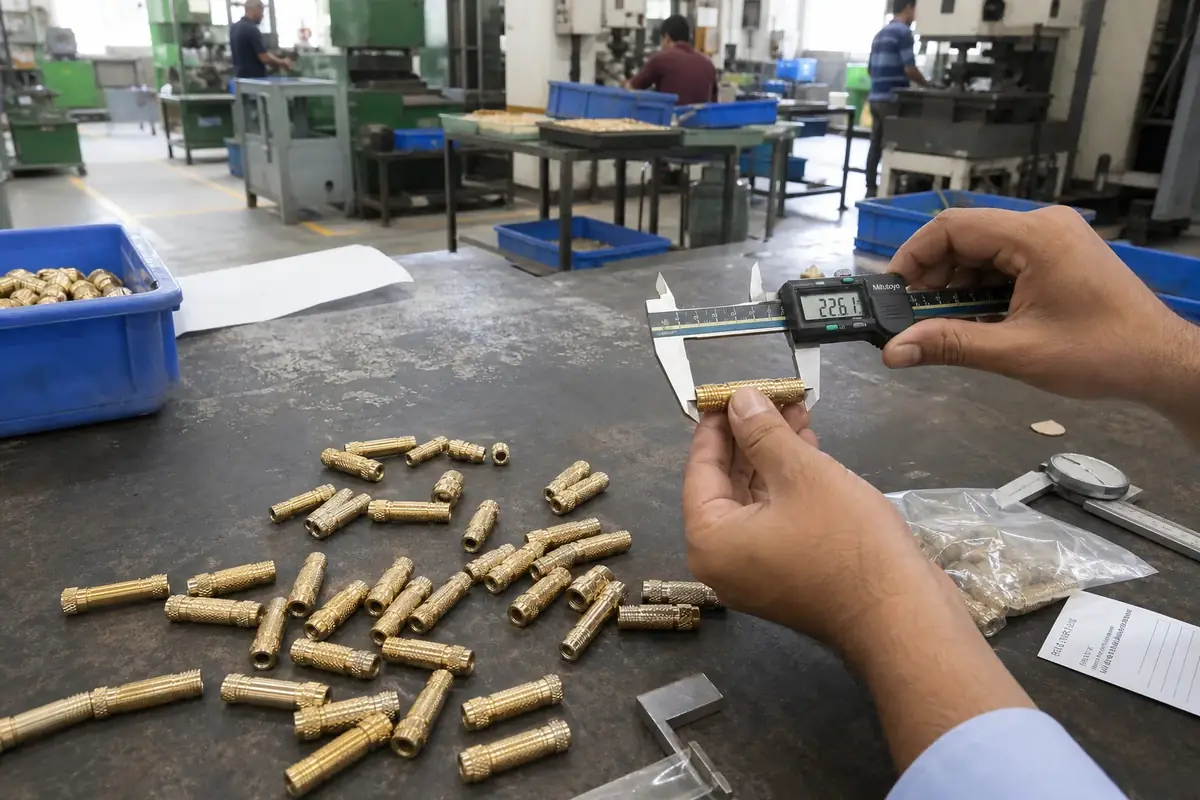
When importing turned brass moulding inserts, quality inspectors must audit four critical physical parameters:
Defect 1: Internal Thread Flash Ingress
During in-mould insert moulding, high-pressure liquid polymer (200+ bar) can seep past core pins into internal threads. Preventive QC: Specify precision internal chamfers (± 0.02 mm) on insert face rims that form a liquid-tight metal-to-metal seal against core pin shoulders.
Defect 2: Internal Thread Burr Contamination
Fine tapping burrs trapped inside threads cause mating bolts to cross-thread or bind during assembly. Preventive QC: Enforce 100% ultrasonic washing and automated optical vision sorting to reject burred parts.
Defect 3: Micro-Cracking Due to Excess Plating Hydride Embrittlement
Improper electro-nickel plating bath chemistry can weaken thin-walled inserts. Preventive QC: Verify plating micron thickness (5 to 8 mum) via XRF testing and enforce 3-hour post-plating thermal stress-relief baking at 180°C.
8. Frequently Asked Questions (FAQ)
Q: What material certification should be requested when ordering inserts for drinking water CPVC fittings?
Potable water pipe inserts must be certified Lead-Free (≤ 0.25% Pb) under NSF/ANSI/CAN 61 and NSF 372 standards, manufactured from lead-free alloys like C27450 or Eco Brass C69300 with an EN 10204 3.1 Spectro MTC.
Q: What is the recommended minimum wall thickness for a plastic boss housing a brass insert?
As a general DFM rule, the plastic boss wall thickness should equal at least 0.8 to 1.0 × D_o (where D_o is the major outer diameter of the insert). For stress-sensitive materials like Polycarbonate, increase wall thickness to 1.25 × D_o.
Q: Which knurl pattern offers higher rotational torque resistance: Diamond (RGE) or Straight (RAA)?
Straight (RAA) longitudinal knurling provides up to 30% higher rotational torque resistance (T_q) than diamond knurling because the vertical teeth form direct mechanical keyways against rotation. Diamond knurling provides a balanced combination of torque and pull-out resistance.
Q: Why are brass inserts preferred over aluminum or stainless steel inserts for plastic moulding?
Free-cutting brass (C36000) offers superior machinability (100% rating), allowing complex knurls, undercuts, and threads to be turned in 3 to 5 seconds per part. Furthermore, brass exhibits high thermal conductivity, allowing rapid heat-transfer during thermal heat-staking.
Need Custom Turned Brass Moulding Inserts?
Browse standard symmetrical, flanged, and CPVC pipe inserts, or submit your custom CAD drawing for direct factory net pricing with no minimum order restriction on Jamnagar.net.