Brass Fasteners, Screws, Bolts & Expansion Anchors: DIN / ISO Engineering & Procurement Manual

Highlights:
- Cold heading/thread rolling for volume screws; CNC for custom studs.
- Cite DIN/ISO part numbers and tensile/shear requirements clearly.
- Isolate galvanic couples when fastening into steel or aluminium.
- Pick passivation, nickel, or other finishes for marine/electrical duty.
Related reading: threading standards guide and plating and passivation options.
1. Executive Overview: Jamnagar's Non-Ferrous Fastener & Anchor Manufacturing Hub
In the mechanical joining and structural fastening industry, steel and stainless steel dominate general structural steelwork. However, in applications requiring high electrical conductivity, anti-magnetic performance, zero-spark hazard in explosive gas zones, natural corrosion resistance, or decorative architectural appeal, non-ferrous brass fasteners are non-negotiable.
Jamnagar processes thousands of metric tons of free-cutting brass rod (ASTM C36000 / EN CW614N) and cold-heading wire (CuZn37 / CW508L) monthly. Hundreds of specialized workshops operate high-speed cold headers, thread rollers, automatic bar turners, and Swiss multi-axis CNC machines producing standard DIN/ISO machine screws, hex head bolts, full-thread studs, winged nuts, plain washers, and heavy-duty masonry expansion anchors.
Global buyers source non-ferrous fasteners directly from Jamnagar to leverage total supply chain integration—where raw scrap recycling, wire drawing, cold heading, roll threading, electroplating, and sea-freight packing exist within a tight 5-mile radius—reducing overall unit procurement costs by 25% to 40% compared to European fastener houses.
2. Manufacturing Pathways: Cold Heading vs. Precision Bar Turning
Fasteners produced in Jamnagar are manufactured via two distinct production pathways depending on head shape complexity, volume, and dimensional tolerances:
1. High-Speed Cold Heading & Roll Threading
Ductile cold-heading brass wire (such as CuZn37 / CW508L) is fed at room temperature into multi-station cold headers. A punch die strikes the wire end, upset-forming the screw head (Cheese head, Countersunk, or Hex head) in a fraction of a second without cutting metal away.
Unthreaded shanks pass between two reciprocating flat thread rolling dies. Cold pressure deforms the brass, forming burnished 60° threads. Cold-rolled threads exhibit 20% higher fatigue strength and smoother surface finish (Ra < 0.4 mum) than cut threads.
- Production Speed: 100 to 350 pieces per minute
- Material Scrap Loss: Zero (Zero chip waste)
- Best For: High-volume standard machine screws (M2 to M10)
2. Precision CNC & Automatic Lathe Turning
Free-cutting brass hex or round bar stock (ASTM C36000 / CW614N) is turned on automatic lathes or multi-axis Swiss CNC turning centers. Carbide cutting tools turn complex head geometries, undercuts, special thread pitches, internal bores, and knurling in a single continuous machining cycle.
Turning is essential for heavy masonry expansion anchors, special architectural bolts, non-standard thread pitches, and low-to-medium batch orders where cold-heading die setup costs are unfeasible.
- Linear Precision: Ultra-Tight (± 0.005 mm)
- Material Scrap Loss: Chip scrap recycled in local foundries
- Best For: Masonry anchors, special studs, low MOQs
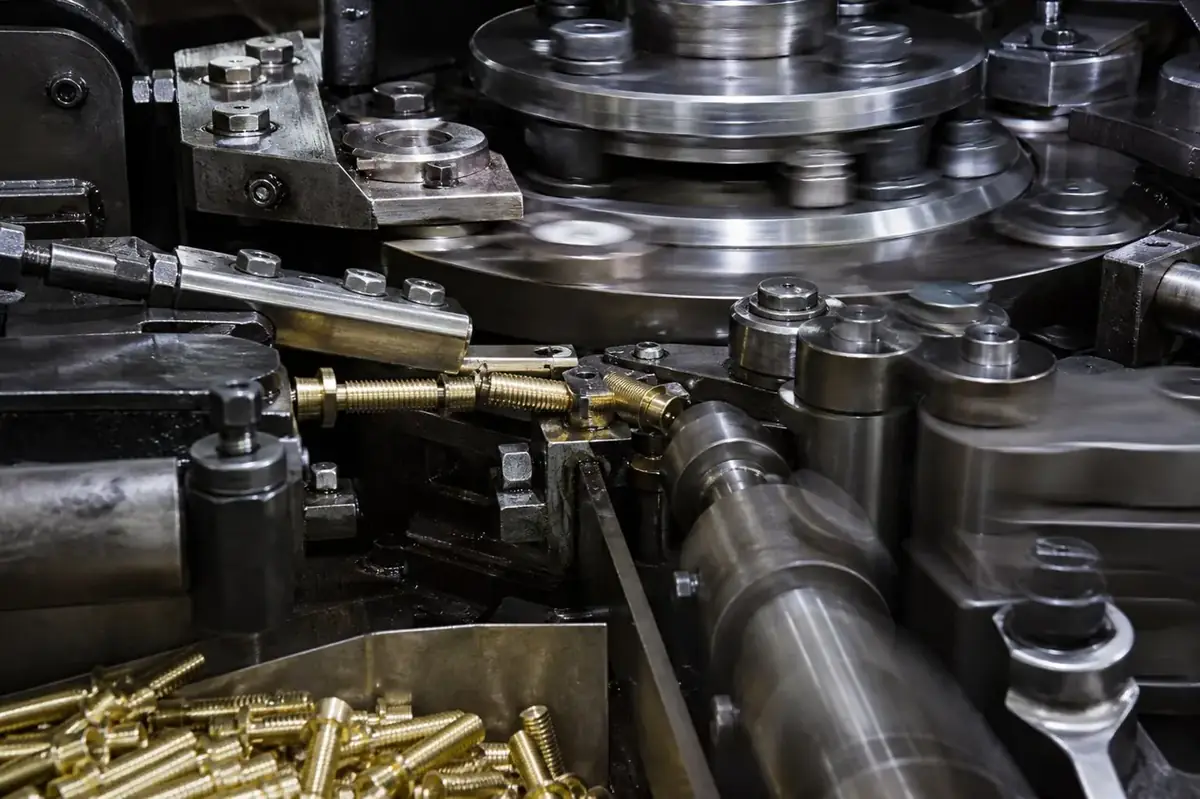
High-speed cold heading station upset-forming brass machine screw heads followed by precision flat-die thread rolling in a Jamnagar fastener plant.
3. Master DIN / ISO Fastener Standard Cross-Reference Matrix
When issuing purchase orders to Jamnagar fastener desks, specifying standard German DIN or international ISO numbers ensures precise head dimensions, drive slots, and thread pitch tolerances:
| DIN Standard | ISO Equivalent | Fastener Description & Geometry | Drive / Head Style | Primary Application Field |
|---|---|---|---|---|
| DIN 84 | ISO 1207 | Slotted Cheese Head Machine Screws | Cylindrical Head / Straight Slot | Electrical switchgear, relay boxes, instrument panels |
| DIN 85 | ISO 1580 | Slotted Pan Head Machine Screws | Rounded Pan Head / Straight Slot | General machinery, electrical terminal clamping |
| DIN 963 | ISO 2009 | Slotted Flat Countersunk Head Screws | 90° Countersunk Head / Slot | Flush surface mounting, hinges, marine cabinetry |
| DIN 7985 | ISO 7045 | Cross-Recessed Pan Head Screws | Pan Head / Phillips (PH) or Pozidriv (PZ) | High-speed automated assembly lines, consumer electronics |
| DIN 933 | ISO 4017 | Hexagon Head Bolts (Full Thread) | External Hexagon / Wrench Drive | Heavy marine bolted joints, busbar connections, valves |
| DIN 931 | ISO 4014 | Hexagon Head Bolts (Partial Thread / Plain Shank) | External Hexagon / Plain Shank | Structural shear joint assemblies, pump flanges |
| DIN 934 | ISO 4032 | Hexagon Full Nuts | Standard Internal Threaded Hex Nut | Universal mating nut for DIN 933 / DIN 975 studs |
| DIN 125A | ISO 7089 | Plain Flat Washers (Form A) | Flat Circular Ring (Unchamfered) | Load distribution under bolt heads and hex nuts |
| DIN 975 / 976 | N/A | Threaded Rods / All-Thread Studs (1m / 2m Lengths) | Continuous 60° Metric Roll-Thread | HVAC pipe suspension, electrical cable tray hanging |
| DIN 315 | N/A | Wing Nuts (American / German Style) | Dual Hand-Wing Butterfly Ears | Hand-tightened battery terminals, temporary fixtures |
4. Industrial Expansion Anchors: Drop-In, Wedge, Shield & Chemical Studs
In construction, MEP (Mechanical, Electrical, Plumbing) contracting, and sanitary installation, turned brass expansion anchors are the premier choice for securing heavy loads into concrete, brickwork, and solid stone.
Unlike steel anchors which rust when exposed to moisture inside concrete drill holes, turned brass anchors are naturally impervious to corrosion, preventing rust expansion stains on building facades. Jamnagar produces four specialized expansion anchor styles:
1. Brass Drop-In Knurled Anchors (Internal Taper Cone)
Features a cylindrical turned brass body with deep external diamond knurling and four longitudinal expansion slots. An internal solid turned brass expander cone sits at the bottom of the internal thread.
Mechanics: A setting tool strikes the internal cone, driving it downward. The cone forces the four slotted segments outward, driving the outer diamond knurls into the concrete drill hole wall for high friction grip.
2. Brass Wedge Anchors (Through-Bolts)
Consists of a full-thread turned brass stud with an integral bottom expansion neck and a stainless steel or brass expansion clip ring.
Mechanics: As the top hex nut is torqued, the stud's bottom tapered neck is pulled upward into the clip ring, wedging the clip tightly against the concrete wall. Ideal for heavy structural shear loads.
3. Brass 3-Piece & 4-Piece Shield Anchors
Comprises three or four heavy cast/turned brass shell segments held together by a steel spring ring around a central square expander nut.
Mechanics: Tightening the central hex bolt draws the square nut upward, expanding all four shell segments uniformly over a massive contact area. Ideal for weaker masonry, hollow brick, and porous stone.
4. Brass Sanitary Fixture Anchors (Wood Thread x Metric Thread)
Dual-threaded turned studs featuring a coarse wood/masonry lag thread on one end and a metric machine thread (M8 or M10) on the other. Paired with a nylon expansion plug and collar nut, it is the global standard for mounting ceramic washbasins and wall-hung toilets.
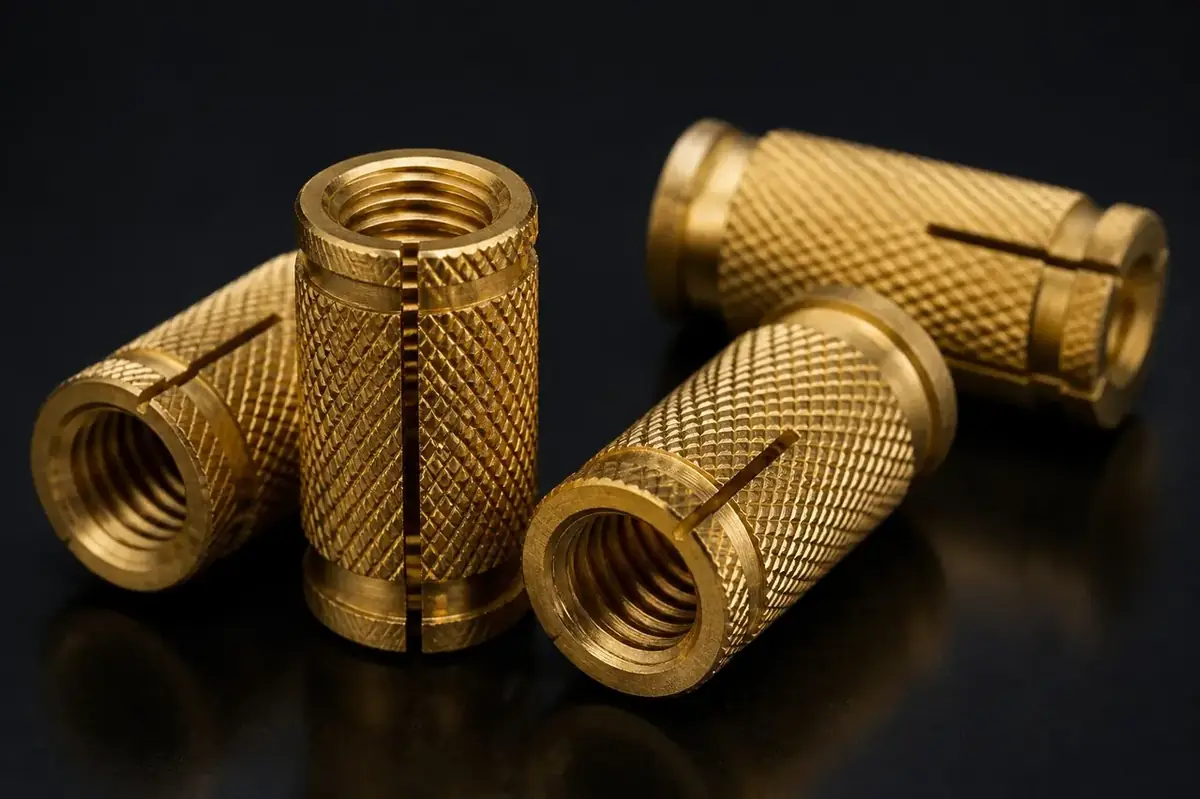
Turned brass drop-in expansion anchors featuring deep external diamond knurling, four-way expansion slots, and internal metric thread for heavy concrete anchor loads.
5. Mechanical Proof Load & Thread Shear Strength Calculation
To prevent bolt shank tensile breakage or nut thread stripping during high-torque assembly, structural engineers calculate the Tensile Stress Area (A_s) and Proof Load (F_p) of metric brass fasteners:
1. Tensile Stress Area (A_s) & Proof Load Formula (F_p)
The effective tensile stress area of a threaded metric bolt shank is determined by pitch diameter (d₂) and minor diameter (d₃):
A_s = fracpi4 cdot ( fracd₂ + d₃2 )²
F_p = A_s cdot sigma_p
- A_s: Effective Tensile Stress Area of Thread (mm²)
- d₂: Pitch Diameter of External Metric Thread (mm)
- d₃: Minor Core Diameter of External Metric Thread (mm)
- F_p: Maximum Safe Non-Yielding Proof Load (Newtons, N)
- sigma_p: Proof Stress Rating of Brass Alloy (MPa), typically 220 to 280 MPa for half-hard brass
Engineering Benchmark: An M8 × 1.25 brass bolt (A_s = 36.6 mm²) turned from half-hard CW614N brass (sigma_p = 240 MPa) delivers a safe tensile proof load of F_p = 36.6 × 240 = 8,784 N (8.78 kN).
6. Galvanic Corrosion Isolation: Bolting Dissimilar Metals
When brass fasteners are used to bolt together dissimilar metals—such as aluminum structures, structural steel, or stainless steel plates—in moist or marine environments, galvanic corrosion can occur.
Under the Anodic Galvanic Series in seawater, brass has an electrode potential of approximately -0.24 V. When brass fasteners directly touch structural aluminum (potential -0.75 V or 3000-series alloys) in the presence of an electrolyte (salt spray or rainwater), the aluminum acts as a sacrificial anode and rapidly corrodes away around the brass bolt hole.
Galvanic Isolation Best Practices for Brass Fasteners
- Bolting Brass to Copper or Bronze: Ideal compatibility. Potential difference is <0.05 V. No galvanic corrosion occurs in outdoor marine air.
- Bolting Brass to Structural Steel: Moderate potential difference (0.25 V). Use non-conductive nylon/PTFE flat washers under bolt heads and hex nuts to break electrical contact.
- Bolting Brass to Aluminum Plates: High potential difference (0.50+ V). Mandatory to install non-conductive top hat shoulder bushings (nylon sleeve washers) to completely isolate the brass shank from touching aluminum hole walls.
- Electro-Tin Plating Mitigation: Electro-tin plating (8 to 12 mum Sn) on brass bolts lowers the surface potential step, significantly reducing galvanic reaction rates against steel and aluminum.
7. Packaging, Thread Protection & Export Container Logistics
Because turned brass is softer than hardened steel, improper packaging during 30-day ocean container transit can cause thread nicking and cosmetic bruising as parts rub together.
Jamnagar fastener exporters utilize structured 4-tier export packaging protocols:
1. Inner Box & Small Polybag Unit Kitting
Small machine screws (M2 to M6) and hex nuts are count-packed into 100-piece or 500-piece heavy-duty 100 mum polybags or printed white inner cardboard boxes. Long threaded rods (1m) are individually plastic-sleeved.
2. VCI Anti-Corrosion Desiccant Protection
Vapor Corrosion Inhibitor (VCI) active paper or VCI polybags are placed inside every inner box, accompanied by silica gel desiccant packs to absorb sea-freight humidity and prevent surface tarnish during ocean transit.
3. Heavy Master Outer Cartons (20 kg to 25 kg)
Inner boxes are packed into 5-ply or 7-ply heavy corrugated master export cartons sealed with reinforced plastic strapping. Master carton weights are capped at 25 kg for safe manual warehouse handling.
4. ISPM-15 Fumigated Wooden Pallet Stacking
Master cartons are shrink-wrapped and plastic-strapped onto ISPM-15 heat-treated/fumigated wooden pallets (1,000 kg max load per pallet) for forklift loading into FCL sea containers at Mundra Port.
8. Printable Pre-Shipment Fastener Quality Audit Checklist
Enforce this 6-point quality audit checklist prior to approving brass fastener and anchor orders from Jamnagar:
Raw Material Spectro Audit: Confirm EN 10204 3.1 Spectro report verifies free-cutting brass (Cu 57-59%, Pb 2.5-3.5%) for turned parts or cold-heading brass (Cu 62-65%, Pb ≤ 0.10%) for headed screws.
Thread Pitch & Fit Check: Check 100% of sampled male bolt threads and female nuts using calibrated Go/No-Go thread ring/plug gauges (Class 6g/6H fit).
Head Drive Recess Depth & Fit: Audit Phillips (PH) or Pozidriv (PZ) slot recess depth using ISO penetration gauges to ensure screwdriver bit engagement without cam-out slipping.
Tensile Proof Load Testing: Perform destructive axial tensile pull tests on bolt samples using universal testing machines to confirm non-yielding proof load (F_p).
Plating Thickness Verification: Audit electro-nickel or electro-tin coating thickness (5 to 8 mum) using non-destructive XRF analyzers.
Drop-In Anchor Expansion Setting Test: Test drop-in expansion anchors in C20/25 concrete test blocks to verify internal cone expansion setting and ultimate pull-out force (F_p ≥ 4.5 kN for M8 anchor).
9. Frequently Asked Questions (FAQ)
Q: What DIN standard governs full-thread brass hexagon bolts?
DIN 933 (ISO 4017) specifies full-thread hexagon head bolts, while DIN 931 (ISO 4014) specifies partial-thread hexagon head bolts with an unthreaded plain shank section under the head.
Q: What is the main difference between cold-headed machine screws and turned brass screws?
Cold-headed machine screws are upset-formed from ductile wire at high speeds (100-350 pcs/min) with roll-formed threads and zero chip waste, making them ultra-cost-effective for high volumes. Turned screws are machined from bar stock on CNC lathes, offering tighter linear tolerances (± 0.005 mm) and custom head shapes for low-to-medium volumes.
Q: How does a brass drop-in knurled expansion anchor work in concrete?
A brass drop-in anchor features a cylindrical knurled body with four longitudinal expansion slots and an internal tapered brass cone. Striking the internal cone with a punch drives it downward, expanding the four slotted shell segments and forcing the outer diamond knurls to grip into the concrete drill hole wall.
Q: What galvanic potential precautions should be taken when bolting brass bolts to aluminum plates?
Direct contact between brass (potential -0.24V) and aluminum (potential -0.75V) causes rapid sacrificial corrosion of the aluminum in moist conditions. Always install non-conductive nylon/PTFE flat washers and shoulder sleeve bushings to electrically isolate the brass bolt from touching the aluminum plate.
Need High-Precision Brass Fasteners & Masonry Anchors?
Explore our complete range of DIN 84/85/933/934 machine screws, hex bolts, nuts, DIN 975 threaded rods, and drop-in expansion anchors available with direct factory net pricing on Jamnagar.net.