Export Packaging, Sea Freight Logistics & Customs Clearance for Jamnagar Brass Hardware: ISPM-15, VCI Protection & Port Clearance Guide
Quick Lookup:
- Use VCI film/paper and desiccants against salt air and container rain.
- Build 4-tier packs: polybags → inner boxes → 7-ply cases → ISPM-15 pallets.
- Correct HS codes, Incoterms, and Mundra/Kandla booking cut clearance delays.
- Protect threads and plating from vibration damage during 20–45 day ocean transit.
Related reading: sourcing from Jamnagar and Jamnagar industrial ecosystem.
1. Environmental Threats During Ocean Transit: Corrosion, Condensation & Battering
When a 20-foot or 40-foot Full Container Load (FCL) of turned brass hardware is sealed at a Jamnagar factory and trucked to the deep-water Port of Mundra or Port of Kandla, it embarks on a maritime journey across equatorial ocean routes.
During ocean transit, shipping containers experience severe micro-climatic shifts. During tropical daylight hours, sunlight heats the steel container ceiling to over 60°C, evaporating residual moisture trapped inside wooden pallets and cardboard packaging. As ambient temperatures drop rapidly at night, the internal air reaches its dew point, causing water droplets to condense on the cold steel roof and drip down onto export cartons—a phenomenon known in maritime logistics as "Container Rain."
If turned brass components are packed in basic unsealed cardboard without chemical corrosion barriers, moisture and ambient oxygen react with copper atoms, triggering rapid surface tarnish, verdigris oxidation (CuCO₃), and water spotting that destroys cosmetic appearance and ruins electro-plated nickel/tin finishes.
The 4 Primary Maritime Hazards for Turned Brass Shipments
- 1. "Container Rain" & Dew Point Condensation: Temperature cycling creates internal condensation dripping, leading to surface oxidation, water spots, and carton collapse.
- 2. Salt Air Marine Atmosphere (High Electrolyte Exposure): Saline air penetrating container door gaskets accelerates galvanic and atmospheric corrosion on bare and plated brass.
- 3. Thread-to-Thread Impact Battering: Heavy turned brass components (8.5 g/cm³ density) shifting inside loose boxes cause pitch thread nicks, burred lead-in chamfers, and bruised hex corners.
- 4. Forklift Crush & Pallet Collapse: High-density metal shipments (1,000 kg per pallet) subject lower cardboard boxes to extreme static stacking compression inside rolling ocean vessels.
2. VCI Chemistry & Desiccant Protection: Eliminating Surface Oxidation
To guarantee that turned brass components arrive at destination assembly lines with bright natural brass luster or pristine electroplated finishes, Jamnagar exporters utilize Volatile Corrosion Inhibitor (VCI) active packaging technology.
VCI packaging materials (VCI polybags, VCI kraft paper liners, or VCI emitter chips) are impregnated with specialized non-toxic organic nitrite salts. Inside a sealed package, the VCI chemicals vaporize slowly, filling the enclosed airspace with invisible anti-corrosion protective vapor.
How VCI Protection Works on Brass Surfaces
VCI Vapor Molecules longrightarrow Adsorb onto Brass Surface longrightarrow Form Monomolecular Passivation Shield (1–2 Nanometers)
The monomolecular VCI film neutralizes oxygen and moisture at the metal surface, blocking the electrochemical reaction that produces copper carbonate (CuCO₃) tarnish. When the buyer opens the VCI bag at destination, the monomolecular VCI layer evaporates harmlessly into the air, leaving a clean, dry, bright brass surface ready for immediate assembly or wave soldering without washing!
Desiccant Integration: High-capacity activated calcium chloride or clay desiccant bags (100g to 1 kg container desiccants) are suspended inside the ocean container to actively absorb up to 200% of their weight in atmospheric water vapor, keeping relative humidity (RH) safely below 45%.
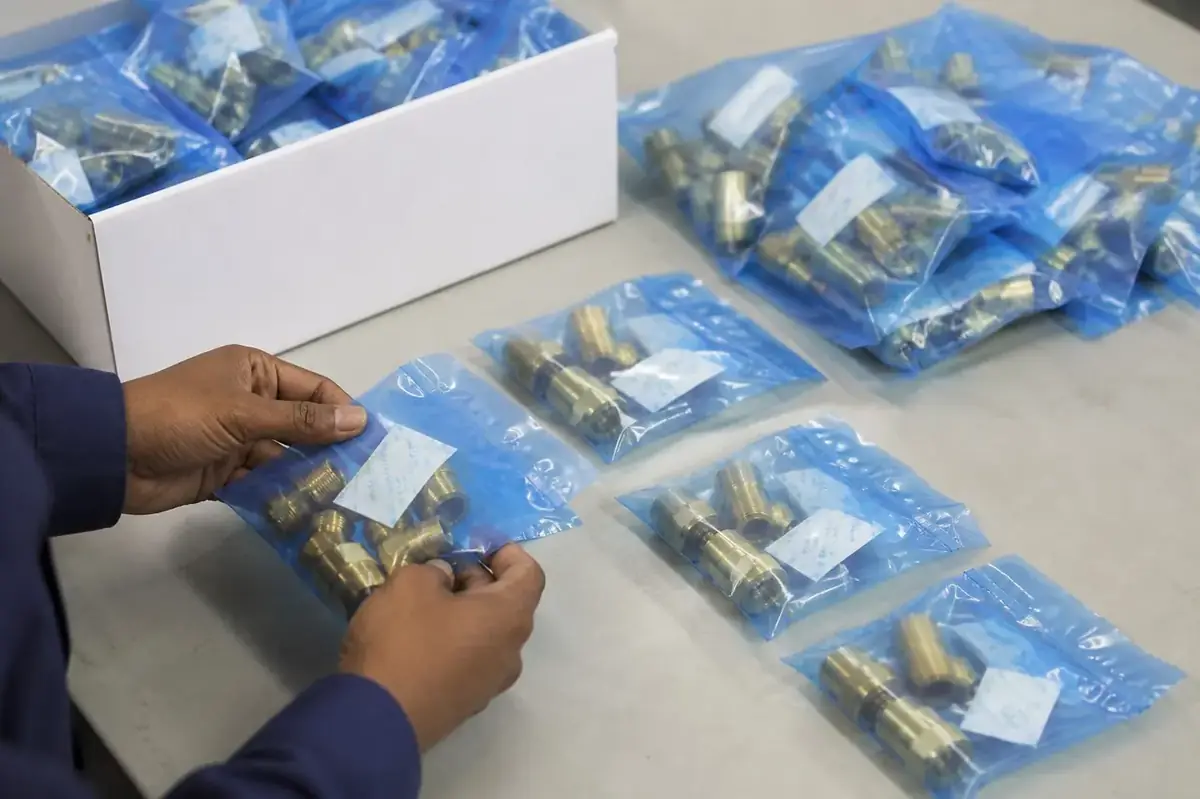
Precision turned brass moulding inserts count-packed and heat-sealed inside a blue VCI (Volatile Corrosion Inhibitor) anti-rust polybag with active desiccant packs.
3. The 4-Tier Sea-Worthy Packaging Architecture
Because turned brass has a high volumetric weight (8,500 kg/m³), export packaging must combine physical crush resistance with thread-to-thread impact cushioning. Jamnagar exporters utilize a standardized 4-tier packaging architecture:
| Packaging Level | Material Specification | Structural Purpose | Standard Load Limits |
|---|---|---|---|
| Level 1: Primary Unit Kitting | 100 mum heavy-gauge heat-sealed VCI polybags, plastic compartment trays, or thread mesh netting. | Prevents direct part-to-part thread contact, provides primary chemical VCI corrosion barrier. | 100 to 1,000 pieces per sealed bag |
| Level 2: Inner Box Packaging | 3-ply stiff corrugated cardboard white/kraft inner boxes with printed part barcode labels. | Organizes unit polybags, provides intermediate stack support and inventory SKU scanning. | 2.0 kg to 5.0 kg max inner weight |
| Level 3: Outer Master Cartons | Heavy 5-ply or 7-ply double-wall corrugated kraft boxes (1,400 kPa edge crush test) with plastic corner edge guards. | Withstands heavy vertical compression during container pallet stacking without sidewall bulging. | Strictly Capped at 20.0 kg to 25.0 kg Max |
| Level 4: ISPM-15 Palletization | Heat-Treated (HT) ISPM-15 compliant solid wooden pallets or heavy-duty recyclable plastic Euro pallets (1,200 × 800 mm or 1,200 × 1,000 mm). | Enables rapid forklift container handling, elevates cargo off container floors, and enforces global phytosanitary quarantine compliance. | 800 kg to 1,000 kg Max Load per Pallet |
4. ISPM-15 Phytosanitary Compliance & Heat Treatment (HT) Standards
When importing palletized freight from India, customs authorities in North America (US Customs & Border Protection), the European Union (EU Regulation 2016/2031), Australia (DAFF), and the UK strictly enforce ISPM-15 (International Standards for Phytosanitary Measures No. 15).
ISPM-15 requires all raw wooden packaging materials (wooden pallets, dunnage, crates) to be heat-treated to destroy timber-boring pests (such as the Asian Longhorned Beetle and Emerald Ash Borer).
ISPM-15 Heat Treatment & Marking Rules
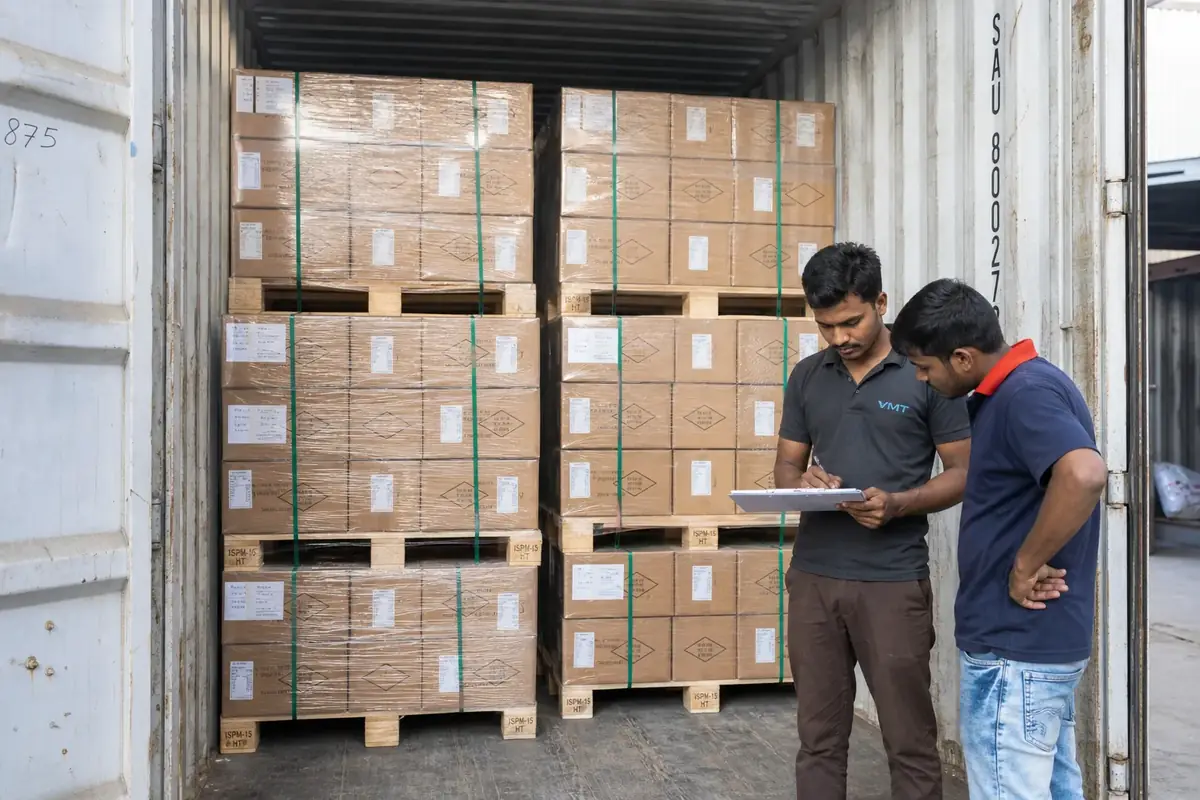
- Heat Treatment (HT) Standard: Raw wooden pallets are placed inside a certified kiln and heated until the core temperature of the wood reaches a minimum of 56°C for at least 30 continuous minutes.
- The ISPM-15 Wheat Stamp: Every compliant wooden pallet must display a visible, permanent wheat-symbol IPPC stamp on at least two opposite sides:
[ IPPC Symbol ] IN - XX - HT (IN = India Country Code, XX = Certified Treatment Plant ID, HT = Heat Treated)
- Rejection Penalty: Importing pallets lacking the official ISPM-15 HT wheat stamp results in immediate customs quarantine at destination ports, mandatory re-export of the entire container at the buyer's expense, or costly port fumigation fines!
5. Customs Classification: HS Code & Import Duty Matrix
Correct Harmonized System (HS) Code classification is critical for determining applicable customs tariffs, Most Favored Nation (MFN) duty rates, and regulatory trade compliance:
| HS / HTS Code Subheading | Official Customs Product Description | Typical Component Examples | Average MFN Import Duty (US / EU) |
|---|---|---|---|
| HS 7415.33 | Screws, bolts, nuts, and turned fasteners of copper/brass, threaded | DIN 933 hex bolts, DIN 934 nuts, DIN 84 machine screws, threaded studs | US: 3.0% to 3.7% / EU: 3.2% |
| HS 7412.20 | Pipe fittings of copper alloys (brass fittings) | Hex nipples, pipe reducers, CPVC/PPR transition inserts, elbows, tees | US: 3.0% / EU: 3.2% |
| HS 8481.80 | Taps, cocks, valves and similar appliances for pipes | Sanitary ball valves, check valves, gas shut-off valves, water meter taps | US: 2.0% to 3.0% / EU: 2.2% |
| HS 8536.90 | Electrical apparatus for switching or making connections to electrical circuits | Neutral bars, earth continuity links, turned PCB terminal pins, cable glands | US: 0.0% to 2.7% / EU: 0.0% (Duty Free) |
| HS 7419.80 / 7419.99 | Other articles of copper or brass, turned, stamped, or cast | Custom turned moulding inserts, special sensor bodies, architectural hardware | US: 3.0% / EU: 3.2% |
6. Incoterms Demystified for B2B Importers: EXW vs. FOB vs. CIF vs. DDP
Selecting the correct Incoterms 2020 rule defines risk transfer, freight payment responsibilities, and insurance obligations between the buyer and Jamnagar manufacturer:
FOB (Free On Board — Port of Mundra / Kandla) — Recommended for Experienced Importers
The Jamnagar manufacturer handles inland trucking, export customs clearance in India, port handling charges (THC), and loads cargo onto the ocean vessel. Risk transfers to the buyer once cargo is safely loaded aboard the ship. The buyer controls ocean freight routing and rates with their preferred freight forwarder.
CIF (Cost, Insurance & Freight — Destination Port) — Recommended for Mid-Sized Importers
The Jamnagar supplier pays for ocean freight and marine cargo insurance (110% Institute Cargo Clauses A coverage) to the buyer's named destination seaport (e.g., CIF Rotterdam, CIF Hamburg, CIF New York). The buyer assumes risk upon vessel arrival and handles destination customs clearance and inland delivery.
DDP (Delivered Duty Paid — Buyer's Warehouse) — Turnkey Solution
The supplier or digital supply desk (such as Jamnagar.net) manages the entire logistics chain from factory floor to the buyer's warehouse door, paying all ocean freight, marine insurance, destination customs duties, and local container trucking. The buyer receives a single hassle-free invoice with zero logistics overhead.
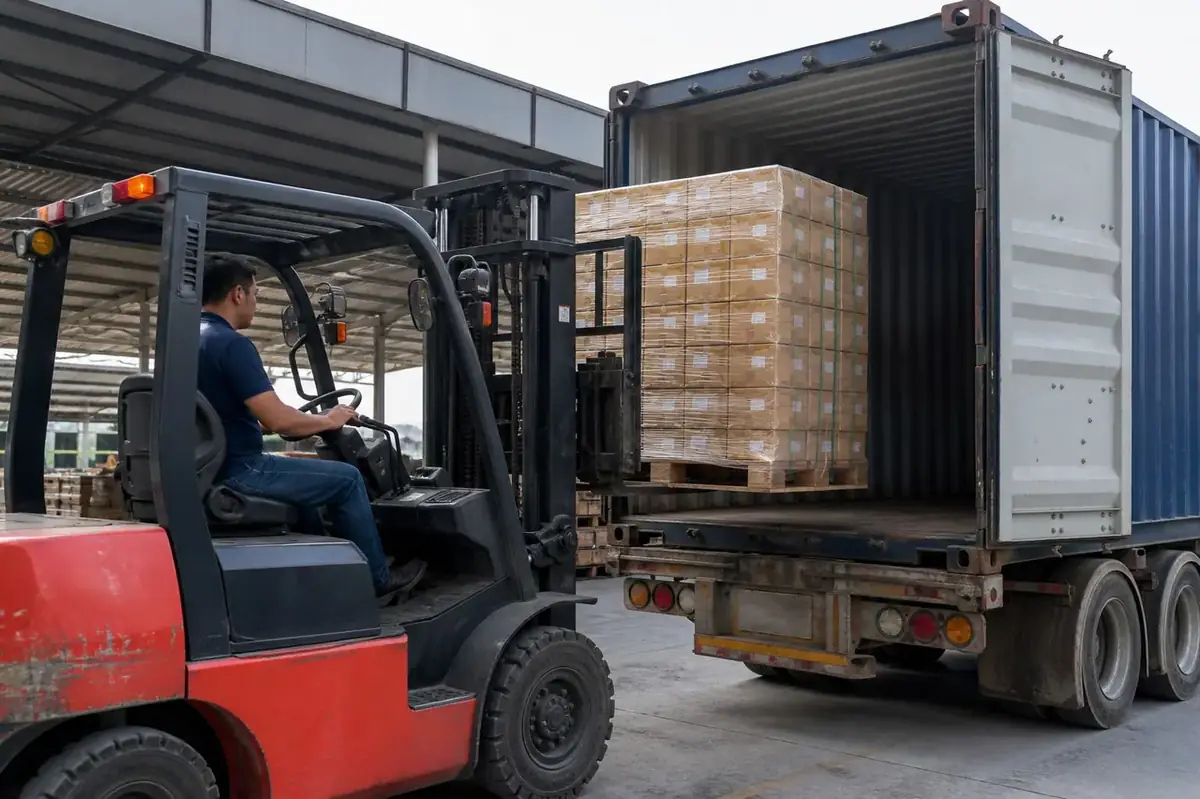
Forklift stuffing ISPM-15 heat-treated wooden pallets loaded with strapped master cases of turned brass components into a 20-foot dry ocean container in Jamnagar.
7. Printable Pre-Shipment Logistics & Packaging Audit Checklist
Enforce this 6-point logistics audit checklist prior to authorizing container dispatch from Jamnagar:
VCI Polybag Heat-Seal Audit: Verify inner polybags are 100 mum active VCI material, fully heat-sealed with active silica gel desiccant packs inside every unit box.
Master Carton Weight Cap: Confirm individual master export box weights do not exceed 25.0 kg to prevent box wall tearing or crushing during manual handling.
ISPM-15 HT Pallet Wheat Stamp Verification: Confirm every wooden pallet displays the official, legible IPPC ISPM-15 Heat-Treatment (HT) stamp on at least two sides.
Pallet Shrink-Wrap & Plastic Strapping: Verify loaded pallets are wrapped in 23 mum stretch film with heavy plastic corner edge protectors and dual heavy polypropylene strapping bands.
Container Desiccant Pole Suspension: Verify 4 to 6 continuous 1.0 kg calcium chloride desiccant poles are hung along container wall tie-rings to prevent "container rain."
Customs Document Matching: Audit Commercial Invoice, Packing List, Certificate of Origin (COO), Bill of Lading (B/L), and EN 10204 3.1 Material Certificates to ensure exact HS Code and quantity matching.
8. Frequently Asked Questions (FAQ)
Q: What HS Code is assigned to turned brass machine screws and threaded fasteners?
Turned brass screws, bolts, nuts, and threaded fasteners are classified under HS / HTS Subheading 7415.33, carrying a standard MFN customs import duty of 3.0% to 3.7% in the US and Europe.
Q: What ocean transit lead time should be expected for sea freight from Mundra Port to European ports?
Direct container vessel sailings from Port of Mundra to major European ports (Rotterdam, Hamburg, Antwerp, Felixstowe) take average ocean transit times of 18 to 22 days.
Q: What is "Container Rain" and how does VCI packaging prevent brass tarnishing?
"Container Rain" occurs when ocean humidity condenses on cold steel container ceilings at night and drips onto freight. VCI (Volatile Corrosion Inhibitor) packaging emits an invisible, non-toxic vapor that adsorbs onto brass surfaces, forming a monomolecular passivating shield that neutralizes moisture and prevents copper oxidation.
Q: Why is ISPM-15 heat treatment mandatory for wooden pallets exported from India?
ISPM-15 is an international phytosanitary standard requiring raw timber packaging to be heat-treated (56°C for 30 minutes) to eliminate wood-boring pests. Non-compliant pallets lacking the official IPPC wheat stamp face immediate quarantine, re-export, or fumigation fines at destination ports.
Need Turnkey Sea Freight & DDP Delivery for Turned Brass Parts?
Every export shipment managed through Jamnagar.net is VCI moisture-sealed, ISPM-15 palletized, and delivered turnkey under FOB, CIF, or DDP terms. Submit your engineering drawings or catalog requirements for a complete landed price quote on Jamnagar.net.