Importing Brass Components from India: A Practical Checklist
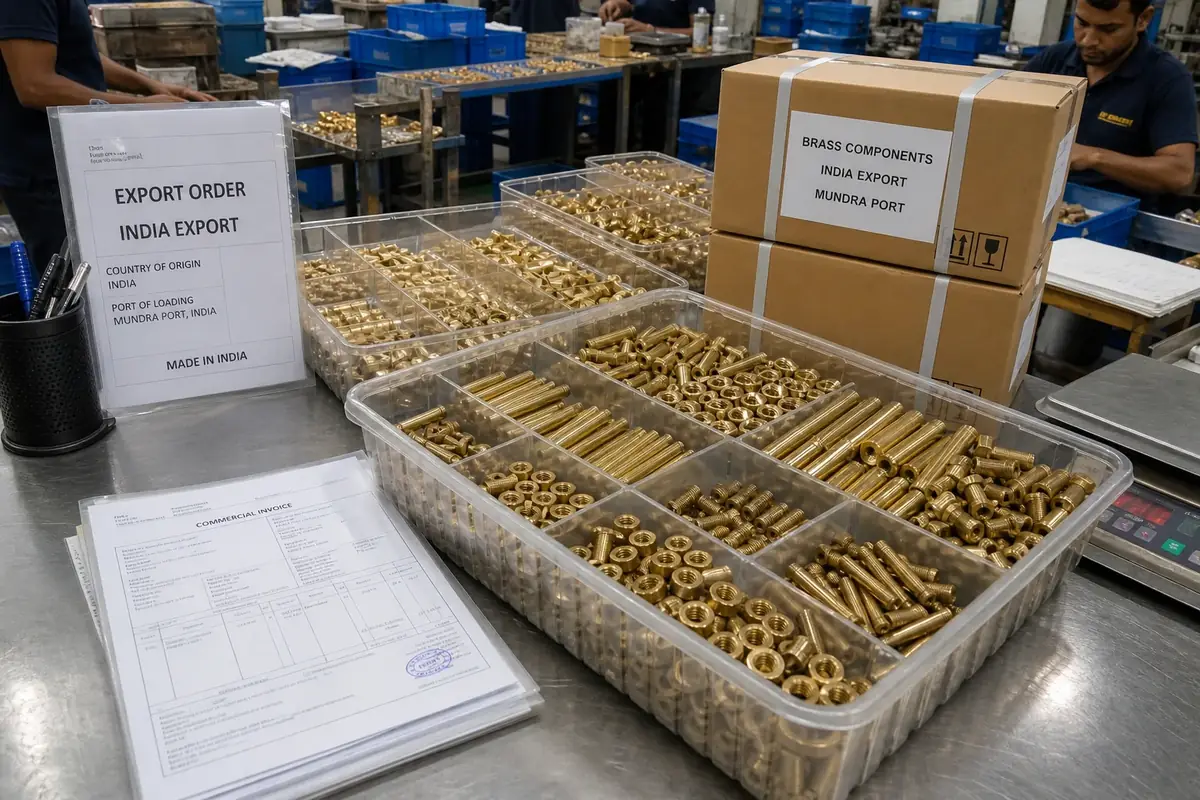
Searching brass items near me can solve a same-week maintenance need. Building a repeatable import lane is a different job. An importing brass components from India checklist forces the boring decisions early—drawings, samples, packing, Incoterms, and inspection—so ocean freight is not your first quality filter.
Gujarat clusters, especially Jamnagar, already concentrate melting, machining, finishing, and export packing. That density helps only if your purchase order carries the same clarity a local shop uses on its router card.
This guide is for procurement and operations readers who want to buy brass for assemblies—not souvenir shopping. It walks the path from RFQ to receiving dock without assuming you already have a resident engineer in India.
Highlights
- Lock specs and sample approval before you chase the lowest piece price.
- Treat packing and Incoterms as quality tools, not afterthoughts.
- “Near me” stock and export factory programs solve different problems—do not mix the playbooks.
Table of contents
- Local stock versus import programs
- Pre-RFQ readiness checklist
- Matching supplier type to your part
- Samples, first articles, and freeze points
- Commercial terms that change landed cost
- Packing and moisture protection
- Documents and compliance basics
- Quality gates before and after sailing
- Stage checklist comparison table
- Mistakes that inflate landed cost
- Consolidation, MOQs, and mixed SKU containers
- Communication rhythm that keeps programs alive
- Landed-cost worksheet habits
- Alloy and market compliance before freight
- Payment, tooling, and relationship risk
- Receiving-dock playbook for first containers
- Seasonality, festivals, and capacity reality
- FAQ
Local stock versus import programs
Search phrases like brass fittings near me, brass rod suppliers near me, or brass suppliers near me usually surface distributors and hardware counters. That channel is right for emergency replacements and small mixed picks.
Import programs optimize for drawing-controlled SKUs, predictable alloys, and container economics. You are not shopping a shelf of brass items for sale; you are building a supply agreement that survives plating baths, monsoon humidity, and customs queues.
Use local stock to bridge gaps. Use India export capacity when annual volume, custom geometry, or cost structure justifies lead time. Mixing the two mental models—expecting catalogue speed at factory prices—creates friction for both sides.
For cluster orientation before you shortlist, start with the Jamnagar brass industry hub.
“A low piece price that ignores packing and rejects is just a delayed invoice for freight and rework.”
Pre-RFQ readiness checklist
Before you email anyone, assemble a package that a shop can quote without guessing. Incomplete RFQs produce optimistic prices and pessimistic deliveries.
- 2D/3D drawings with revision control and material callouts.
- Alloy and compliance notes (including lead-free or dezincification needs if applicable).
- Process preference — turned from rod, forged, cast, or assembled.
- Thread standards and gauges — series, class, plating state.
- Finish — polish, nickel, tin, lacquer, or raw; thickness if critical.
- Volume ladder — sample, pilot, annual forecast.
- Packing expectations — bagging, VCI, carton marks, pallet rules.
- Target Incoterms and destination port or door.
If you are still choosing who to approach, use the structured method in the brass parts manufacturer buyer guide.
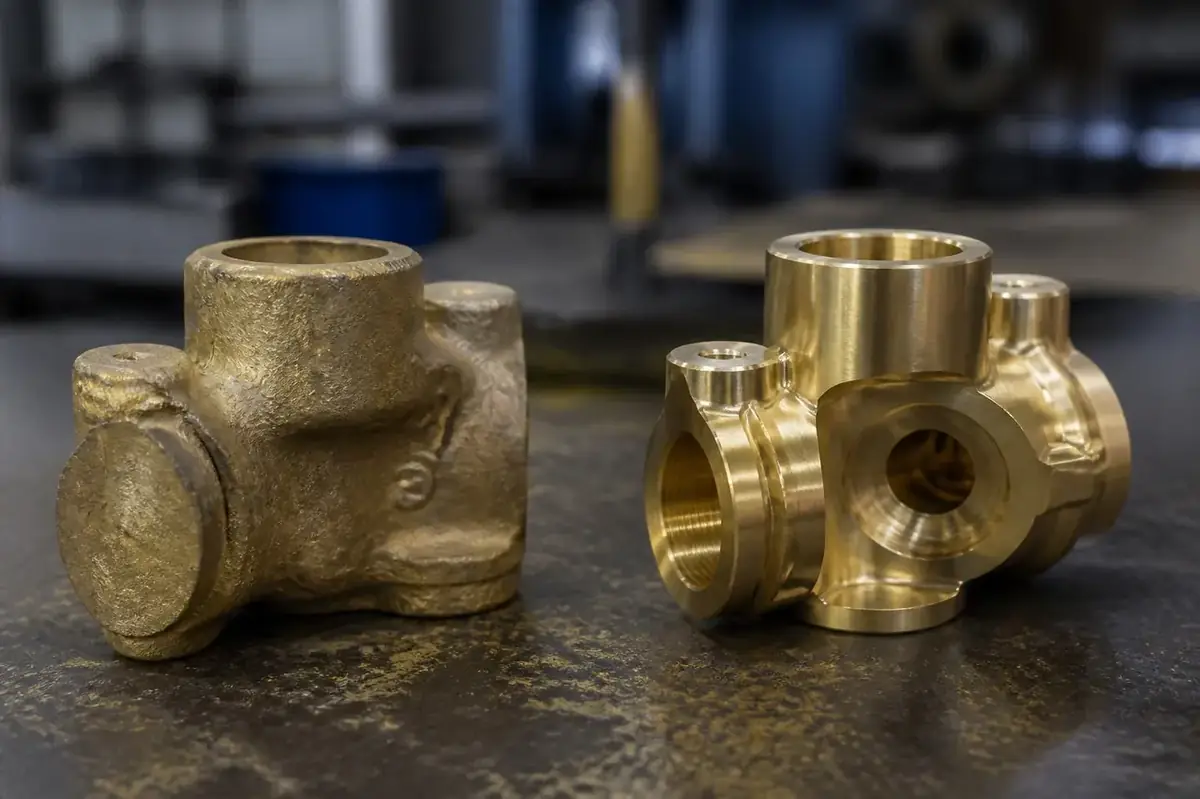
Matching supplier type to your part
Not every workshop that can buy brass scrap can export your part. Match the cell: high-volume cam shops for inserts and fasteners; forging plus machine for valve bodies; CNC for concentric connectors; traders for mixed decorative SKUs.
Ask who owns the critical operation. If plating is outsourced, ask who controls thickness and bath chemistry. If packing is subcontracted, ask who inspects carton marks. Layers are normal; invisibility is not.
Industry use cases—plumbing, electrical, furniture, automotive—are mapped in brass applications by industry. Use that map to avoid sending a sanitary forging RFQ to a pure insert shop.
Samples, first articles, and freeze points
Air samples prove intent. Production lots prove process. Treat them as related but not identical.
Approve dimensions, threads, and finish against written criteria. Photograph approved cosmetics. Freeze the revision that production will follow. If the sample used hand polish and production will use bulk tumble, say so before you sign.
For custom geometry, MOQ, and sampling tactics, continue to custom brass components: drawings, MOQ, samples.
“Sample by air, production by assumption—that is how good first articles become bad containers.”
Commercial terms that change landed cost
Piece price is one line. Landed cost includes tooling amortisation, sample freight, rejects, duties where applicable, inland haulage, and delay. Compare offers on the same Incoterm and the same packing standard.
Common patterns: EXW when your forwarder collects; FOB when the supplier delivers to a named port; CIF/CFR-style when ocean freight is bundled. None is universally “best.” Choose based on who controls risk better for your team.
Payment terms should match trust and program maturity. New suppliers often start with smaller pilots. Escalating container size before process freeze is a classic way to learn expensive lessons.
Packing and moisture protection
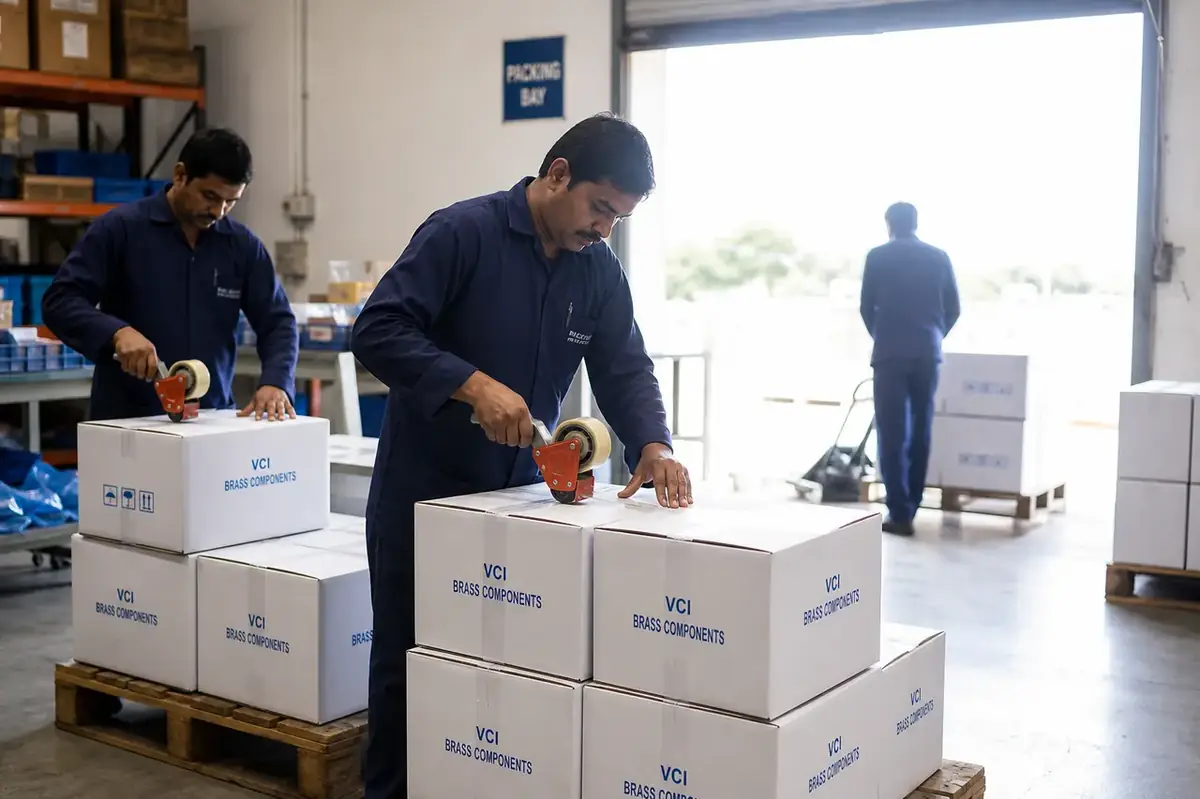
Brass travels well when packing respects finish. Raw turned blanks tolerate denser packing than polished nickel parts. Threads nick when loose metal parts rattle for three weeks at sea.
- Polybags or VCI wraps for corrosion-sensitive finishes.
- Separators or trays for polished faces and decorative hardware.
- Thread protectors or compartment bags for sharp crests.
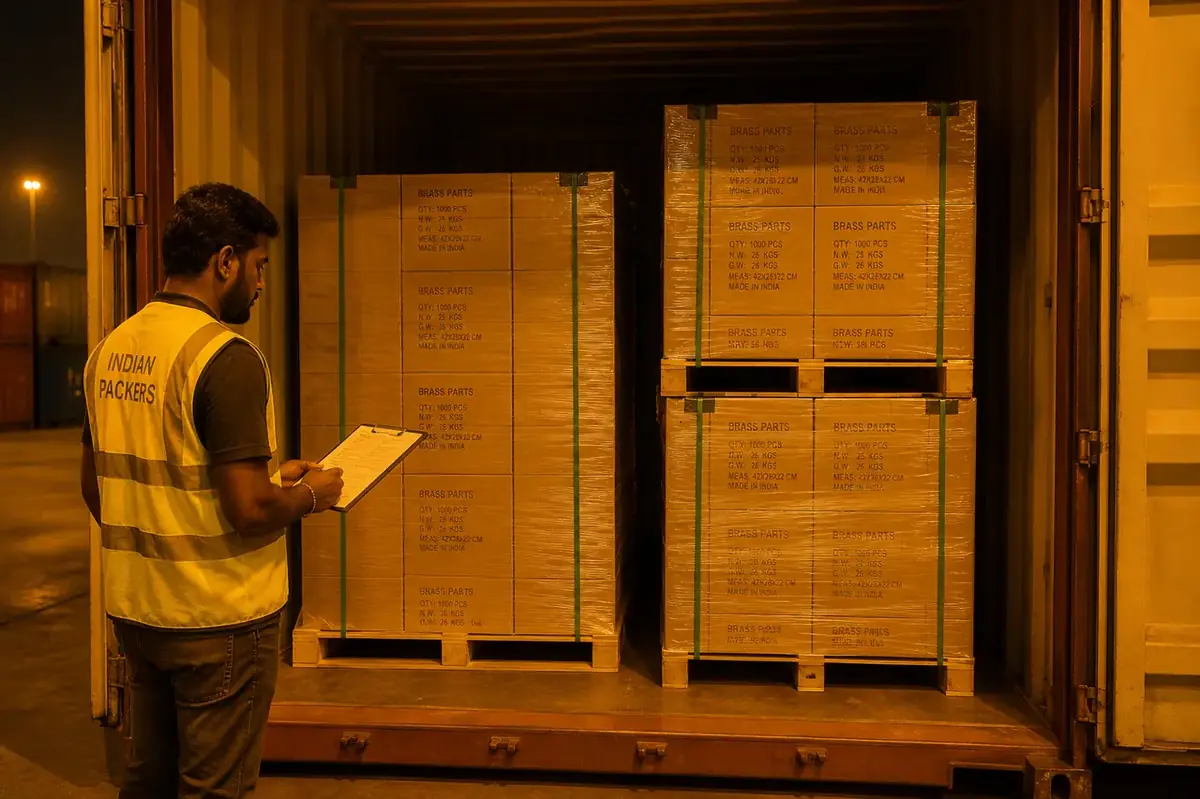
- Export cartons with clear marks: PO, part number, quantity, destination.
- Pallet rules if destination warehouses require them.
Write packing into the PO. “Export worthy” without detail is not a specification.
Documents and compliance basics
Typical sets include commercial invoice, packing list, and transport document. Many programs add certificate of origin, material notes, or inspection reports. Align HS classification early with your broker so invoice descriptions match reality.
Alloy claims should track melt documentation where the application demands it. Soft words like “good brass” do not help customs or your engineering team. Destination-market rules for lead content or drinking-water contact deserve explicit RFQ lines when relevant.
This hub cannot replace legal or customs advice for your country. It can remind you to put document owners on the project plan before the vessel books.
Quality gates before and after sailing
Define gates: in-process checks at the shop, pre-shipment inspection if you use one, and receiving inspection at your dock. Each gate needs a written AQL or CTQ list—not “looks OK.”
Defect families—porosity, wrong alloy colour cues, thread damage, plating peel—are covered in depth in brass product defects and quality checks. Import your inspection plan from that thinking; do not invent it on the warehouse floor.
When rejects happen, isolate lots by heat or carton mark. Traceability language in the PO makes that possible. Without marks, every carton becomes a suspect.
Stage checklist comparison table
Use this as a program dashboard. Exact durations vary by part complexity and season.
| Stage | Buyer action | Supplier action | Exit criterion |
|---|---|---|---|
| RFQ pack | Send drawings, alloy, finish, volumes | Clarify process route and gaps | Comparable quotes on same scope |
| Sample | Approve CTQs and cosmetics | Produce sample on stated process | Signed sample + freeze note |
| Pilot lot | Receive and inspect under AQL | Run production tooling and packing | Pilot accepted or CAPA closed |
| Container | Confirm Incoterms and docs | Pack, mark, book freight as agreed | Clean docs + traceable cartons |
| Receiving | Dock audit vs freeze criteria | Support claims with lot data | Lot disposition recorded |
Mistakes that inflate landed cost
- Comparing EXW and CIF quotes as if they were the same offer.
- Ordering full containers before a pilot packing trial.
- Assuming brass items near me pricing models apply to custom export SKUs.
- Leaving thread and plating notes verbal while locking commercial terms in writing.
- Skipping carton marks, then discovering mixed SKUs at receiving.
- Choosing a shop by brochure photos instead of process cell fit.
The cure is procedural boredom: same checklist every program, every revision.
Consolidation, MOQs, and mixed SKU containers
Smaller importers rarely fill a container with one part number. Consolidation is normal: multiple SKUs, sometimes multiple process cells, packed under one forwarder booking. That flexibility is useful only when carton marks and packing lists stay obsessive.
Agree minimums per SKU and per shipment. A shop may accept a low piece MOQ yet still need a sensible melt or plating batch. Trading partners who aggregate brass items for sale across buyers can help—but you still need drawing control on your own lines.
When mixing polished furniture hardware with oily industrial blanks in one container, separate cartons and humidity strategies. Cross-contamination of packing materials is a quiet source of stains and odours at receiving.
Air freight pilots and sea production lots should share the same packing recipe whenever possible. Learning packing failures on a full ocean load is an expensive classroom.
Communication rhythm that keeps programs alive
Time zones and festival calendars affect Gujarat production weeks. Build buffer into sample and sailing dates instead of treating every quote lead time as a promise carved in stone.
Use a single revision-controlled drawing pack as the source of truth. Chat photos of “a small change” without a revision bump are how silent deviations enter production. Confirm tooling ownership and who pays for drawing-driven changes before the second sample round.
Weekly status during first production—heat ready, plating booked, cartons packed—beats a single “shipped” message after problems are irreversible. Ask for carton photos of packed goods when finishes are fragile.
If your team still thinks in local retail search terms like brass fittings near me or brass rod suppliers near me, translate those needs into forecast SKUs and safety stock. Import lanes replace emergency counters; they do not behave like them.
Landed-cost worksheet habits
Build a simple worksheet every time you buy brass offshore: piece price, tooling amortisation, sample freight, ocean or air freight, insurance, duties/broker fees where applicable, inland delivery, expected yield loss, and inspection labour.
Re-run the sheet when finish changes from raw to nickel, or when packing upgrades from bulk polybag to individual wraps. Finish and packing often move landed cost more than a small piece-price negotiation.
Compare at least two capable shops on the same worksheet, not five random emails with mismatched scopes. Capability first, then cost. A third quote from a mismatched cell only adds noise.
Keep the worksheet linked to the drawing revision. When engineering revises a tolerance, procurement should refresh landed cost before locking a yearly blanket order.
Alloy and market compliance before booking freight
Destination markets differ on lead content, drinking-water contact, and labelling. Put those rules in the RFQ, not in a post-shipment email. A container that is dimensionally perfect can still be commercially stuck if chemistry is wrong for the market.
Ask how the supplier segregates free-cutting leaded grades from lead-free campaigns. Shared chip bins and shared plating racks are common failure points. Compliance is a yard discipline problem as much as a certificate problem.
If your product touches food or potable systems, say so explicitly. Soft phrases like “good quality brass” do not communicate regulatory intent to a turning shop racing a delivery date.
Keep a one-page compliance annex with every blanket PO: alloy list, restricted substances notes, and who owns test reports. Update it when laws or your SKU mix change.
Payment, tooling, and relationship risk
New supplier relationships often start with advance payments or letter-of-credit style structures depending on your bank and theirs. Match payment milestones to sample approval, pilot acceptance, and container readiness—not only to a calendar promise.
Tooling ownership should be written. Who pays for dies, form tools, and gauges? Who may use them for other customers? Ambiguity here creates both IP discomfort and scheduling fights during peak season.
Dual-source critical SKUs when volume justifies it. A single cam shop fire or plating line outage should not freeze your entire assembly line. Dual-sourcing still requires identical drawings and gauge rules.
Relationship quality shows in how shops handle the first defect claim. Fast, evidence-based responses beat defensive silence. Score that behaviour before you award the next annual volume.
Receiving-dock playbook for the first three containers
The first ocean lots teach more than the brochure. Plan extra inspection time. Photograph carton marks on arrival. Quarantine until CTQs clear. Do not release parts to production on “looks familiar” alone.
Compare packing condition to the approved pilot. If separators disappeared to save cube, stop and renegotiate before the next sailing. Silence trains the wrong packing habit.
Track yield: good pieces versus rework versus scrap. Feed that number back into landed cost. A cheap invoice line with a 8% dock reject rate is not cheap.
After three clean containers, you can often thin sampling—but keep lot identity and a periodic deep audit. Stability is earned, not assumed because the supplier is friendly on email.
Local emergency buys from brass suppliers near me can still cover spikes. Just do not let emergency retail grades silently enter a controlled OEM BOM without engineering sign-off.
Seasonality, festivals, and capacity reality
Festival weeks, monsoon logistics, and port congestion can stretch otherwise honest lead times. Build calendar awareness into blanket orders. Asking for miracle sailings during peak holiday clusters is how relationships fray.
Capacity is not infinite even in a dense cluster. Long cam runs for inserts can queue behind another exporter’s urgent lot. Share forecasts early if you want priority that is more than polite language. That habit turns an importing brass components from India checklist into an operating rhythm, not a one-time document.
FAQ: importing brass from India
Can small importers still source from Jamnagar effectively?
Yes, with realistic MOQs and consolidation. Spec clarity still beats order size when you want repeatable lots.
What should an importing brass components from India checklist include first?
Drawings, alloy, process, threads, finish, volumes, sample rules, packing, and Incoterms. Price without those inputs is not a fair comparison.
Is searching brass suppliers near me enough for export programs?
Near-me searches help emergency stock. Export needs capability, documents, and packing discipline. Use both channels for what they do well.
Which Incoterms are common for Indian brass component exports?
FOB and ocean freight–inclusive terms are frequent; EXW/FCA suit buyers who control logistics. Put risk transfer in writing.
How should buyers handle samples before a full container?
Approve against the intended production process. Note any planned differences in heat, plating, or packing before release.
What documents typically travel with brass shipments from India?
Invoice, packing list, transport document, plus origin or material papers as agreed. Some programs add inspection or plating records.
How do I compare buy brass offers from traders versus factories?
Ask who cuts, finishes, and packs. Traders help mixed SKUs; direct process owners matter more for tight tolerances.
What packing details matter for plated brass parts?
Moisture protection, separators, thread care, strong cartons, and clear marks. Finish-grade packing is part of quality.
Conclusion
Importing works when the checklist is boring and complete. Treat local “near me” availability as a different tool from factory export lanes. Lock drawings, samples, packing, and Incoterms before the vessel, and your receiving dock stops being the primary inspection department.
When you are ready to convert a checklist into an export enquiry, use a direct supply desk that can route the RFQ to the right process cell.
Ready for an Export Enquiry?
Send your packing notes, drawings, and destination details for a direct Jamnagar export discussion on Jamnagar.net.