Brass Applications by Industry: Where Copper-Zinc Parts Actually Work
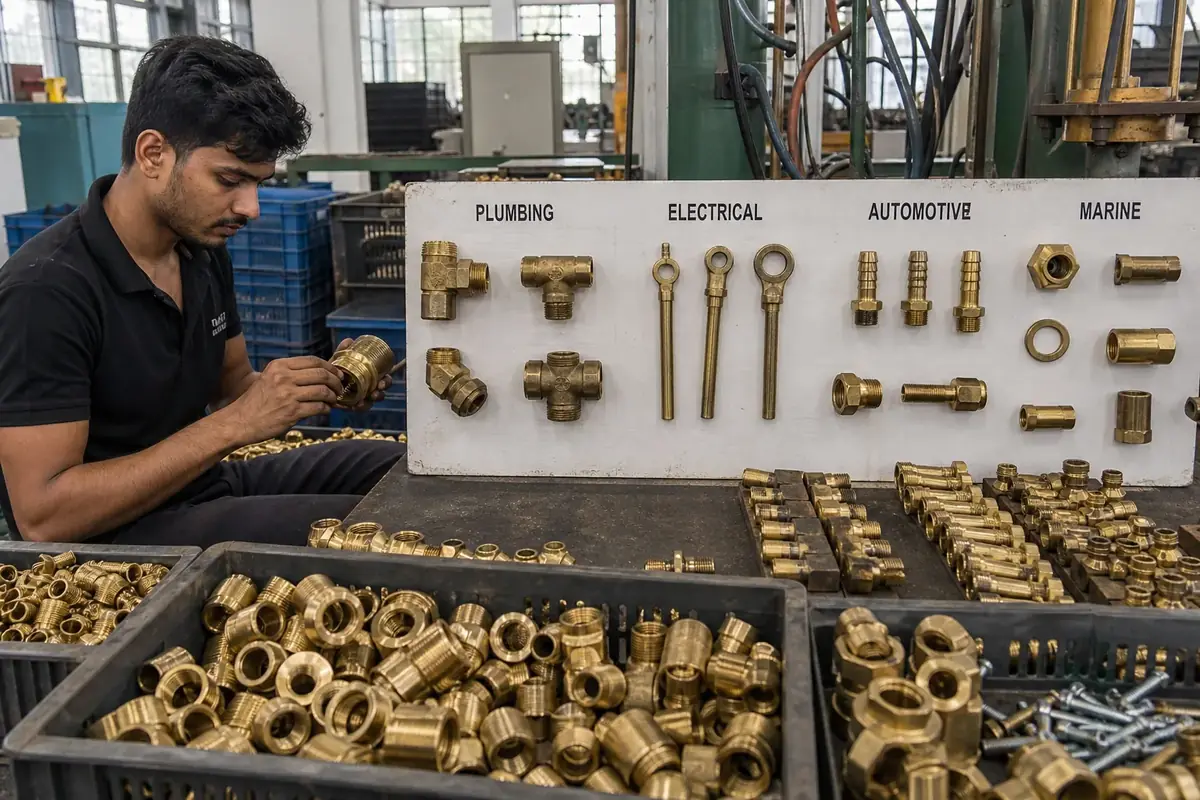
Procurement teams rarely buy “brass” in the abstract. They buy a fitting that must seal, a gate that must conduct, a bushing that must endure, or a handle that must look right after three years of hand traffic. Mapping brass applications by industry is the practical first filter before drawings leave engineering and quotes leave Gujarat.
Jamnagar’s cluster ships into many of these end markets at once. That density helps—but it also creates confusion when a sanitary forging shop and a decorative hardware cell receive the same vague RFQ. Industry duty decides alloy notes, thread standards, finish, and which workshop actually belongs on the shortlist.
This hub is written for buyers and product engineers who need orientation across sectors. It is not a catalogue of every SKU. It shows how copper-zinc parts show up in plumbing, electrical work, vehicles, marine gear, furniture, and tools—and what to ask next.
Quick Lookup
- Name the industry duty on every RFQ—geometry alone is not enough.
- Plumbing and electrical programs fail differently from furniture and gift programs.
- Match Jamnagar process cells to the sector, then compare piece price.
Table of contents
- Why map brass applications by industry
- Plumbing, sanitary, and fluid systems
- Electrical, lighting, and brass conduit hardware
- Automotive, radiator, and heat-exchange parts
- Marine and coastal exposure duty
- Furniture, door, and architectural hardware
- Tools and measuring aids, including stair gauge
- Bushings, inserts, and general engineering
- Industry comparison table
- When one SKU serves two industries
- Volume patterns buyers should expect by sector
- Inspection emphasis changes with industry duty
- How to write an industry-aware RFQ
- FAQ
Why map brass applications by industry
A collar that looks identical in a photo can serve four different lives: a decorative spacer, a plumbing adapter, an electrical bushing, or a marine deck fitting. The alloy, plating, and leak test change with that life. Industry mapping prevents “same drawing, wrong shop” quotes.
It also clarifies compliance language. Potable-water markets care about lead limits. Electrical programs care about conductivity and flame-path integrity. Furniture programs care about colour match and handle wear. One generic “yellow brass, bright finish” note cannot carry all three.
For cluster context on how Jamnagar organises melting, extrusion, and machining around these demands, start with the Jamnagar brass industry hub. Use this page to decide which product family your industry actually needs.
“If the RFQ does not name the duty—water, current, salt, or hand traffic—the quote will optimise for the wrong failure mode.”
Plumbing, sanitary, and fluid systems
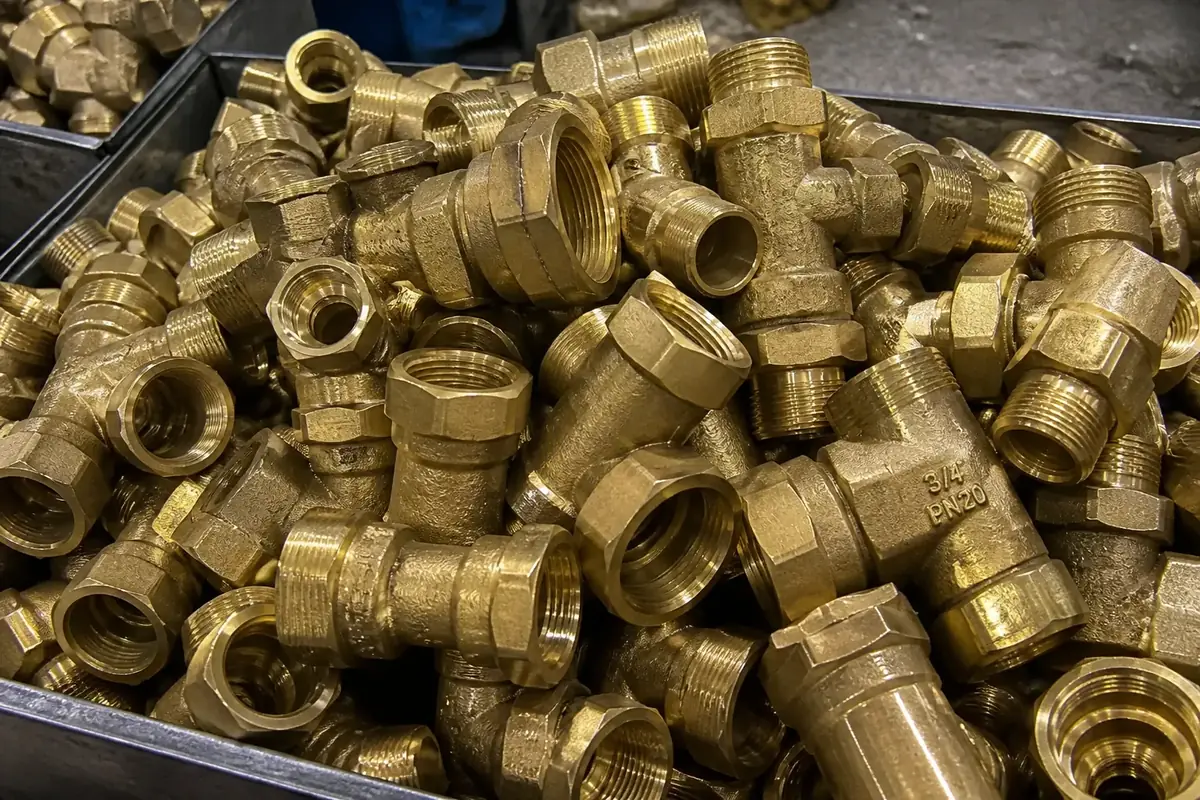
Plumbing remains one of the largest continuous pull for brass fittings, valve components, adapters, and sanitary hardware. Threads must seal. Faces must sit flat. Alloys must survive the water chemistry of the destination market.
Common part families include elbows, nipples, unions, compression fittings, cartridge housings, and forged bodies that later receive machining on sealing seats. Hot forging and rod turning both appear; the geometry decides which route wins on scrap and strength.
Buyers should treat thread standard as a first-class requirement. BSP, NPT, and metric series are not interchangeable by eyeball. Plating thickness can also push borderline thread classes out of Go/No-Go after coating.
Water chemistry varies. Soft water, hard water, chlorinated municipal supply, and closed loop systems stress alloys differently. If your market publishes dezincification or lead limits, put those notes on the RFQ before shops select free-cutting grades by habit.
Visible sanitary trim—showerside forms with polished faces—adds finish control on top of sealing duty. Treat those SKUs as dual-requirement parts: fluid integrity plus appearance AQL. Hidden adapters behind walls can follow a stricter mechanical, simpler cosmetic plan.
What plumbing RFQs should lock early
- Alloy and any lead-free or dezincification notes for the market.
- Thread form, pitch, and gauge ownership.
- Pressure or leak-test method if the part is fluid-critical.
- Finish that will not flake in wet service.
For fitting families and sanitary detail, continue to the brass fittings and plumbing fittings guide.
Electrical, lighting, and brass conduit hardware
Electrical and lighting programs pull glands, terminals, neutral links, lamp holders, and enclosure hardware. Conductivity, thread integrity, and sealing against dust or moisture matter more than mirror polish—unless the part is also a visible fixture.
Brass conduit fittings sit in this family when metal raceways need durable couplings, bushings, or adapters. Buyers often underestimate how much thread form and plating affect assembly torque and long-term contact resistance. Specify both.
Lighting hardware adds a second layer: visible finish. Antique, polished, and brushed looks must match across batches when fixtures ship as sets. Functional electrical parts behind a canopy can follow a stricter mechanical spec with a simpler finish.
Electrical buyer checks
- Current path versus purely mechanical role.
- IP or sealing expectation for outdoor or industrial glands.
- Plating that does not poison contact surfaces where bare brass is required.
- Batch colour control when the part is customer-facing.
Lighting and electrical fitting detail continues in the brass lighting and electrical fittings guide.
Automotive, radiator, and heat-exchange parts
Automotive and general vehicle programs still consume brass for fittings, sensor adapters, bushings, and specialty heat-exchange components. The full yellow brass radiator of older cars is less dominant in mass OEM lines today, yet brass and copper-brass parts remain in restoration, specialty vehicles, industrial coolers, and repair ecosystems.
Where heat exchange still uses brass-related constructions, buyers care about joint integrity, tube-to-header fit, and corrosion in coolant chemistries. Where the part is a turned adapter, the conversation shifts to concentricity, thread class, and plating that survives under-hood temperatures.
Auto programs also punish silent process changes. A sample turned from one rod heat and production from mixed scrap heats can pass first-article photos and fail field vibration later. Ask for melt discipline when the part is safety-adjacent or high-cycle.
“Restoration radiator work and modern under-hood adapters share the word brass—but almost nothing else in the inspection plan.”
Marine and coastal exposure duty
Marine and coastal applications stress dezincification, salt fog, and seizure on threads. Deck hardware, through-hull adjacent fittings (where allowed by design), instrument mounts, and enclosure glands see harsher chemistry than indoor furniture pulls.
Not every yellow brass alloy belongs on a salt-sprayed rail. Buyers should name the exposure, preferred alloy family if known, and whether the part will be lacquered, plated, or left to develop a controlled patina. “Marine look” finish language without corrosion notes is how pretty parts seize in service.
Packing matters too. Coastal shipping and humid container transit can start corrosion before the part ever meets seawater. VCI, dry packs, and finish cure times are part of the application story, not afterthoughts.
Furniture, door, and architectural hardware
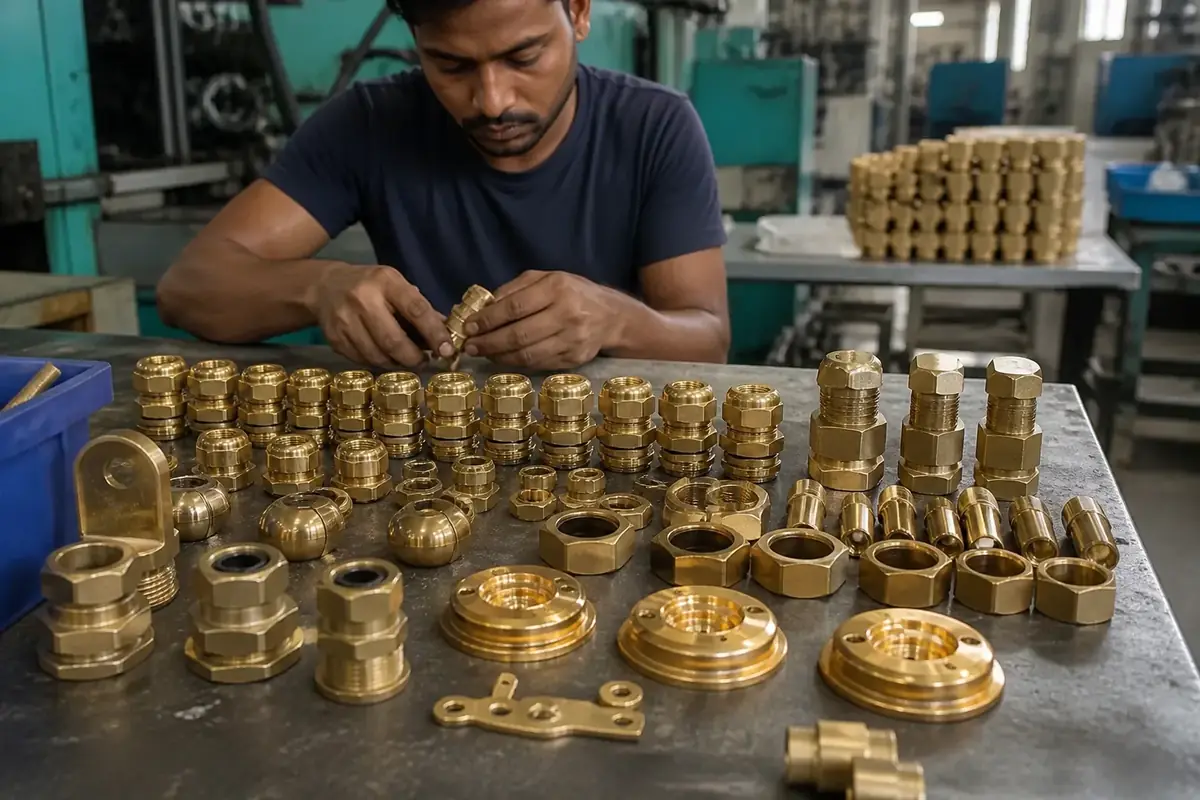
Furniture and architectural OEMs pull knobs, pulls, hinges, escutcheons, decorative collars, and lighting-adjacent hardware. Hand traffic and finish consistency dominate. A tiny colour shift between batches becomes a retailer return even when dimensions pass.
These programs often mix functional threads with visible faces. Specify which surfaces are cosmetic datums and which are purely mechanical. Buffing that removes too much metal can destroy hinge pin fit while improving shine photos.
For OEM furniture and related hardware patterns, see brass hardware furniture OEM applications.
Tools and measuring aids, including stair gauge
Trade tools still use brass where corrosion resistance, mass, and clean marking matter. A stair gauge is a clear example: small clamps that lock onto a framing square so carpenters can transfer consistent rise and run. Brass bodies hold knurling and stamped marks well and do not rust in damp vans the way cheap steel clones can.
Other tool-adjacent parts include gauges, bushings for jigs, level vials housings, and specialty measuring accessories. Tolerances are usually tighter on the functional faces than on the decorative edges. Ask for which surfaces are gauged and which are appearance-only.
Tool buyers often need low-volume flexibility with stable dimensions across reorders years later. Document alloy, knurl pitch, and clamp screw specs so a reorder does not quietly change feel.
Bushings, inserts, and general engineering
Across industries, brass bushings, collars, spacers, and threaded inserts appear whenever designers need a wear surface, a thread in soft material, or a conductive mechanical link. These parts look simple and fail quietly when concentricity or alloy hardness is wrong.
Plastic moulding programs need insert knurl and installation method. Rotating equipment needs ID/OD concentricity. Electrical panels need terminal geometry. The same “brass bush” sketch can mean three different RFQs.
Deepen that family with the hub on brass bushings, inserts, collars, and bearings.

Industry comparison: duty, risk, and first questions
Use this table as a shortlist filter. Exact specs still belong on the drawing.
| Industry | Typical brass parts | Primary risk | First RFQ question |
|---|---|---|---|
| Plumbing / sanitary | Fittings, valves, adapters | Leak, wrong thread, lead rules | Alloy + thread standard? |
| Electrical / lighting | Glands, terminals, brass conduit fittings | Seal fail, contact issues | Conductive vs cosmetic duty? |
| Auto / heat exchange | Adapters, bushings, brass radiator-related parts | Vibration, heat, coolant | OEM or restoration duty? |
| Marine / coastal | Hardware, glands, mounts | Dezincification, seizure | Salt exposure level? |
| Furniture / door | Handles, hinges, knobs | Finish mismatch, wear | Visible finish standard? |
| Tools / trade | Stair gauge, jigs, gauges | Feel, marking, reorder drift | Which faces are functional? |
When one SKU serves two industries
Some geometries cross sectors. A threaded collar may ship as furniture hardware one month and as an electrical spacer the next. That does not mean one specification serves both. Plating that looks right on a cabinet pull can interfere with grounding paths. Lacquer that protects a showroom finish can fail in under-hood heat.
When a drawing is reused across industries, split the SKUs on finish and acceptance notes even if the machining program stays identical. Label cartons by duty. Incoming inspection should know which lot is which. Silent dual-use is how field failures get blamed on “Jamnagar quality” when the real issue was mixed requirements.
Distributors consolidating mixed industries into one container should still keep lot identity. A furniture buyer opening an electrical plating lot will reject for colour; an electrical buyer opening a lacquered décor lot will reject for contact resistance. Industry mapping continues after the PO is signed.
Volume patterns buyers should expect by sector
Plumbing programs often run steady monthly call-offs once a fitting is approved. Electrical OEM schedules can spike with panel builds. Furniture seasons follow retail calendars. Tool accessories may reorder in smaller irregular lots years apart. Matching shop capacity to that rhythm avoids both stockouts and dead inventory.
High-volume cam cells love plumbing inserts and standard glands. Decorative furniture pulls with hand antique work do not belong on the same planner assumptions. Ask suppliers which lines are machine-paced versus labour-paced before you promise your own customers aggressive lead times.
Sample lead time also differs. A stair gauge prototype may ship quickly from bar stock. A marine hardware set needing special alloy and salt-aware finish takes longer even when the sketch looks simple. Build industry reality into the project plan, not only into the unit price spreadsheet.
Inspection emphasis changes with industry duty
Plumbing lots lean on thread gauges and leak or pressure checks where relevant. Electrical lots care about thread engagement, sealing faces, and sometimes conductivity or plating exclusion zones. Auto adapters need dimensional SPC on critical diameters. Marine hardware needs finish integrity and material notes. Furniture hardware needs visual AQL and finish rub checks.
Borrowing a fastener sampling plan for cast decorative hardware—or a décor visual plan for pressure fittings—creates false confidence. Write the inspection plan beside the industry sentence on the RFQ. If the supplier proposes a different plan, make them explain why it still catches the duty’s failure mode.
Export packing is part of inspection readiness. Polished lighting cups scuff differently from zinc-plated conduit fittings. Moisture protection that saves plated glands may trap fingerprints on bright décor. Industry duty follows the part into the carton.
How to write an industry-aware RFQ
Start with one sentence that names the industry and duty. Example: “Potable-water compression fitting for residential manifolds” beats “brass part as photo.” Then attach drawings, alloy preference, finish, volume ladder, and sample needs.
- State industry duty and environment (wet, electrical, salt, hand traffic).
- Attach dimensioned drawing with critical-to-function callouts.
- Name alloy family or compliance constraints.
- Define threads, gauges, and finish with acceptance method.
- Give annual volume and first sample quantity.
- Ask which process cell the supplier proposes—and why.
Industry mapping does not replace engineering judgment. It keeps the first conversation honest so Jamnagar shops quote the right route instead of the cheapest misread.
FAQ: brass applications by industry
How should importers use this map with Jamnagar suppliers?
Name the industry duty, then match process cells—turned fittings, forged bodies, bushings, or decorative hardware—instead of sending one generic brass drawing to every workshop.
Do marine applications need special brass grades?
Often yes. Salt exposure and seizure risk change alloy and finish choices. Confirm service environment before production, not after the first rust claim.
What does brass applications by industry mean for a buyer RFQ?
It means grouping copper-zinc parts by end-use environment so alloy, finish, thread standard, and inspection tests match the duty—not only the geometry on the print.
Why is brass still used in plumbing and sanitary systems?
It machines cleanly, holds threads well, and can resist many water-side conditions when the grade is chosen correctly. Confirm lead and dezincification rules for your market.
Where do brass conduit fittings fit in electrical programs?
They appear with glands and conductive hardware where raceway durability, grounding paths, or sealing matter. Specify thread series and plating before you compare piece prices.
Is a brass radiator still a common OEM part?
Full brass cores are less common in mass lines, but brass and copper-brass heat-exchange parts, tanks, and repair components remain in specialty auto, industrial, and restoration supply chains.
What is a stair gauge and why is it often brass?
It clamps to a framing square to mark consistent stair rise and run. Brass resists toolkit corrosion and takes clear stamped or engraved markings without flaking paint.
Which industries care more about decorative brass than functional brass?
Furniture, door hardware, and lighting programs often balance appearance and wear. Plumbing, electrical, and auto programs usually prioritise sealing, conductivity, or mechanical fit first.
Conclusion
Copper-zinc components succeed when the industry duty is named early. Plumbing wants seals. Electrical wants contact integrity. Auto wants heat and vibration survival. Marine wants chemistry resistance. Furniture wants finish that lasts under hands. Tools want feel that reorders the same five years later.
Use this map of brass applications by industry to choose the right product hub next—and to keep RFQs honest before Jamnagar shops cut metal.
If you remember one rule: duty before diameter. Geometry without industry context is how good machines make the wrong part.
Know Your Industry Duty—Get the Right Quote Path
Match plumbing, electrical, auto, marine, or hardware programs to Jamnagar process cells with an industry-specific RFQ. Browse categories or send drawings through Jamnagar.net.