Brass Bushings and Threaded Inserts: Collars, Sleeves & Fits
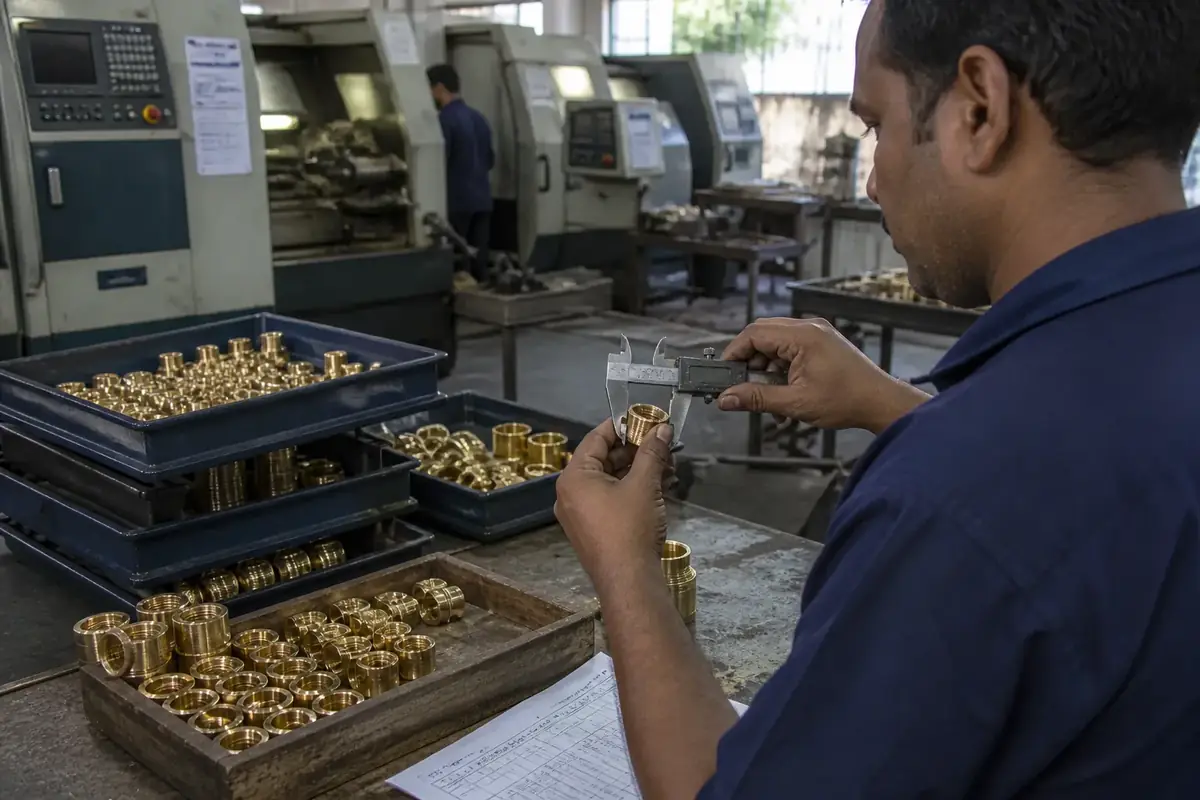
Round brass parts that look alike on a sorting tray can fail for opposite reasons. A sleeve that seizes on a shaft is not the same problem as an insert that spins in plastic. Buyers specifying brass bushings and threaded inserts need clear function language—wear surface, thread carrier, spacer, or locating collar—before they compare piece prices.
Jamnagar’s cam and CNC shops turn these parts at high volume: brass bushings, brass inserts, brass collar parts, spacers, and sleeve-style bearing elements. The cluster advantage is tooling speed. The buyer advantage is writing fits and knurls that survive first-article and year-two production alike.
This guide separates product families, installation methods, and the tolerance calls that keep assemblies quiet and threads reusable. Treat each family as its own drawing discipline even when one workshop can machine all of them.
Quick Lookup
- Name the job: sleeve wear, plastic thread, spacing, or clamping collar.
- Insert knurl and installation method matter as much as thread size.
- Plain brass bearing sleeves are not drop-in replacements for every rolling bearing.
Table of contents
- Product families at a glance
- Bushings, sleeves, and plain bearings
- Threaded inserts for plastic and soft hosts
- Collars, spacers, and locating rings
- Earth tags, craft rings, and collar stays
- How shops typically make them
- Fit and function comparison
- Tolerance and surface priorities
- Wear, lubrication, and housing notes
- RFQ and sampling checklist
- Plastic hosts and hybrid assemblies
- Mistakes that spin or seize
- FAQ
Product families at a glance
Start every RFQ with one primary noun. Brass bushings imply a bore that guides or supports. Brass threaded inserts imply reusable threads in a weaker host. Collars clamp or locate on a shaft. Spacers hold distance. Calling everything “brass inserts” when you mean a plain sleeve is how wrong knurls and wrong IDs arrive in the same carton.
Related fastener joints—when you need a nut or machine screw rather than an insert—belong in brass fasteners: screws, nuts, and bolts. Keep the BOM lines distinct even if one supplier can make both.
“If plastic holds the part, design the knurl. If a shaft rides in the part, design the bore. Mixing those sentences on one drawing is expensive.”
Bushings, sleeves, and plain brass bearings
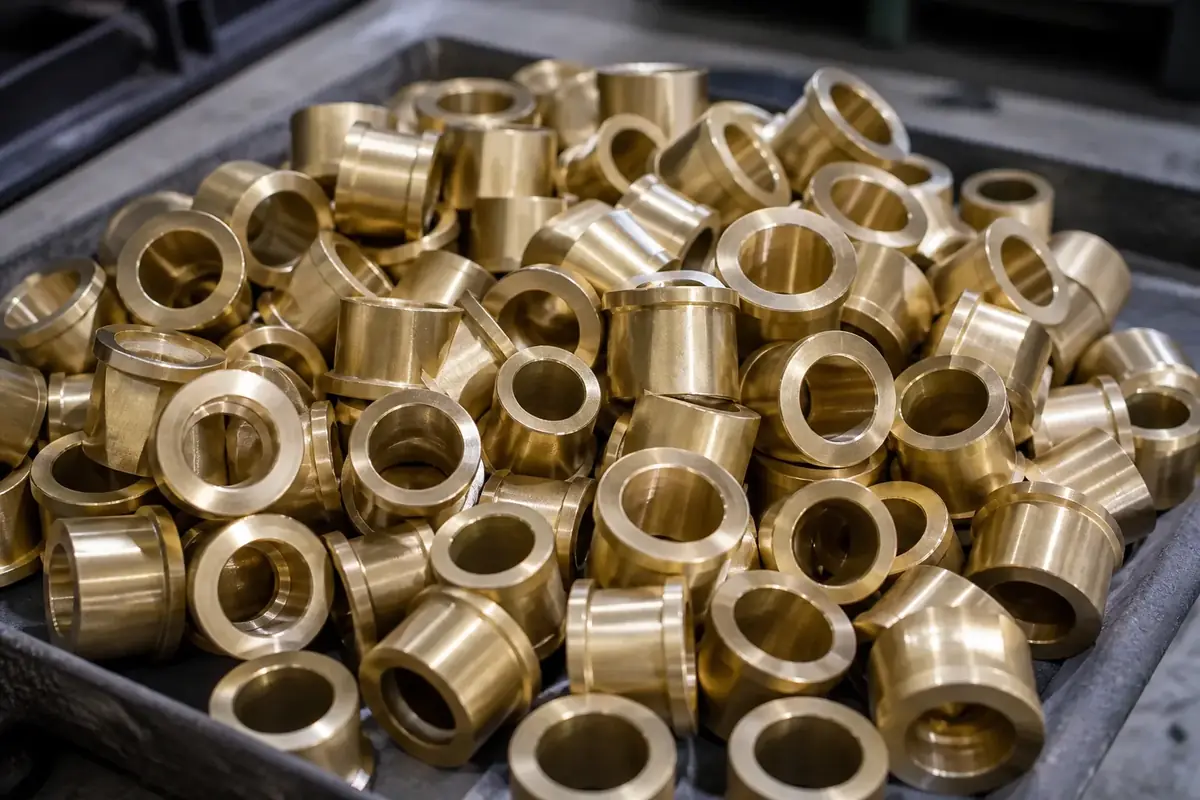
A brass sleeve bushing (or brass sleeve) is a cylindrical wear element: ID for the shaft, OD for the housing, length for engagement. Oil grooves, flanges, and split designs appear when maintenance or assembly needs them. Plain brass bearing language in RFQs often means this sleeve family—not a sealed ball bearing cartridge.
Fit class decides noise and life. Too tight and the assembly runs hot; too loose and you get slap. Specify shaft material, lubrication plan, and whether the bushing is press-fit, adhesive-fit, or retained by a shoulder. Surface finish inside the bore matters more than a bright OD that nobody sees after installation.
Brass suits many moderate-duty, corrosive, or electrically relevant environments. It is not automatically correct for high-speed precision spindles. Be honest about PV (pressure-velocity) expectations even if you only write them as duty notes for the shop.
Sleeve drawing notes that help
- ID / OD / length with which dimensions are critical.
- Flange diameter and thickness if flanged.
- Groove or hole features for lubrication.
- Press-fit interference target or housing tolerance.
- Deburr standard on entry chamfers.
Brass inserts for plastic and soft host materials
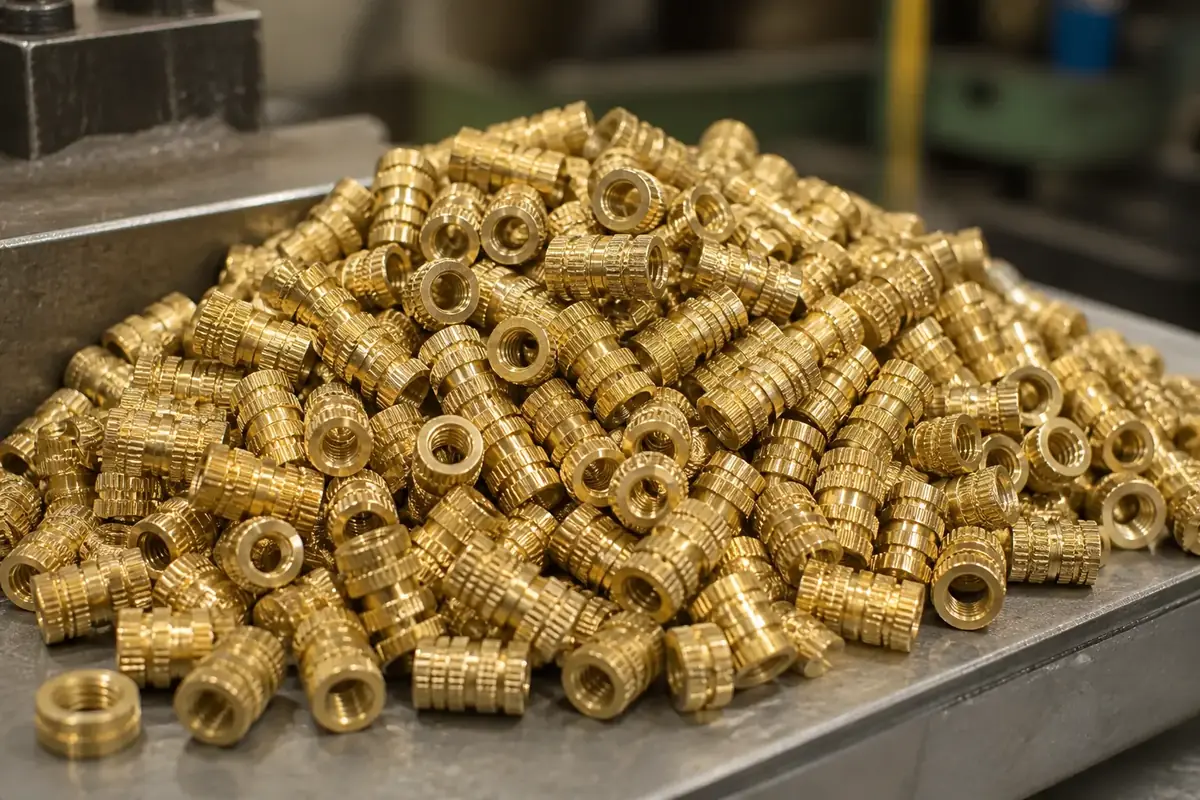
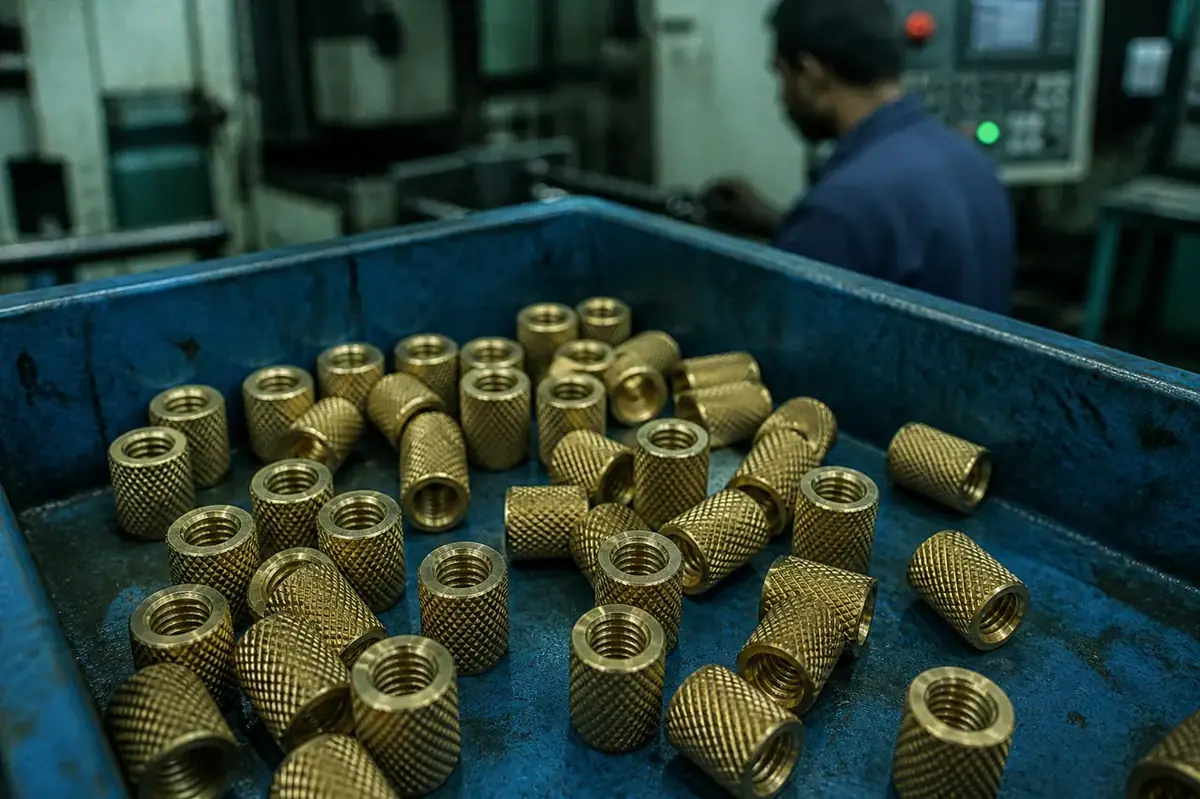
Brass inserts for plastic are a Jamnagar staple. Knurled or undercut exteriors grip the polymer; internal threads take machine screws repeatedly without chewing the plastic. Installation methods—heat-staking, ultrasonic, moulded-in, or press-in—change knurl geometry and pilot-hole advice.
Name the plastic. ABS, nylon, polycarbonate, and filled compounds pull differently around a hot insert. A knurl that locks in one resin can crack another. Flange inserts, reverse-taper designs, and blind inserts each solve a different pull-out or cosmetic constraint.
Thread quality still follows fastener rules: standard, pitch, and plating allowance if screws are coated. Pair insert specs with component specifications, threads, and tolerance when class fits are tight.
Insert installation checklist
- Installation method and temperature/energy window if heat or ultrasonic.
- Pilot hole diameter and depth for the chosen method.
- Knurl pattern or undercut dimensions with retention requirement.
- Thread size and whether the insert is through or blind.
- Pull-out and torque-out test method on the real plastic grade.
Collars, spacers, and locating rings
A brass collar may clamp with a set screw, sit as a solid locating ring, or act as a decorative stop. Brass spacers control stack height between components—length tolerance is the product. Face squareness matters when the spacer transmits clamp load or aligns a bearing housing.
Set-screw collars need a proper pad or cup point note so the screw does not raise a burr that ruins shaft removal later. Split collars ease assembly on crowded shafts; solid collars can be stronger for the same OD if designed correctly. Say which you need.
Furniture and equipment OEMs often buy spacers and collars alongside visible hardware. Application context continues in brass hardware and furniture OEM applications.
Earth tags, craft rings, and collar stays
Not every “small brass ring” is an engineering bushing. Earth tags are conductive bonding tags used with cable glands and electrical hardware—hole pattern, thickness, and plating dominate. Brass rings for crafts prioritise colour and join quality for jewellery or décor. Brass collar stays are apparel components with stiffness and edge comfort requirements foreign to a machine bushing drawing.
Group these correctly on purchase orders. A shop that shines at cam-turned inserts may not be the right cell for stamped earth tags, and vice versa. Ambiguous “brass ring” language wastes everyone’s week.
How Jamnagar shops typically make them
Most of these parts start as extruded rod. Automatic lathes dominate high-volume inserts and spacers; CNC covers concentric bushings with tighter bore requirements or odd grooves. Secondary knurling, tapping, cross-drilling, and milling add retention and assembly features.
Casting appears when near-net shapes beat solid-bar scrap, then machining finishes the functional faces. Process selection guidance sits in brass casting, machining, and CNC turned parts. For custom geometry, MOQ, and sampling discipline, use custom brass components: drawings, MOQ, sampling.
Chip control and tool wear on free-cutting grades keep unit costs down. If your market requires lead-free alloys, expect different speeds, finishes, and sometimes different knurl behaviour—validate with the production alloy, not a convenient substitute. A beautiful leaded sample that will never ship to your market is a schedule risk wearing a yellow coat.
“Sample inserts in the real resin. Sample bushings on the real shaft. Paper fits lie politely.”
Fit and function comparison
Use this table to keep mixed turned-part RFQs from blurring into one SKU.
| Part family | Primary function | Critical features | Typical test |
|---|---|---|---|
| Sleeve bushing / bearing | Guide shaft / reduce wear | ID, OD, bore finish, length | Fit on shaft; spin/drag check |
| Threaded insert | Threads in plastic/soft host | Thread, knurl, flange | Install + torque/pull-out |
| Collar | Locate or clamp on shaft | Bore, width, set-screw detail | Clamp hold; face square |
| Spacer | Control stack height | Length, faces, bore clearance | Length gauge; parallel faces |
| Earth tag | Electrical bonding | Holes, thickness, plating | Continuity; fit on gland |
Tolerance and surface priorities
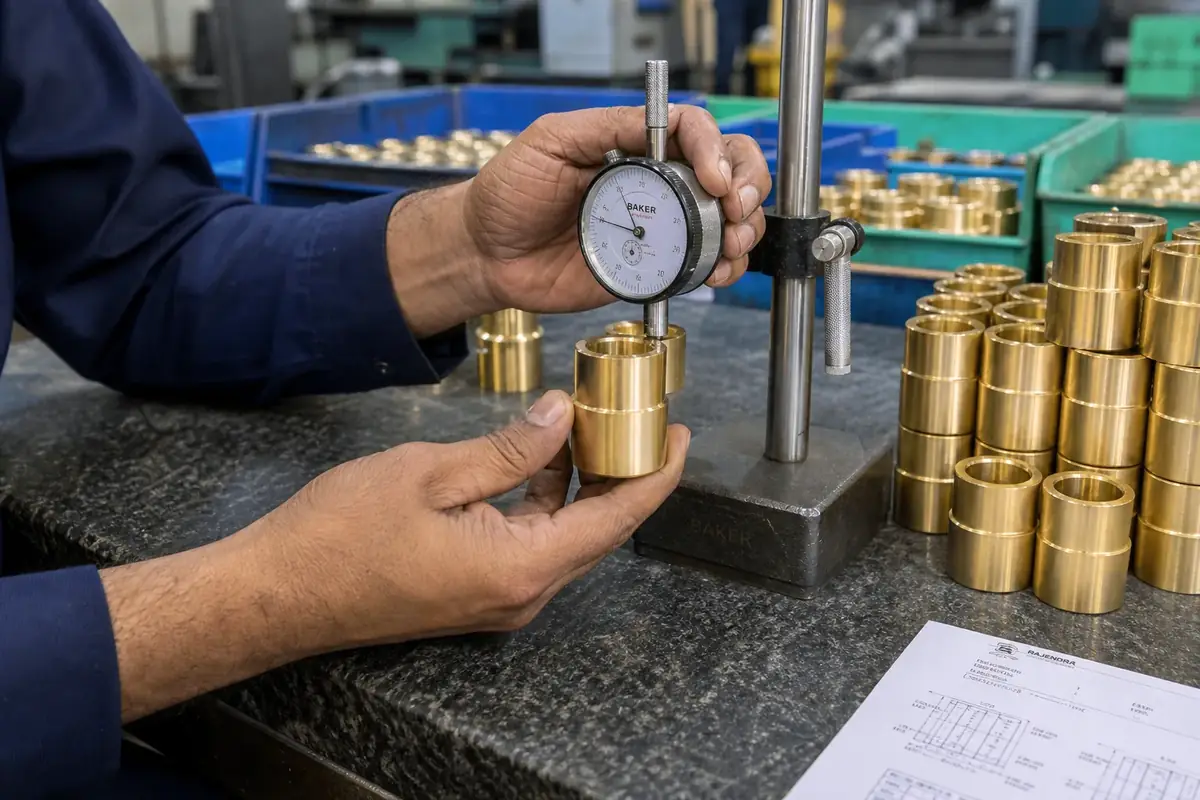
Not every dimension deserves a tight box. Mark critical fits. A spacer length may be ±0.05 mm while the OD is free. A bushing bore may need a defined surface roughness while the OD only needs press-fit size.
Concentricity between ID and OD matters on rotating sleeves. Runout that looks minor on a bench can vibrate in a fan or pump. For inserts, concentricity between knurl pitch diameter and thread axis reduces screw tilt and cosmetic sink marks in thin plastic walls.
Deburr is a functional spec on entry chamfers and thread starts. A sharp burr can score a shaft or peel plastic during heat installation.
Wear, lubrication, and housing design notes
A brass sleeve bushing lives or dies with the housing and shaft it meets. Soft housings that ovalise under press-fit will pinch the bore. Hard shafts with poor surface finish will polish ridges into the brass within weeks. Specify shaft hardness and finish when duty is continuous. Add oil holes or grooves when relubrication is part of the maintenance plan—not as decoration on a drawing that never sees oil again.
Dry-running brass against some plastics can work for light duty and fail for heat-prone cycles. If designers expect “maintenance free,” prove it on a duty cycle test, not on hope. Flanged sleeves help with axial location; unflanged sleeves need a shoulder or retainer so they do not walk out under vibration.
For inserts, plastic creep is the silent enemy. A perfect knurl install in January can loosen in July if clamp load and temperature push the polymer. Design bosses with enough wall, and consider metal collars or larger flanges when joints see repeated service torque. Blind inserts keep screws from poking into wiring cavities—use them when the opposite face must stay sealed or cosmetic.
Incoming inspection that matches the failure mode
Measure what fails in the field. If inserts spin, audit knurl outer diameter and undercut depth, then re-run install trials. If bushings seize, audit ID, roundness, and bore finish—not only the pretty OD. Spacers that tilt need face parallelism checks with a sensible sample size, not a single first-article hero piece.
Keep a gold-sample tray: one approved insert, one approved bushing, one approved spacer per active SKU. Production drift is easier to catch when the eye and the micrometer share a physical reference. Photograph knurls under consistent lighting; they are hard to describe in words alone.
When volumes jump from pilot to mass production, reconfirm that the same rod diameter, machine type, and knurl wheels are still in use. Silent process changes—new subcontractor, new heat, new plating bath—are classic insert failure roots.
RFQ and sampling checklist
- Part function — bushing, insert, collar, spacer, tag, or craft component.
- 2D/3D drawing with critical dimensions flagged.
- Alloy and any lead-free or plating requirements.
- Host details — shaft size/material or plastic grade and install method.
- Thread and knurl data for inserts; bore/OD for sleeves.
- Volume ladder and target annual usage.
- First-article contents — gauges, install trial, retention masters.
- Packing — prevent knurl crush and bore denting in transit.
If you change plastic grade mid-program, reopen insert validation. Resin changes are not “free” even when the brass print stays still. The same warning applies when screw plating changes: an insert that accepted a plain steel screw may bind on a heavily coated one.
Where spacers and collars share a shaft with sleeve bushings, dimension the stack on one drawing view. Piece-level RFQs that never show the assembly invite three perfect parts that cannot assemble. A single stack sketch saves more argument than another round of isolated mic reports.
Plastic hosts, metal hosts, and hybrid assemblies
Brass inserts for plastic dominate export volumes, but inserts also land in wood composites, soft aluminium housings, and cast bodies that cannot hold fine threads alone. Each host changes pilot geometry and install energy. What “feels seated” in ABS may crush a thin PC boss. Publish host-specific hole charts and keep them revision-controlled beside the insert drawing.
Hybrid assemblies—plastic cover on a metal frame—often mix insert-mounted screws with direct metal threads. Standardise screw families where you can so service technicians do not carry six drive bits for one product. Where a brass collar locates a shaft that also passes through a polymer bearing pocket, stack-up analysis prevents mystery binding that gets blamed on the brass alone.
Electrical products sometimes place inserts near live parts. Creepage, clearance, and earthing paths belong in the design review. An insert is a conductor. Treat it like one when the housing is an insulator by design.
Scaling from sample to container
Pilot lots often run on a skilled CNC cell; mass lots move to cam automatics. Both can be excellent—if knurl wheels, thread tools, and inspection plans transfer. Demand a process confirmation when volume steps up: same alloy rod source family, same knurl specification, same gauge set. A “cost-down” that silently changes OD stock by 0.1 mm can alter press-fit bushings enough to scrap housings.
Packing must scale too. Knurls crush when bulk bags are overfilled. Bore IDs dent when parts rattle loose in thin cartons. Use compartment trays or layered poly with stiffeners for precision sleeves. Cheap packing is a common root cause that looks like a machining defect at receiving.
Mistakes that spin or seize
- Ordering inserts without naming heat vs ultrasonic vs moulded-in installation.
- Calling a plain sleeve a “bearing” without duty or lubrication notes.
- Ignoring plating thickness on insert internal threads.
- Accepting sample knurls that were hand-adjusted and never tooled for production.
- Mixing craft ring cosmetics into industrial bushing tolerances.
- Skipping chamfer/deburr notes until shafts and plastics show damage.
- Changing plastic resin without re-validating insert retention.
- Moving from CNC pilot to cam production without knurl re-approval.
These parts are small and numerous. A one-percent functional failure rate is a large absolute number. Design the retention and the fit on paper before you chase the last fraction of a cent.
FAQ: bushings, inserts, collars & bearings
What belongs in a first-article insert pack?
Dimensions, thread gauges, knurl evidence, material note, and installation results in the actual plastic. Retain masters for production comparison.
How are these parts usually made in Jamnagar?
Mostly turned from extruded rod on automatic or CNC lathes, with knurl and secondary ops as needed. Casting appears for certain near-net shapes before machining.
What is the difference between a brass bushing and a threaded insert?
A bushing guides or supports; an insert provides threads in a softer host. Name the primary function so knurl and bore features are not confused.
How do I specify brass inserts for plastic?
Thread, knurl/undercut, pilot hole, installation method, and plastic type. Add pull-out and torque-out expectations for the real resin.
When is a sleeve bushing better than a rolling bearing?
For moderate loads, simple assemblies, corrosion preference, or oscillatory motion. High-speed precision spindles usually need a different bearing approach.
What tolerances matter on collars and spacers?
Length/thickness for spacing, bore/OD for fit, and face squareness when locating against shoulders. Flag critical dimensions explicitly.
Are earth tags part of the insert family?
They often ship with electrical hardware programs but are a separate stamped/formed family. Spec holes, thickness, and plating on their own line.
Can craft rings use industrial bushing specs?
Share alloy families if needed, but not QC plans. Craft prioritises appearance; bushings prioritise controlled fits and wear surfaces.
Conclusion
Bushings, inserts, collars, and spacers are precision commodities only when the function is named. Jamnagar can turn them quickly; your drawing decides whether they press, spin, or seize.
Validate inserts in real plastic and bushings on real shafts. Protect knurls and bores in packing. Keep craft rings and earth tags out of the engineering bushing line. When volume scales, reconfirm the process cell—not only the piece price—so pilot quality survives the first full container.
That is how brass bushings and threaded inserts stay boring—in the good way—year after year. Quiet assemblies are the point; silent process changes are the risk.
Need Inserts, Bushings or Collars?
Send bore fits, knurl details, and plastic or shaft notes for a focused inserts and bushings RFQ. Review turned components with direct supply-desk support on Jamnagar.net.