Brass Fasteners, Screws, Nuts & Bolts: Buyer Spec Guide
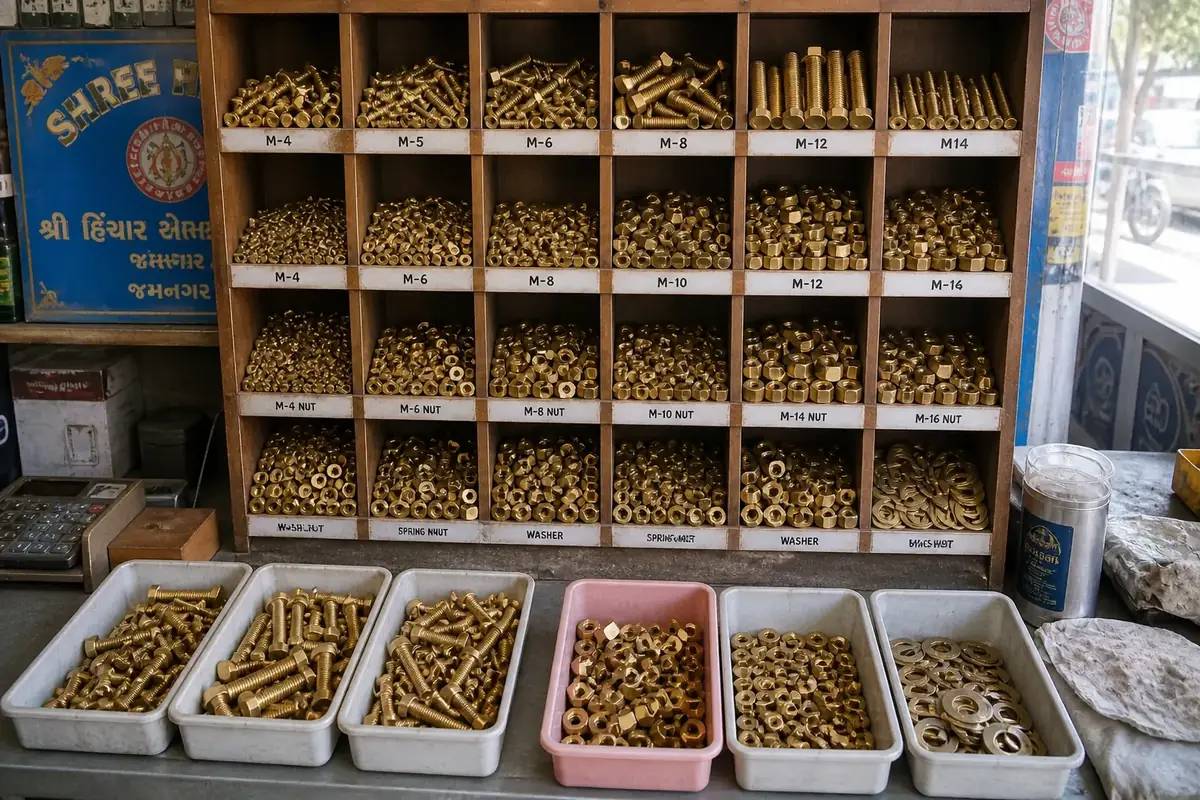
A fastener looks simple until a plated thread will not start, a wing nut binds, or a decorative screw head twists off under a power driver. Buyers researching brass fasteners screws nuts bolts need more than a size chart—they need thread discipline, finish awareness, and a clear split between machine hardware and architectural ironmongery.
Jamnagar’s automatic lathe density grew partly on high-count brass screws, brass nuts, and related turned hardware. That capacity helps OEMs and distributors—but only when drawings name the standard, the head, and the acceptance gauges.
This hub covers machine fasteners, washers, anchors and eyelets, plus door and sash hardware that shares the “brass fastener” search label without sharing the same shop cell.
Highlights
- Thread standard mismatches cause more failures than alloy colour.
- Plating thickness can push borderline threads out of class—plan for it.
- Door bolts and sash fasteners are not industrial hex bolt clones.
Table of contents
- Why brass fasteners earn a place
- Brass screws and machine screw types
- Nuts, bolts, and related hardware
- Washers, cups, and load spreaders
- Anchors, eyelets, pins, and clips
- Door bolts and sash fasteners
- Threads, gauges, and plating
- Fastener family comparison
- Quality checks before shipment
- Kits and OEM line-side packing
- RFQ checklist
- Alloy, lead-free notes, and finish stacks
- FAQ
Why brass fasteners earn a place on the BOM
Brass fasteners show up where corrosion resistance, appearance, conductivity, or non-sparking preferences matter more than ultimate tensile strength. Furniture OEMs, electrical assemblies, marine-adjacent interiors, and instrument makers all pull brass hardware for reasons steel coatings cannot fully replace.
Strength honesty matters. Brass is not a substitute for structural steel bolts in high-load joints. Use it where the joint load fits the alloy—and where a seized steel fastener would be worse than a carefully specified brass one.
For furniture and OEM contexts that consume mixed hardware sets, see brass hardware and furniture OEM applications.
“A beautiful screw that fails Go gauge after plating is scrap with good photography.”
Brass screws and machine screw types
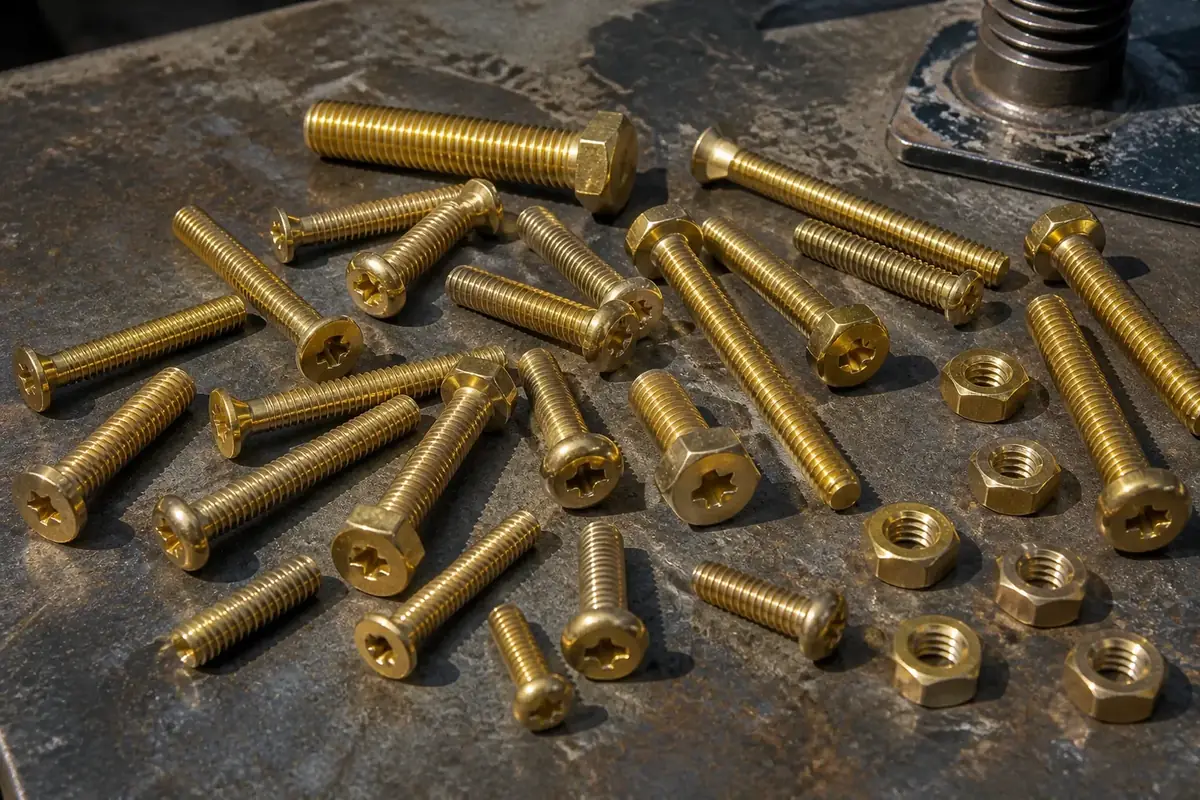
Brass machine screws are the volume backbone: metric and imperial threads turned or rolled for nuts and tapped holes. Head styles include pan, cheese, countersunk, and round head brass screws. Drive types—slotted, Phillips, hex socket—must match the customer’s assembly tools, not the machine that happens to be free on Tuesday.
Small brass screws and popular sizes such as M4 brass screws move constantly through export cartons. Brass set screws and brass socket screws serve clamping and adjustment duty where a headless or hex-socket form fits the design. Antique brass screws add a finish call—approve colour under the same light the end customer will use.
Length under head, thread length, and point style belong on the print. Implying “same as sample from last year” without a retained master is how mixed lots appear after a tooling refresh. If last year’s master is lost, cut a new approval lot before releasing volume—nostalgia is not a gauge.
Screw RFQ details that prevent rework
- Thread size and pitch with standard reference.
- Head style, drive, and recess depth limits.
- Full thread vs partial thread length.
- Finish: plain, nickel, antique, lacquer—plus plating thickness if coated.
- Packaging: bulk, counted polybags, or kit assortments.
Brass nuts, bolts, and related hardware
Brass nuts and bolts (also searched as brass nut bolt) cover hex nuts, lock-style variants where specified, brass wing nuts for tool-free adjustment, and brass bolts in hex, carriage, and eye forms. Brass carriage bolts need a clean square neck; brass eye bolt designs need a defined eye ID and load story even when used lightly.
Across-flats accuracy and thread concentricity decide whether a nut spins freely by hand or binds at the first thread. For high-count programs, insist on gauge plans that match the screw lot—not a generic “OK by eye” from the plating line.
Where a threaded joint needs a bushing or insert instead of a nut, switch product families. Inserts and collars are covered in brass bushings, inserts, collars, and bearings.
Washers, cups, and load spreaders
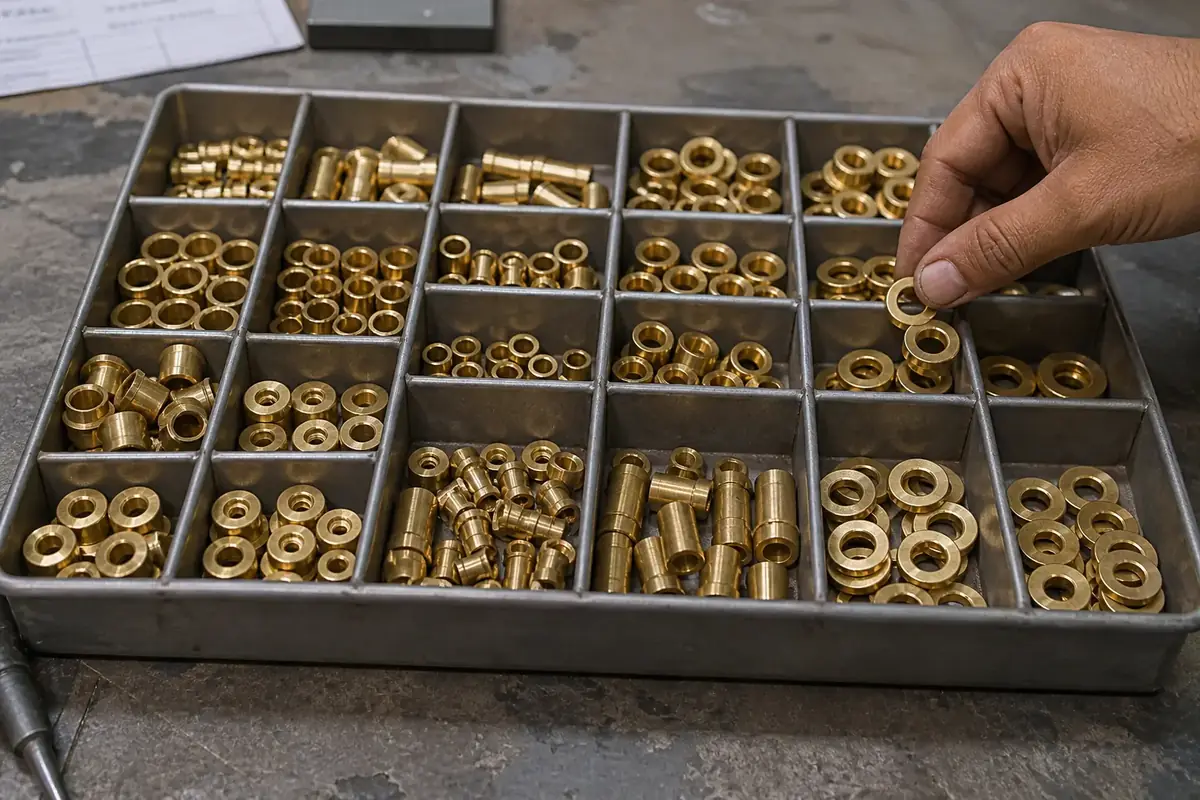
Brass washers look trivial and cause loud complaints when the ID nicks a thread start or the OD looks wrong on finished wood. Specify inner diameter, outer diameter, thickness, and flatness. Soft brass marks easily—packing that allows washers to telescope and scratch will show on bright lots.
Screw cup washers (often discussed with brass screw cups) dress countersunk or raised heads on cabinetry. Match cup geometry to the screw head, not to a generic washer OD. Finish should travel with the screw family so mixed antique and bright parts do not appear on one drawer front.
Anchors, eyelets, pins, clips, and small metalware
Beyond classic nut-and-bolt sets, buyers pull brass anchors, brass eyelets, brass eyelet variants, brass grommets, brass clips, brass nails, brass staples, brass split pins, brass split ring parts, brass safety pins, brass d ring hardware, and even brass carabiner-style accessories for light duty. Each family has its own tooling and test method.
Eyelets and grommets need hole size, flange diameter, and setting tool compatibility. Split pins need wire diameter and eye form. Anchors need substrate guidance—what works in one board may spin in another. Do not bury these SKUs inside a hex-bolt price line.
Marble and stone hardware sometimes references a marble tower bolt style fastener for panels or furniture. Treat that as application-specific hardware with finish and throw requirements, not as a standard machine bolt.
Door bolts, sash fasteners, and architectural ironmongery
Brass door bolts, brass deadbolt components, sash fastener hardware, brighton sash fastener styles, and casement fastener sets are mechanisms first. They include plates, slides, wedges, and screws as a system. Quoting them like loose brass bolts for machinery invites missing keepers and wrong offsets.
Architectural programs care about hand, backset, throw, and finish match to nearby handles. Continue into door-specific sourcing via brass door hardware: handles, knobs, hinges when the fastener is part of a visible ironmongery suite.
Sample on the actual window or door section. A sash fastener that seats on one profile can miss the meeting rail on another by a few millimetres—enough to scrap a container of “almost right” castings.
“If it has a keeper, it is a mechanism. Price and inspect it like one.”
Threads, gauges, and plating reality
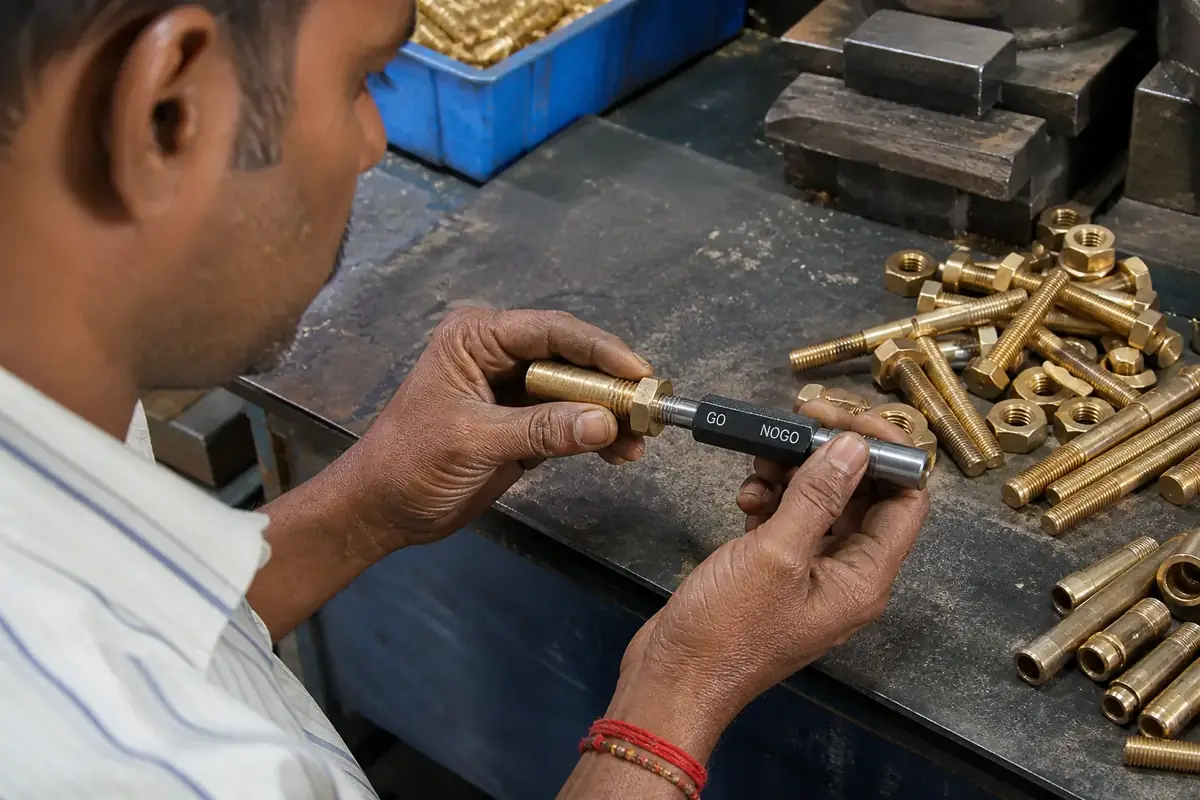
Thread standard is non-negotiable. Metric coarse, metric fine, Unified, and specialty forms do not “almost” assemble. Write the standard on the drawing and keep Go/No-Go ownership clear between buyer and seller.
Plating adds thickness. Nickel or similar coatings can push a borderline external thread into interference—especially on fine pitches and small diameters like M4. Either machine for plating allowance or specify a plating thickness that the thread class can absorb. Deeper guidance lives in brass component specifications, threads, and tolerance.
Never approve threads only after plating if production will change bath thickness. Lock the process note with the sample.
Fastener family comparison
Use this table to keep mixed hardware RFQs from collapsing into one vague “brass fasteners” line.
| Family | Key specs | Typical use | Watch-outs |
|---|---|---|---|
| Machine screws | Thread, head, drive, length | Tapped holes, nuts, instruments | Plating vs thread class |
| Nuts & bolts | AF, thread, grade/load note | Assemblies, adjustment, eye forms | Strength overpromise |
| Washers / cups | ID, OD, thickness, finish | Load spread, cabinetry dress | ID nicking threads |
| Eyelets / grommets | Hole, flange, set height | Textiles, leather, panels | Tool mismatch |
| Pins / rings / clips | Wire dia, form, opening | Retention, light linkages | Spring-back; mixed alloys |
| Door / sash fasteners | Throw, hand, finish, keepers | Windows, doors, furniture bolts | Profile fit; incomplete sets |
Quality checks before shipment
Incoming inspection for fasteners is cheap compared with field failures. Prioritise thread gauges, head and drive checks, and finish adhesion on coated lots. Sort mixed sizes ruthlessly—one wrong M4 in an M5 bag becomes a production-line legend for the wrong reasons.
Defect patterns and sampling logic are expanded in brass product defects and quality checks. For plated screws, include a simple fit test in the mating nut or tapped block from the same approval lot.
Count accuracy matters on small screws. Weigh-count methods need calibration pieces from the actual lot; density shifts with plating and head style.
Minimum inspection set
- Go/No-Go on external and internal threads as applicable.
- Head height, diameter, and recess depth sampling.
- Across-flats on nuts and hex bolts.
- Visual finish vs approved sample under agreed light.
- Bag/poly count audit on small hardware kits.
Kits, assortments, and OEM line-side packing
Many buyers do not want loose bulk. They want counted kits: ten M4 brass screws, ten washers, two wing nuts, one spare—labelled for a furniture SKU. Kit work adds labour and error modes. Wrong bag counts and mixed finishes inside one polybag create louder complaints than a slightly soft hex corner ever will.
Define bag material, label fields, barcode rules if any, and whether anti-tarnish paper is required. Bright brass in humid warehouses darkens; some programs accept that patina, others treat it as a defect. Say which. For retail assortments of small brass screws, compartment boxes need foam or dividers so vibration does not cross-contaminate sizes.
OEM line-side packing may demand orientation—heads nested, points protected—so robots or operators pick without gloves full of scratches. That is a process note, not a free courtesy. Price it, sample it, lock it.
Driver and assembly realities
Brass is softer than many steel fasteners. Power drivers set for steel will cam out of brass recesses or twist heads off. Publish recommended torque bands for critical joints, especially on round head brass screws and fine decorative hardware. Slot drives look traditional and punish impatient pneumatic tools.
If your assembly uses threadlocker or sealant, confirm chemical compatibility with any lacquer or plating. Some compounds stain bright brass permanently. A one-page assembly note attached to the PPAP-style pack prevents “supplier quality” tickets that were really process tickets.
For mixed-metal joints—brass screw into steel insert, or brass nut on steel stud—watch galvanic and seizure behaviour in wet environments. Designers sometimes choose brass for looks and forget the rest of the stack is still steel outdoors.
RFQ checklist for brass fasteners
- Product family — machine screw, nut/bolt, washer, eyelet, architectural fastener.
- Thread standard and size — including pitch and class if known.
- Geometry — head, drive, length, AF, eye ID, flange sizes as relevant.
- Alloy and finish — plain, plated, antique; plating thickness if coated.
- Mating part note — nut, tapped hole, sash profile, or substrate for anchors.
- Volume ladder — sample, pilot, annual forecast.
- Gauge and AQL plan — who owns Go/No-Go masters.
- Packing — bulk vs kits, labels, rust/moisture protection for mixed metal sets.
Photos help for head style. Standards beat photos for acceptance. Send both. If you maintain a preferred-parts list across multiple products, publish it to suppliers so they stop reinventing near-identical M4 and washer variants that only differ by undocumented fillet radii.
For architectural ironmongery, include hand, offset, and finish adjacency notes—what handle or hinge family the bolt or sash fastener must sit beside. Industrial hex programs can skip that language; door programs cannot. Matching “brass” across two factories without a shared master is how lobbies end up with two yellows under the same spotlight.
Alloy, lead-free notes, and finish stacks
Free-cutting brass dominates screw-machine fasteners because chips break and tools last. Destination markets that restrict leaded alloys change machinability and sometimes surface response after plating. Call the compliance need on day one—not after a container of bright screws fails a customer audit.
Finish stacks vary: plain polished, clear lacquer, nickel, antique chemical, and other decorative systems. Each stack changes thread fit and corrosion behaviour. Antique brass screws should reference a retained master; “antique” without a chip is a mood, not a spec. Where conductivity matters—certain electrical hardware—confirm that lacquer or heavy decorative coats will not isolate contact faces unintentionally.
Washers and cups must travel with the same finish family as their screws when they sit on visible furniture. A bright cup under an antique head reads like a mistake even if both parts are dimensionally perfect. Kit BOMs should lock finish codes per line, not assume “brass colour” is one colour.
Volume planning and second sources
High-count fasteners tempt single-source dependency. If one cam shop owns your entire M4 program, ask what happens during tool rebuild weeks. A documented second cell—or at least a proven overflow route inside the cluster—keeps OEM lines fed. Samples from the overflow route must pass the same gauges; “same drawing” is not enough if knurl-free screws suddenly arrive with different head fillets.
Forecast honestly. Sudden spikes force mixed heats and rushed plating that create the defects your AQL was meant to catch. A staggered release plan with safety stock of critical sizes usually costs less than airfreighting emergency screws after a line stop.
Common sourcing mistakes
- Ordering “brass screws” with no thread standard or head style.
- Approving unplated samples, then plating production without allowance.
- Mixing sash fastener mechanisms into industrial bolt price comparisons.
- Ignoring washer ID that damages the first thread on assembly.
- Assuming brass matches steel strength classes by size alone.
- Skipping drive-recess depth checks until bits cam out on the line.
- Changing plating houses mid-program without re-gauging threads.
- Building kits without a counted audit plan for small hardware.
Fasteners are high-count, low-forgiveness parts. The paperwork should be stricter than the piece price suggests. When in doubt, gauge more and narrate less.
FAQ: brass fasteners, screws, nuts & bolts
Are door bolts and sash fasteners industrial hex bolts?
No. They are architectural mechanisms with keepers, throws, and finish systems. Quote and inspect them as their own family.
Why choose brass fasteners instead of steel?
Corrosion behaviour, appearance, and certain electrical or non-magnetic needs. Strength is lower than high-grade steel—match the alloy to the load.
What thread details belong on a brass screw RFQ?
Standard and size, pitch, length under head, head and drive, plating notes, and gauge ownership. Sample approval rules should be written, not verbal.
Are machine screws the same as wood or self-tapping brass screws?
No. Thread geometry and tips differ. Keep machine screws for nuts and tapped holes; specify specialty screws separately.
When should I use brass washers or screw cups?
Washers spread load and protect surfaces. Screw cups finish cabinetry heads. Spec ID, OD, thickness, and finish with the matching screw.
Can local shops supply anchors and specialty hardware?
Often yes—anchors, eyelets, grommets, clips, and pins appear across the cluster. Confirm process route and test installation on your substrate.
How do antique brass screws differ in sourcing?
Antique is a finish call over the same dimensional screw. Approve colour samples under real lighting before mass production.
What checks catch bad nuts and bolts early?
Thread gauges, AF and head checks, drive recess depth, plating adhesion, and fit tests in the mating part. Mixed standards are a top failure mode.
Conclusion
Brass fasteners reward precision: thread standard, head geometry, finish thickness, and honest load expectations. Jamnagar can produce volume—your RFQ decides whether that volume is usable.
Separate machine screws from sash hardware. Gauge after the real finish process. Pack small parts so counts and surfaces survive the ocean. Keep kit audits and torque guidance beside the drawing pack so assembly teams inherit the same discipline purchasing used at quote stage.
Those habits turn brass fasteners screws nuts bolts from a commodity search into a controlled supply line—one that still looks right on a finished door, drawer, or instrument panel after months of real handling.
Building a Brass Fastener Program?
Share thread standards, head styles, and annual volumes for OEM fastener support. Browse screws, nuts, bolts, and related hardware with direct factory pricing on Jamnagar.net.