Brass CNC Turned Components in Jamnagar: Casting to Machining
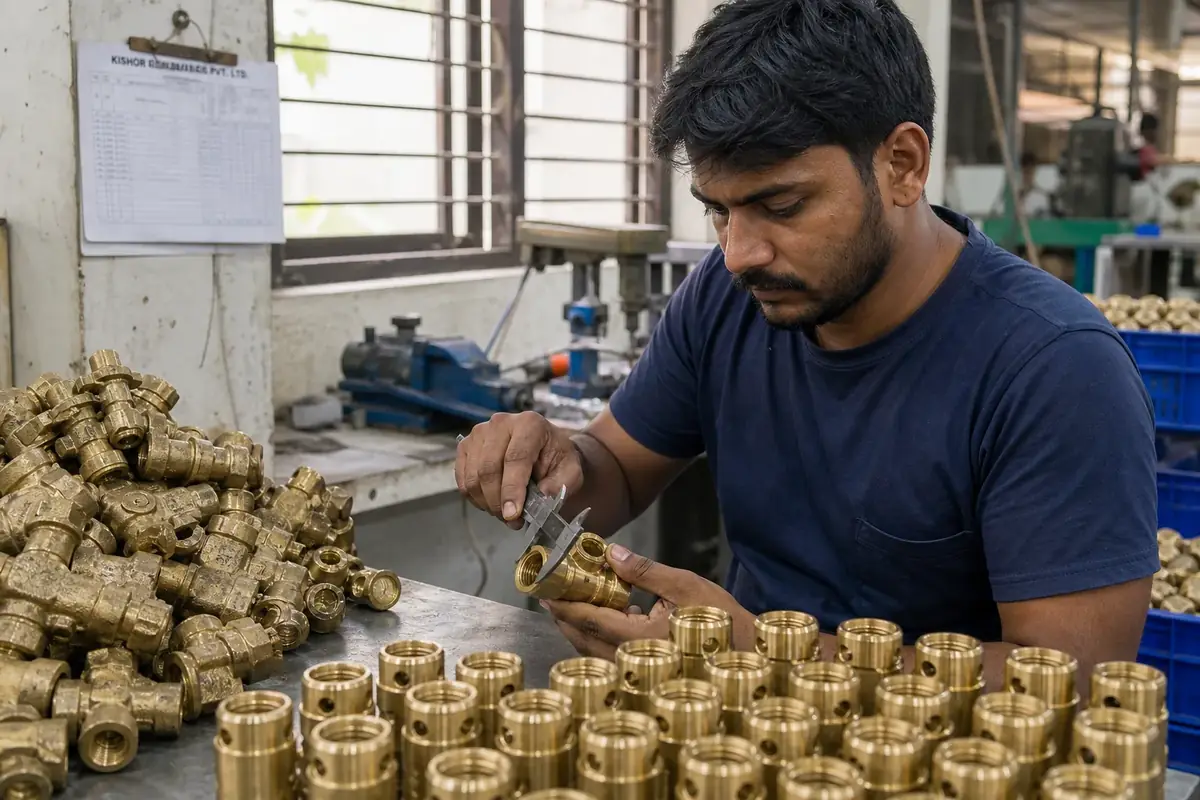
Most RFQs that say “machine this in brass” hide a process choice. Some parts belong on extruded rod under a CNC turret. Others start as castings, then receive threads and sealing faces. A few need brazing brass joints after primary machining. Understanding how brass CNC turned components Jamnagar shops actually route work prevents quotes that look cheap until porosity, ovality, or wrong stock shows up.
This guide walks casting, bar machining, secondary operations, joining, and inspection—the same language used when buyers ask for pins, cylinders, strainers, hex nipples, or a brass ball valve body blank. It is written for engineering and procurement readers, not as a catalogue page.
If you are still shortlisting factories, pair this process map with the brass parts manufacturer buyer guide.
Quick Lookup
- Rotational parts from rod: cam or Swiss CNC. Bulky near-net shapes: cast or forge, then machine.
- Valve and meter bodies fail on porosity and sealing faces more often than on polish.
- Joining (braze/solder/weld) needs its own acceptance test—do not bury it in “machining.”
Table of contents
- Choosing cast, forge, or rod-turned routes
- Brass casting for near-net blanks
- Brass CNC turned components in Jamnagar
- Hex bar, round stock, and secondary ops
- Product examples: valves, strainers, pins
- Brazing, soldering, and welding in assemblies
- Finish, powder coat, and surface notes
- Process comparison table
- QC plans that catch real failures
- RFQ and sampling checklist
- FAQ
Choosing cast, forge, or rod-turned routes
Start with geometry and duty, not with the machine you like. A slender pin with tight concentricity wants bar-fed CNC. A thick, irregular housing wants casting or forging with machining allowances. A mid-volume hex fitting might sit happily on brass hex bar with minimal milling.
Pressure duty changes the filter. Parts that must hold water or gas need denser process control—especially if cast. Cosmetic hardware can tolerate different porosity rules. Write the duty on the drawing so the foundry and the CNC cell do not invent conflicting assumptions.
Volume matters next. Tooling for dies and patterns pays back at scale. Prototype and bridge quantities often stay on solid bar even when the production route will later cast. Say so explicitly in the RFQ so sample metallurgy matches the long-term plan—or so everyone knows it will not.
Tolerance philosophy should follow the route. Cast-plus-machine parts need generous stock on functional faces and looser as-cast cosmetics where they will never be seen. Solid-bar CNC parts can hold tighter diameters but punish designs that demand deep off-axis pockets better suited to milling centres or cast cores. If your drawing mixes Swiss-level runout with a cast body note, expect a polite clarification—or an impolite surprise.
Cost models should include scrap. A turned part that removes 60% of the bar weight may still win on total cost when chips return to a controlled remelt loop. A casting that looks cheaper per piece can lose when porosity scrap and impregnation enter the ledger. Ask shops to show yield assumptions, not only piece price.
“A casting quote and a bar-turned quote are not rival prices for the same part—they are prices for two different manufacturing stories.”
Brass casting for near-net blanks
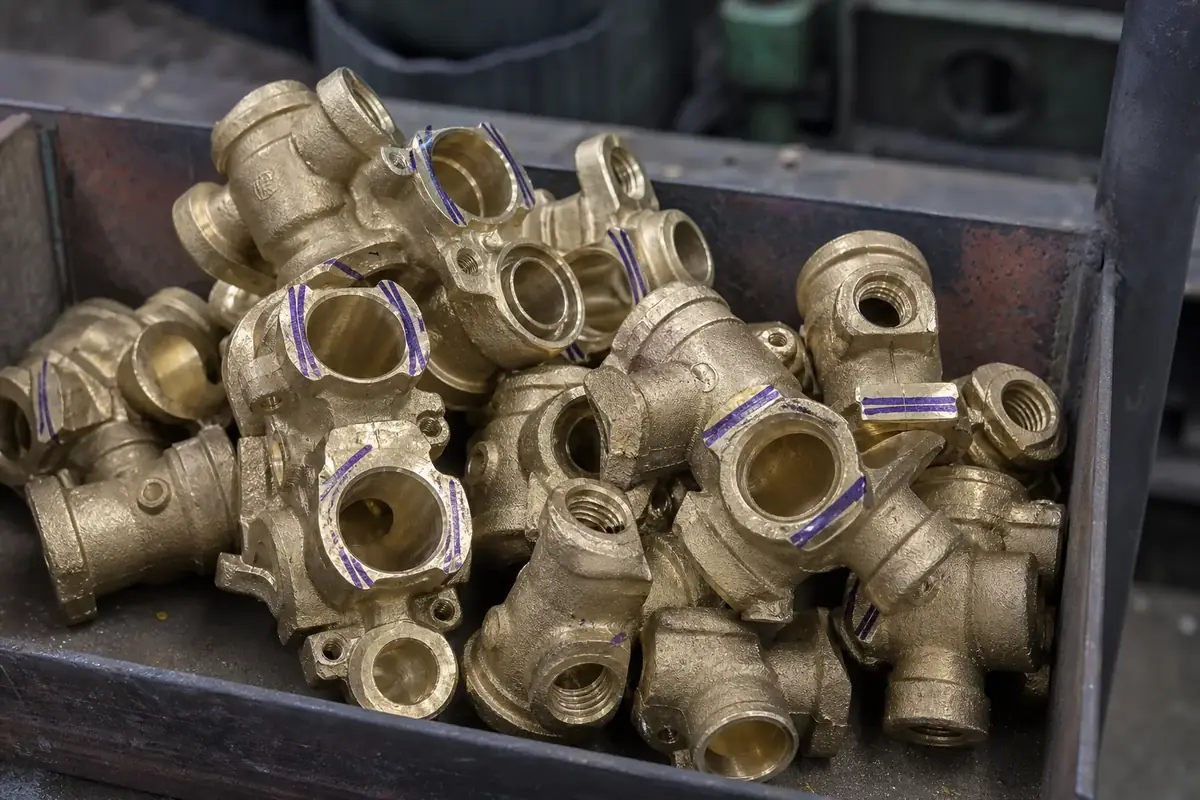
Domestic buyers typing brass casting near me are usually hunting local foundry capacity. Export buyers should hunt process evidence: gating practice, melt control, machining partners, and pressure testing. Jamnagar and nearby Gujarat cells can supply cast blanks that feed in-house or sister-unit machining.
Casting earns its keep on strainer bodies, ornate or bulky housings, thick bosses, and shapes where bar scrap would dominate the BOM. After cast, shops machine sealing faces, threads, and critical bores. Leaving adequate stock on those faces is not waste—it is how you avoid cutting into subsurface voids.
Casting watch-outs
- Porosity in pressure galleries and thin walls.
- Misrun or cold shut on intricate sections.
- Inconsistent machining datum surfaces between heats.
- Finish hiding defects until plating or leak test.
For defect patterns and incoming checks, continue to brass product defects and quality checks.
Brass CNC turned components in Jamnagar
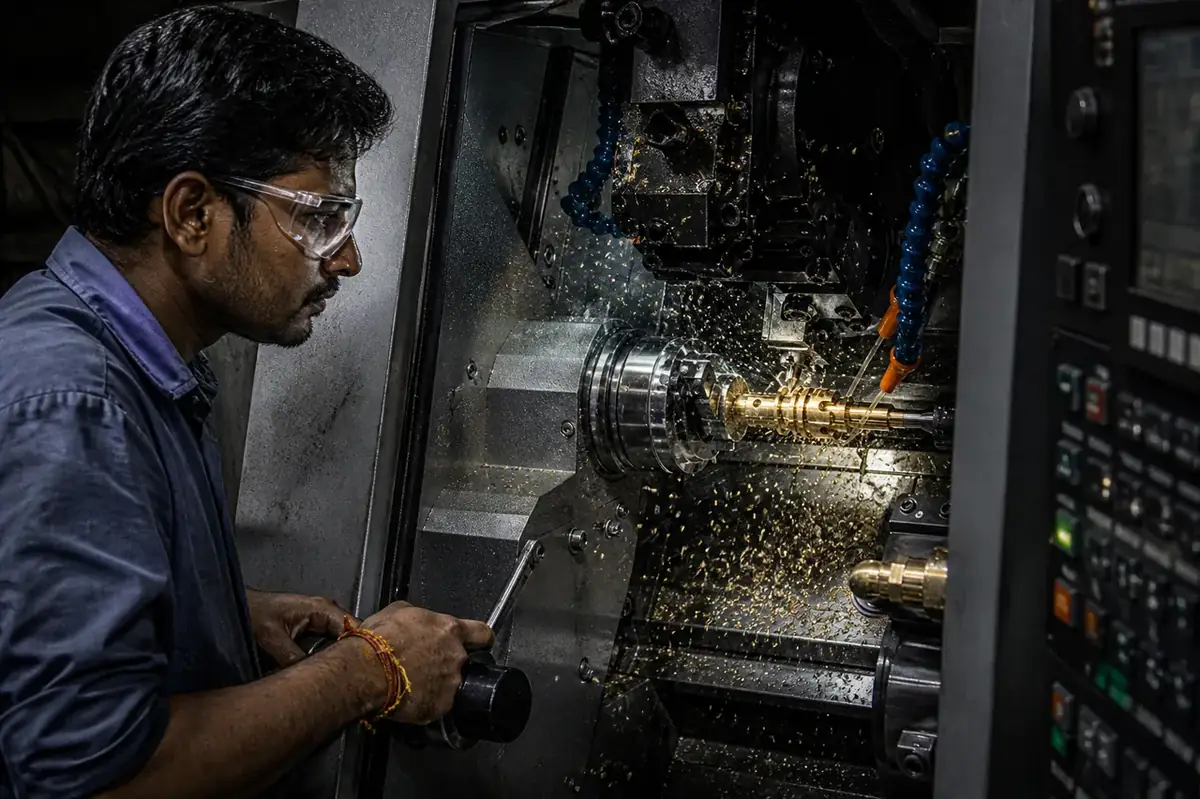
Bar-fed turning is the cluster’s signature volume engine. Free-cutting rod feeds cam automatics and CNC/Swiss cells that produce inserts, glands, adapters, brass pins, brass dowel pins, collars, and connector bodies at high count. When people say Jamnagar makes “brass parts,” they often mean this lane.
CNC shines when you need flexible setups, multi-diameter steps, cross-holes, and tighter concentricity than a simple cam job can hold. Cam shops still win many standard fasteners and inserts on cost. Match the cell: do not pay Swiss rates for a loose-tolerance spacer, and do not demand cam pricing for a connector with six critical diameters.
Bushings, collars, and moulding inserts are a major subset of this work—covered in depth in brass bushings, inserts, collars, and bearings.
Bar preparation is part of quality even when it never appears on the invoice line. Bent stock, mixed diameters in one rack, or unmarked ends from two heats will show up as tool chatter and dimension drift mid-shift. Ask how incoming rod is checked for diameter, ovality, and straightness before it reaches the magazine. Serious cells quarantine suspect bars instead of “running them carefully.”
Chip control is not only a machinability story—it is a housekeeping and remelt story. Free-cutting grades throw short chips that convey well; wrong grades or dull tools make birds’ nests that scratch finished diameters. If your part is plated later, those scratches become reject magnets. Write maximum surface roughness where cosmetics or sealing matter, and decide whether a light polish or tumble step is allowed after turning.
For multi-operation parts, define workholding datums. A pin that is turned, then milled, then tapped can lose concentricity if the second operation re-chucks on a decorative diameter. Put the functional datum on the drawing in plain language. Shops in Jamnagar are fast; they are not telepathic about which diameter is the real reference.
What good turned-part RFQs include
- Stock diameter preference (design around common extruded sizes when possible).
- Thread standard and class; plating thickness if threads are close.
- Concentricity / runout callouts where they matter.
- Burr and edge-break notes for assembly-critical ends.
- Annual volume ladder so tooling and machine choice make sense.
Hex bar, round stock, and secondary ops
Brass hex bar is the quiet hero behind many fittings. A brass hex nipple often starts as hex stock: turn the threads, face the ends, and you keep wrench flats without milling them from round. Round rod still dominates pins, rollers, and cylinders where OD is the functional surface.
Secondary operations eat schedule if you forget them: cross-drilling, knurling, slotting, broaching, tapping deep holes, and light milling. Deburr is not cosmetic on parts that assemble into rubber seals or plastic housings. Write edge condition; do not assume “machine finish” means safe to assemble.
Thread and tolerance language deserves its own drawing discipline—see brass component specifications, threads, and tolerance.
Product examples: valves, strainers, pins
Search interest around brass ball valve sizes—1/2 inch, 3/4, 1 inch, 2 inch—and price chatter often lands buyers on finished valves. Manufacturing reality underneath is mixed: forged or cast bodies, machined seats and threads, separate balls and stems, then assembly and pressure test. Component buyers should specify which piece they want: body blank, stem, ball, or complete valve.
Brass Y strainer, brass strainer, brass filter, and related bodies lean cast or fabricated with machined ports. Screen or mesh elements are separate supply. A brass water meter or meter-related housing is another cast-plus-machine story; dimensional interfaces and pressure integrity dominate over shine.
On the bar-turned side, brass balls (where specified as solid balls), brass cylinder sections, brass roller blanks, brass pins, and brass dowel pins are classic CNC or dedicated turning work. Brass camlock fittings and similar couplings combine machining with careful interchange dimensions—samples and gauges matter more than brochure photos.
Decorative or kitchen-adjacent items such as a brass tea strainer may share alloy colour with industrial filters while living in a completely different tooling and finish world. Keep consumer SKUs and pressure components on separate quality plans.
Size-specific valve chatter—half-inch, three-quarter, one-inch, two-inch ball valves and their price searches—often pulls buyers toward finished goods. Component programmes should still name the piece: body blank, end connection machining, stem, ball, seat retainers, or full assembly. A machining cell quoting a stem cannot honestly bid a complete valve unless it owns assembly and test. Insist on a process map when the SKU name sounds like a finished catalogue item.
Camlock-style couplings and similar interchange fittings live or die on nose dimensions and locking geometry. Samples should be checked against a known mating half, not only against a paper print that drifted three revisions ago. If your market uses a published coupling profile, put that reference on the drawing title block. “Looks like last year’s sample” is not a standard.
Meter-related housings and strainer bodies also need clear notes on which faces are sealing faces after paint or plate. A cast-machined body can pass dimensional checks and still weep if a porosity cluster sits under a sealing land. Pressure test after final machining—and after plating if the coat can mask a path that later opens.
Brazing, soldering, and welding in assemblies
Not every assembly should be one solid slug. Tubes, multi-piece fittings, and repairable joints use brass brazing rod, brass welding rod, brass solder, or brass solder wire depending on temperature and strength needs. Silver soldering brass appears where stronger, cleaner joints are required than soft solder can give.
Shop talk also covers brazing brass to steel, brazing copper to brass, solder brass to copper, and soldering copper to brass. Those are process notes for assembly cells, not alloy grades for the primary casting. Define filler, flux cleanup, heat tint limits, and leak tests. Flux left under plating is a classic delayed adhesion failure.
A brass ball catch or small hardware assembly might only need light joining or staking. A pressure manifold needs a written test. Do not let joining hide inside a machining line item without acceptance criteria.
Fixture design decides whether a braze joint stays square. Tubular assemblies distort when clamps are improvised from the previous job’s blocks. If distortion limits are tight, ask whether dedicated fixtures exist or will be built into the sample cost. Paying for a fixture once is cheaper than arguing about oval sockets after plating.
Cleaning after joining deserves its own router step. Flux residues under nickel look like adhesion failures weeks later in humid warehouses. Sequence should read join → clean → inspect → finish → final test. Skipping clean to “save a day” is how containers earn claims.
Soft solder joints and higher-temperature braze joints are not interchangeable on the same drawing callout. Temperature, gap, and strength differ. If field service might resolder a joint, say so—some finishes and plating stacks hate a second heat cycle.
“If the joint must hold pressure, a photo of a shiny fillet is not a test plan.”
Finish, powder coat, and surface notes
Most industrial turned brass ships as machined, nickel-plated, tin-plated, or polished. Brass powder coat shows up more on decorative or colour-matched assemblies than on precision threads. Powder over functional threads is usually a design error unless masked.
Brass powder as a material form is a different industry (powder metallurgy / filler uses) from powder coating a machined part—clarify language in RFQs so you do not receive the wrong quote family. Brass cutters and tooling language likewise belong to the machine shop’s toolroom, not to the finished goods BOM, unless you are literally buying cutting tools.
Sequence finishing after joining and before final gauge checks when plating thickness affects thread fit. Build that sequence into the router card, not into tribal knowledge.
Process comparison table
| Route | Typical parts | Strength | Main risk |
|---|---|---|---|
| CNC / Swiss from rod | Pins, inserts, cylinders, precision adapters | Tight diameters, flexible setups | Wrong stock OD; over-specified tolerances |
| Cam / automatic turning | High-volume fasteners, simple inserts | Unit cost at scale | Limited complex features |
| Hex bar machining | Hex nipples, fittings with wrench flats | Flats without milling | Bar AF tolerance stack-up |
| Cast + machine | Strainer/filter bodies, bulky housings | Near-net complex shape | Porosity in pressure zones |
| Forge + machine | Many valve bodies, heavy fittings | Grain flow and strength | Die cost; flash cleanup |
| Machine + braze/solder | Tubular assemblies, multi-piece builds | Design flexibility | Heat distortion; flux/finish issues |

QC plans that catch real failures
Turned parts fail on diameter, thread, burr, and plating thickness. Cast-machined parts fail on porosity, leak, and datum shift. Do not recycle one AQL story onto both.
- First-article pack with ballooned drawing and actuals.
- Go/No-Go thread ownership stated (who holds master gauges).
- Leak or hydrostatic test for pressure-retaining SKUs.
- Visual standard for polish/plate—photos with limits, not “bright.”
- Packing that protects threads and sealing faces in export cartons.
Sampling after process change matters as much as sampling at kickoff. New heat, new plating bath, or new subcontractor for casting blanks should trigger a mini first-article—not a silent continuation.
RFQ and sampling checklist
Custom work needs more than a WhatsApp photo. Use the structured approach in custom brass components: drawings, MOQ, and sampling.
- Process preference: cast+machine, forge+machine, or solid-bar CNC.
- Alloy and compliance notes.
- Critical-to-quality dimensions highlighted.
- Joining method and test if assembly is included.
- MOQ, sample quantity, and what freezes after approval.
Price curiosity around finished valves is normal, but component RFQs should separate body, trim, and assembly labour. Otherwise you compare a machining cell to a valve assembler and wonder why numbers disagree.
Build a simple capability matrix when you shortlist: cast only, cast+machine, forge partner access, cam capacity, Swiss CNC, plating in-house or subcontracted, and leak-test equipment. A shop that scores well on cam inserts may still be the wrong cell for a porous-risk strainer body. Visit or video-call the actual machine that will run your part—not only the office that prints the quotation.
For bridge volumes, agree whether samples are cut from production-intent stock and tooling. Soft prototype shortcuts are useful for fit checks and dangerous as silent approvals for ocean freight. Write “sample process = production process” or explicitly list the differences you accept. That sentence prevents most “but the sample was fine” disputes.
Packing for machined brass is part of process control. Loose parts in a carton nick sealing faces and raise plating rejects at destination. Use separators, VCI where specified, and thread protectors on fine pitches. Export programmes that skip packing notes inherit damage that looks like machining error on the receiving dock.
FAQ: casting and CNC brass parts
What drawings are needed for custom brass CNC parts?
Toleranced 2D, alloy, threads, finish, volumes, and sample rules. 3D helps; unmarked photos of someone else’s part do not.
Why do hex nipples and strainer bodies often use different process routes?
Hex nipples usually come from hex bar turning. Strainer and filter bodies often need casting or fabrication plus port machining. Geometry and pressure duty decide.
When should a part be cast instead of CNC turned from brass rod?
When the shape is bulky or irregular, or bar scrap would dominate cost. Turn from rod when the geometry is largely rotational and tolerances live on diameters and threads.
What makes brass CNC turned components from Jamnagar competitive?
Cluster density: extruded rod nearby, many turning cells, finishers, and export packers. Competitiveness still depends on matching shop capability to your tolerance band.
Can the same shop machine a brass ball valve body and small turned pins?
Only if it truly owns both cells. Valve bodies often need forge/cast partners; pins need bar-fed CNC. Ask who cuts which feature before treating one vendor as universal.
How do brass brazing rod and welding rod fit into component sourcing?
They are joining consumables and process choices for assemblies. Specify them beside joint design and leak tests—not as a substitute for base-part alloy.
What inspection should buyers require on CNC brass parts?
First-article dimensions, thread gauges, critical runout, and finish criteria. Add leak testing for pressure parts such as valve or meter-related bodies.
Is searching for brass casting near me useful for export buyers?
It helps local logistics. Export programs should prioritise melt control, machining partnership, and test capability over map distance alone.
Conclusion
Jamnagar’s strength is not one magic CNC brand—it is a municipal toolkit: casting, forging partners, cam banks, Swiss cells, joining, and finish. Buyers who name the route, the alloy, and the test catch problems before ocean freight.
Treat every part as a process story. When the story is clear, quotes become comparable—and CNC turned brass stops being a vague category and becomes a controlled supply line.
Sourcing Custom Turned or Cast Brass Parts?
Upload drawings for CNC, casting-plus-machine, or assembly routes. Get process-fit feedback and factory options via Jamnagar.net.