Brass Parts Manufacturer Buyer Guide: How to Source Without Guesswork
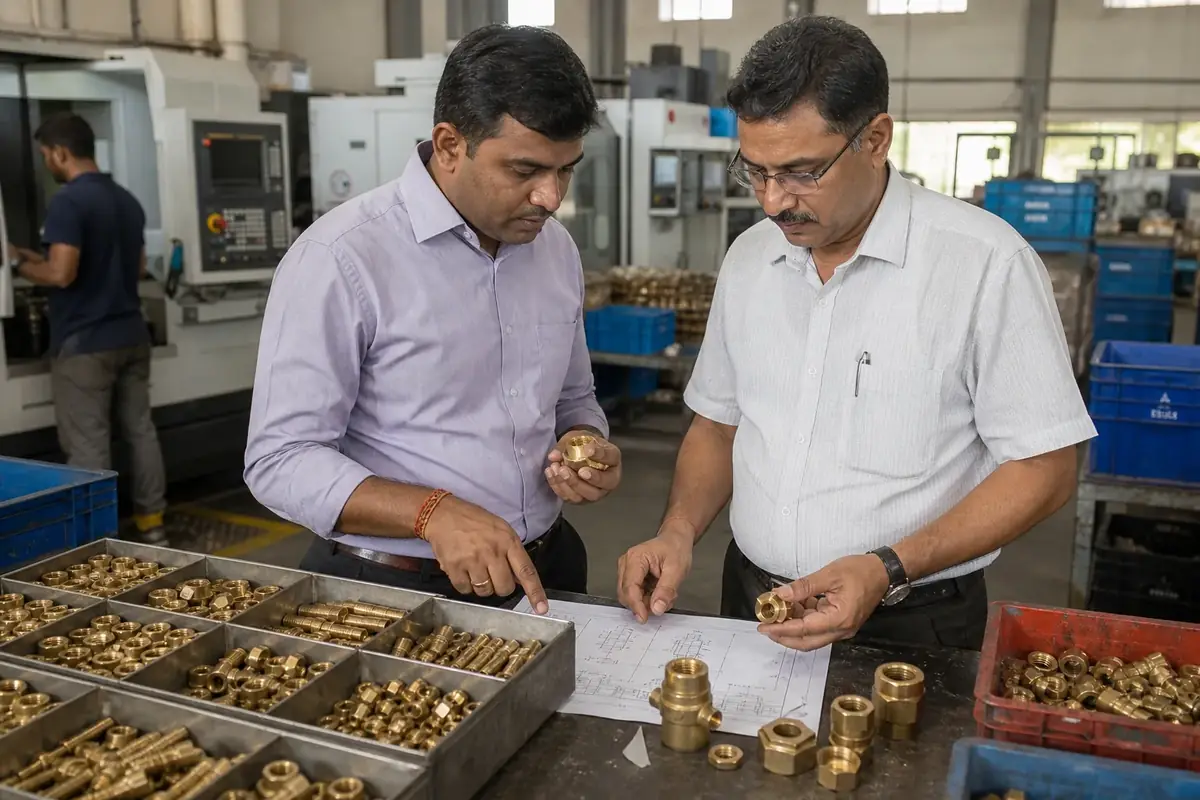
Most sourcing failures with copper-zinc hardware start before the purchase order. A thin RFQ, a mixed shortlist, and a sample that never locked process details can turn a cheap quote into a delayed container. This brass parts manufacturer buyer guide is written for procurement and engineering teams who need a repeatable method—not brochure language.
India’s Gujarat cluster concentrates many capable workshops, but capability is not interchangeable. A cam shop that runs inserts all day is not the same cell as a forging unit making valve blanks. Buyers who treat every quote as identical metal usually discover the difference after plating and freight.
Use this page to structure shortlists, RFQs, sampling, and packing checks. For cluster context—melt, extrusion, machining density—start with the Jamnagar brass industry hub.
Quick take
- Shortlist by process fit first; price second.
- Name alloy, threads, finish, and packing before comparing rates.
- Approve samples with process notes so production cannot quietly change.
Table of contents
- Who this buyer guide is for
- Manufacturer vs supplier: know who cuts the metal
- Define the brass parts package before RFQs
- How to shortlist brass manufacturers
- RFQ checklist that prevents wrong quotes
- Sampling, first article, and change control
- How to compare quotes fairly
- Quality evidence, packing, and Incoterms
- Red flags and common buyer mistakes
- Running the program after first PO
- FAQ
Who this brass parts manufacturer buyer guide is for
This guide targets B2B buyers who source recurring brass parts: inserts, glands, fittings blanks, fasteners, terminals, bushings, and custom CNC components. It also helps distributors consolidating mixed SKUs, provided they still know which workshop owns critical operations.
It is less useful if you only need one decorative gift piece with no drawing. Once you have a print, a tolerance, or a compliance rule, the method below pays for itself.
Engineering readers should treat commercial and technical gates as one workflow. Procurement alone cannot catch a wrong thread form; quality alone cannot catch an Incoterm that leaves moisture risk undefined.
The method also scales. A one-SKU pilot and a forty-SKU sanitary catalogue use the same gates—they simply repeat them. Teams that skip gates on “simple” parts usually discover that simple parts still carry alloy, thread, and packing risk.
If you are new to the Gujarat cluster, expect uneven English on shop floors and strong practical judgment on chips, dies, and gauges. Bring drawings that stand alone. A visit helps, but a complete RFQ helps even when you cannot travel.
Manufacturer vs supplier: know who cuts the metal
In everyday language, brass manufacturers and brass suppliers get used interchangeably. On the floor they are not the same risk profile.
A brass parts manufacturer typically owns turning, forging, casting, or secondary machining capacity and can speak to chip behaviour, die wear, and plating sequence. A trading supplier may consolidate cartons from several shops and present one invoice. That can be efficient for standard catalogue SKUs—and opaque for tight GD&T.
Hybrid models exist. Some exporters run a core machine shop and subcontract plating or forging. That can work if the process owner is named and change control is written. It fails when nobody admits which cell cut last month’s rejects.
Capacity claims deserve scepticism without evidence. “CNC available” may mean one machine shared across jobs. Ask what shares your calendar: other export programs, domestic rush work, or plating bath queues. Lead time honesty beats optimistic machine lists.
Questions that separate the two
- Which machine family will cut the first article—cam, CNC, Swiss, forge press, foundry?
- Is rod or billet purchased from a fixed mill relationship or open local market?
- Who owns Go/No-Go gauges for your thread series?
- If plating fails, which cell reworks—and who pays for scrap?
- Can you visit or video the process cell that will run production?
“If nobody can name the machine that will cut your part, you do not have a manufacturer quote yet—you have a brokerage conversation.”
Define the brass parts package before RFQs
Buyers lose weeks when drawings leave half the story on the table. Lock a minimum package before emails go out.
- Geometry — 2D drawing with datums; 3D helps for complex pockets.
- Alloy — named grade or standard reference, not “yellow brass.”
- Process preference — turned from extruded rod, forged, cast, or welded assembly.
- Thread standard — BSP, NPT, metric, UNC/UNF, and class of fit.
- Finish — polish, nickel, tin, chrome-style, or raw; thickness where it matters.
- Volume ladder — sample, pilot, and annual forecast bands.
- Compliance — lead-free, potable-water, or market-specific rules if applicable.
Thread and tolerance language should be explicit. Ambiguous notes on a print are how BSP gets cut as NPT. For deeper specification language, use the hub on brass component specifications, threads, and tolerance.
If your design is still fluid, say so. Ask for a design-for-manufacture note on stock diameters and forging parting lines before tooling money is spent.
Revision control belongs in the package too. If revision B changes a thread relief and revision A samples are still in transit, say which revision is live. Shops will otherwise machine whichever PDF is easiest to open.
Critical-to-quality callouts help more than dense GD&T with no priority. Mark the three dimensions that scrap the part in assembly. Local inspectors work faster when they know what matters versus what is reference.

How to shortlist brass manufacturers
A strong shortlist is small and process-matched. Three to five shops that fit geometry and volume beat fifteen random replies.
Match shop type to part family
- High-volume round inserts, pins, nuts → automatic lathe / cam cells.
- Concentric connectors and tight OD/ID work → Swiss or CNC turning cells.
- Elbows, valve bodies, heavy fittings → hot forging + machining.
- Irregular near-net shapes → casting + machine critical faces.
- Mixed catalogue SKUs with loose tolerances → capable consolidator may be fine.
Ask each candidate for recent similar work—not unrelated polished photos. Similarity beats vanity. If your annual volume is low, confirm whether the shop still wants the program after sample romance fades.
For custom geometry, MOQs, and sampling cadence, continue in custom brass components: drawings, MOQ, and sampling.
During shortlisting, watch how questions come back. Strong shops ask about mating parts, plating after threading, and whether annual volume is steady or spiky. Weak replies only ask for target price. Curiosity about the assembly is a positive signal.
Also separate “can make a sample” from “can hold a monthly release.” Sample romance is cheap. Sustained packing discipline, gauge calibration, and heat segregation are what keep importers returning.
RFQ checklist that prevents wrong quotes
Send the same package to every bidder. Unequal information creates unequal optimism.
| RFQ field | Why it matters | Weak version | Strong version |
|---|---|---|---|
| Alloy | Machinability, compliance, corrosion | “Brass” | Named grade + lead-free note if needed |
| Process | Cost and defect modes differ | Silent | “Turned from extruded rod” / “forged blank” |
| Threads | BSP vs NPT mismatches scrap lots | “1/2 thread” | Standard + class + gauge ownership |
| Finish | Thickness affects fit and colour | “Bright” | Finish type + thickness / visual standard |
| Volume | Tooling and machine choice | “Ongoing” | Sample / pilot / annual bands |
| Packing | Plating damage and moisture | “Export packing” | Bag, carton marks, VCI, pallet rules |
Add destination port, preferred Incoterms, and whether dual sourcing is planned. Dual-source programs need identical acceptance tests, or the two suppliers will drift.
Commercial fields belong in the same packet: currency, payment terms, tooling ownership, and who pays for first-article freight. Leaving money talk for later creates two negotiations—one technical, one awkward—after samples already biased the relationship.
If you use a target price, label it as a target, not a ceiling disguised as engineering. Shops that meet an impossible number usually cut inspection, alloy discipline, or packing—not magic productivity.
“A complete RFQ is cheaper than a cheap quote that ships the wrong thread.”
Sampling, first article, and change control
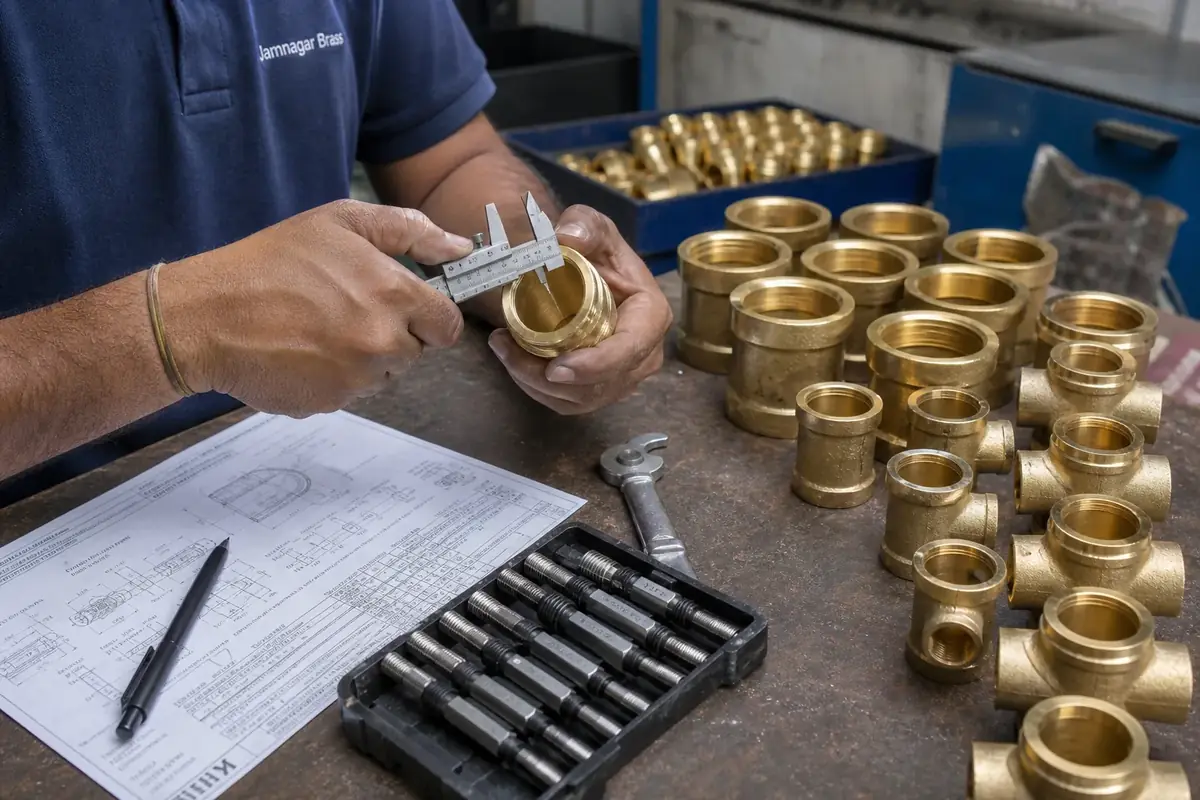
Samples are not souvenirs. They are process contracts. Approve dimensions, finish, and the route that produced them.
Write on the approval note: alloy source, machine type, plating bath identity if relevant, and packing method. If production will use a different heat, different plating line, or different carton supplier, treat that as a new approval—not a courtesy email.
Practical sample sequence
- Dimensional first article with marked balloon report.
- Functional fit check on mating parts or gauges you own.
- Finish check under agreed light / thickness method.
- Pilot lot under production packing.
- Release production with locked router notes.
Air-freight samples that never match ocean packing are a classic trap. If vibration or moisture is a risk, pilot packing must look like the export carton—not a padded envelope.
Keep a simple deviation log. If the sample used a temporary form tool or a soft-jaw setup that production will not repeat, note it. Temporary excellence is not a process capability.
For multi-cavity or multi-spindle work, ask whether all stations were represented in the sample. Approving one perfect spindle while five others drift is how “sample OK” becomes “lot mixed.”
How to compare quotes fairly
Line up apples. A forged quote and a turned quote for “the same” elbow are not the same part risk. A plated piece price without thickness is not comparable to a raw machining price.
Score each bid on process fit, documentation, lead time honesty, sample policy, and packing clarity—then look at unit price. If two shops are close commercially, prefer the one that already runs your geometry family.
- Is tooling amortised or separate? Who owns dies and form tools?
- Does price include plating, sorting, and export packing?
- What happens on dimensional rejects—rework, remake, or credit?
- Are payment terms realistic for your cash cycle and their working capital?
- Is the quoted lead time tied to rod availability or only machine hours?
Landed cost thinking also belongs here. For import steps, documents, and freight sequencing, see importing brass components from India.
Build a one-page scorecard: process fit (1–5), documentation (1–5), sample policy (1–5), packing clarity (1–5), commercial fit (1–5). Force the team to score before revealing who was cheapest. That habit prevents charismatic quotes from winning by default.
Watch currency and metal clauses. Some quotes float with copper-zinc markets; others fix for a window. Neither is wrong—unspoken assumptions are. Ask what happens if rod price jumps mid-PO.
Quality evidence, packing, and Incoterms
Ask for evidence that matches defect modes. Turned parts need dimensional and thread control. Castings need porosity awareness in pressure zones. Plated parts need thickness and adhesion discipline.
Common useful artefacts: melt certificates when chemistry matters, first-article reports, in-process check sheets, plating thickness logs, and a written AQL or sampling plan. For defect families and inspection focus, use brass product defects and quality checks.
Packing notes that protect plated brass
- Part-to-part contact rules for polished or nickel surfaces.
- Polybag / VCI expectations for ocean transit.
- Carton strength and drop risk for dense brass weight.
- Marking and lot traceability on outer cartons.
- Palletisation and moisture barriers for long sailings.
Agree Incoterms early. A low ex-works price can look attractive until inland haulage, documentation gaps, and packing disputes appear. Write who buys insurance and who owns damage after gate handover.
Lot traceability should match your risk. High-reliability inserts may need heat codes on bags; decorative hardware may only need carton lot marks. Over-specifying paperwork on low-risk SKUs slows shops; under-specifying on pressure parts invites denial after failure.
Incoming inspection at your warehouse should mirror the supplier plan, not invent new criteria after arrival. If you will check threads with a different gauge class than the shop used, align that before PO—not after a dispute email.
Red flags and common buyer mistakes
- Quotes that never ask about alloy, thread standard, or finish thickness.
- Promises of every process under one roof with no cell detail.
- Sample photos instead of dimensional reports.
- Unit prices far below peer quotes without a process explanation.
- Refusal to lock production route after sample approval.
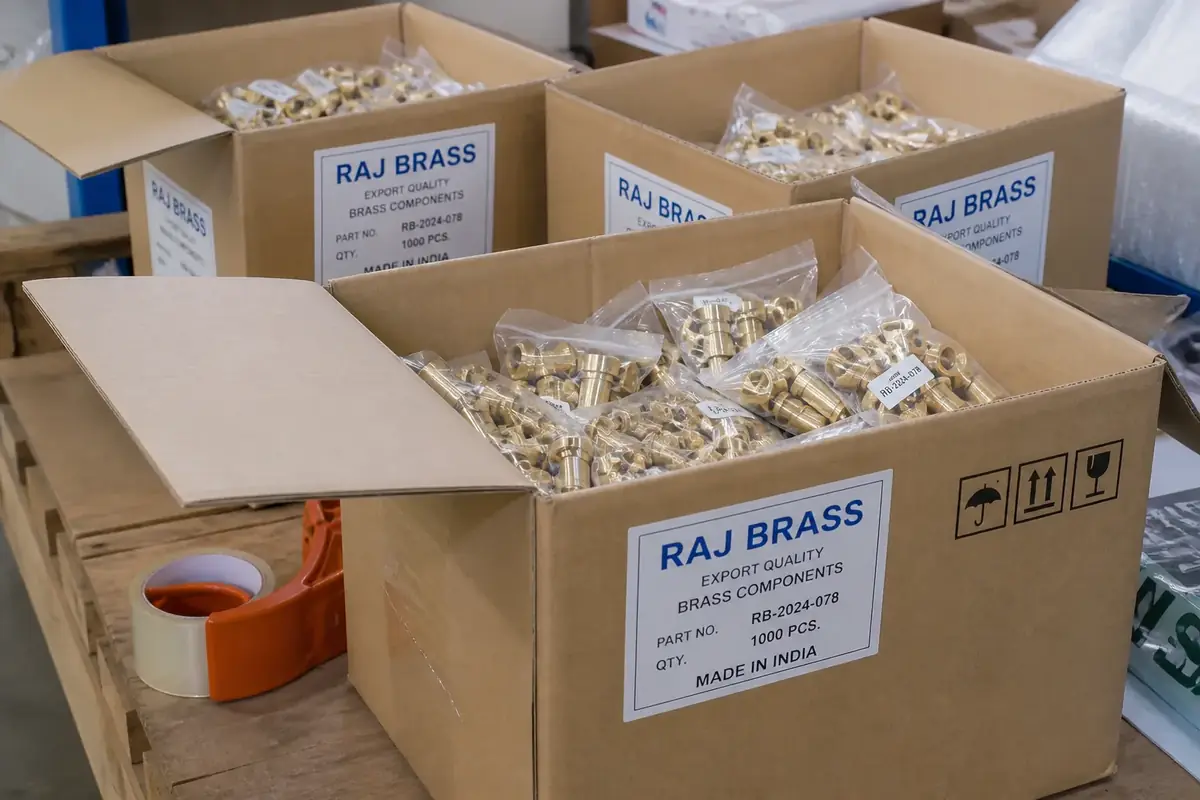
- Packing described only as “export quality” with no materials list.
Another recurring mistake: launching production on verbal “same as sample” while changing rod supplier, plating vendor, or carton size. Brass is forgiving until it is not—thread class and plating drag-in punish silent changes.
Finally, do not confuse brochure English with shop English. Ask for router steps. If the answer stays marketing-soft, keep shopping.
Rushing dual source without a shared golden sample is another trap. Two shops can both be “capable” and still drift in knurl feel, plating colour, or thread stand-off. Freeze a physical master or detailed photos with notes before splitting volume.
Last mistake: treating Jamnagar as one phone number. The cluster is a menu. Your job is to order the right dish, not to average every kitchen into one blended quote.

Running the program after first PO
First containers teach more than first samples. Schedule a structured review after the initial ocean lot: dimensional drift, plating colour spread, carton damage, and document accuracy. Capture fixes in a living quality agreement—not only in chat threads that disappear.
Forecast honesty matters more after PO than before. If your releases will be lumpy, say so. Shops that staff for a smooth monthly call-off will resent sudden spikes and may borrow capacity from weaker cells. Spikes are manageable when planned; surprise spikes create alloy and plating shortcuts.
Keep a spare-gauge plan. If Go/No-Go ownership sits only at the supplier, disputes get philosophical. Buy or share a matched gauge set for incoming inspection on critical threads. The cost is trivial next to a rejected container argument.
Engineering changes need a freeze window. A “small” knurl change mid-tooling can scrap work-in-progress. Use ECR dates, and decide whether open POs ship to old revision or stop. Ambiguous change emails are how mixed revisions enter the same SKU code.
Relationship hygiene still counts. Pay on agreed terms when quality is good. Chronic late payment trains suppliers to prioritise louder customers—then your urgent release waits behind someone else’s. Professional buyers get professional slots.
When volumes grow, revisit process fit. A cam shop that was perfect at 20,000 pieces a month may need CNC support or a second cell at 200,000. Growth without re-qualification is how yesterday’s hero becomes tomorrow’s bottleneck.
Document the “golden lot” early—photos, dimensions, finish notes, packing photos. Two years later, when staff have changed on both sides, that record is the only memory that still tells the truth.
FAQ: buying from brass parts manufacturers
What quality evidence should buyers request before PO?
First-article dimensions, thread gauge plan, melt data when relevant, plating thickness method, and a sampling plan. Photos are supporting evidence, not acceptance criteria.
Are lowest piece prices a reliable way to choose?
No. Rejects, rework, delays, and freight dominate landed cost. Process fit and inspection discipline usually win.
How should importers handle packing and Incoterms?
Define bagging, moisture protection, carton marks, pallets, and Incoterms before price lock. Plated brass needs clearer packing notes than raw blanks.
What should a brass parts manufacturer RFQ include?
Drawings, alloy, process route, threads, tolerances, finish, volume ladder, sample needs, packing, and compliance notes. The clearer the package, the cleaner the quote comparison.
How do brass manufacturers differ from trading brass suppliers?
Manufacturers control a cutting or forming cell. Traders may consolidate. Both can be useful; only one should be trusted blindly for tight tolerances without naming the process owner.
What MOQ should buyers expect for custom brass parts?
It depends on process. Stock-rod turning can support smaller lots; forging and casting often need higher volumes to justify dies and patterns. Ask for sample, pilot, and production MOQs separately.
How many brass suppliers should be on a first shortlist?
Three to five process-fit shops is usually enough. Extra bids only help when each bidder can truly hold your geometry and finish.
Should sample approval lock the production process?
Yes. Record alloy source, machine type, plating, and packing. If any of those change, re-approve before mass production.
Conclusion
Sourcing copper-zinc components well is a documentation habit. Name the process, alloy, threads, finish, and packing. Shortlist shops that already live in your part family. Approve samples as process contracts, not pretty parcels.
When those gates are clear, piece price becomes comparable instead of theatrical. That is the real job of a buyer guide: fewer wrong containers, fewer quiet process changes, and fewer meetings that start with “the sample was fine.”
Use the linked hubs next for specifications, custom MOQ practice, import execution, and defect checks as your RFQ hardens into a purchase order.
Ready to RFQ Brass Parts with Clear Specs?
Upload drawings and volume bands to a direct supply desk that routes enquiries into the right Jamnagar process cells. Browse catalogue families or start a custom quote on Jamnagar.net.