Brass Plumbing Fittings Types: Specs Buyers Should Lock Before Ordering
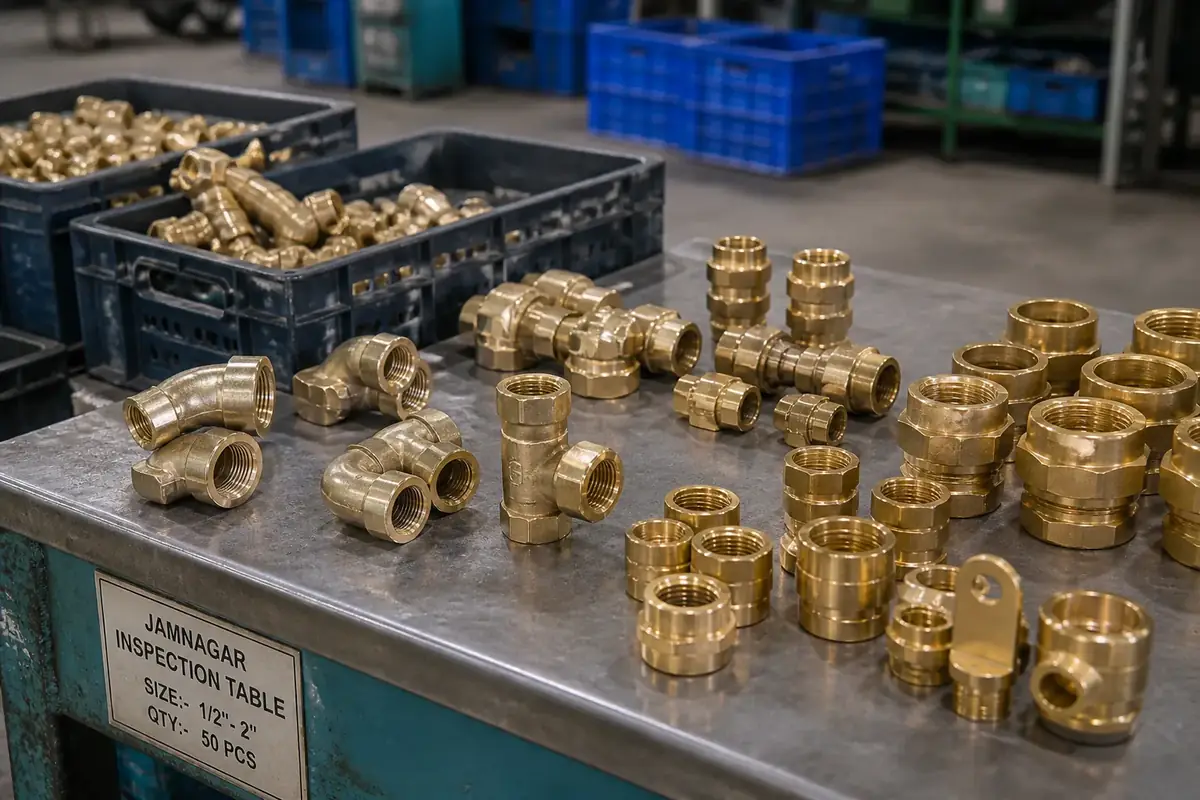
Search results for copper-zinc hardware mix pressure parts with home décor. Procurement teams need a cleaner map. This guide focuses on brass plumbing fittings types—what each shape does, which specs matter, and how Jamnagar workshops typically make them for OEM and export programs.
Brass fittings earn their place on water, air, gas, and transition lines because they machine cleanly, take threads well, and tolerate common finishes. That only helps if size, gender, and standard are written without ambiguity. A “1/2 tee” without BSP or NPT is not a specification—it is an invitation to leak complaints.
You will also see where plumbing RFQs should stop. Door hardware, lamps, trays, and ornaments share alloy colour, not pressure duty. Keeping those programs separate saves tooling arguments and finish fights.
Highlights
- Name fitting family, size, gender, and thread/socket standard on every line item.
- Forged-and-machined bodies are common for pressure fittings; rod-turned parts suit simpler shapes.
- Potable-water duty needs alloy rules stated—not assumed.
Table of contents
- Why brass still dominates many plumbing fittings
- Core brass plumbing fittings by shape
- Sizes, threads, and transition systems
- Adapters, unions, flanges, and end closures
- Duty notes: water, gas, air, and fuel lines
- How brass fittings manufacturers typically make parts
- Spec comparison table for common SKUs
- Adjacent brass categories that confuse RFQs
- Buyer checks before you approve samples
- Catalogue programs vs OEM private-label fittings
- FAQ
Why brass still dominates many plumbing fittings
Brass plumbing fittings sit in a useful middle ground: stronger and more heat-tolerant than many plastics, easier to machine and plate than many stainless geometries for high-volume sanitary hardware. Threads cut cleanly in free-cutting grades. Sealing faces polish or machine to predictable finishes.
Cluster economics matter too. Hot forging, rod turning, threading, and nickel finishing often sit within the same industrial belt, which supports mixed catalogues—elbows one week, reducing bushes the next—without rebuilding logistics.
That density does not remove engineering homework. Dezincification risk, lead limits for drinking water, and sealant compatibility still belong on the drawing notes. “Yellow metal that looks right” is not a materials call.
Finish expectations also ride on brand channel. A contractor-grade elbow can tolerate minor forging witness lines under nickel. A showroom sanitary trim cannot. State the visual standard with limit samples, or every shipment becomes a subjective argument under warehouse lights.
Inventory strategy matters for importers. Standard elbows and tees turn quickly; odd reducing combinations and large flanges sit. Ask shops about economical batching so you are not forced into oversized MOQs on slow movers just to unlock a press day.
Core brass plumbing fittings by shape
Start with geometry. Most catalogues organise around a few families that cover the majority of line work.
Elbows and bends
Elbows change direction—commonly 90° and 45°. Street elbows combine male and female ends to reduce joint count. Specify angle, end types, and whether the bore must stay full for flow-critical runs.
Long-radius versus short-radius language shows up more in industrial specs than in retail packs. If flow noise or pressure drop matters, say so. Cosmetic elbows for exposed runs may prioritise surface over hydraulic elegance—write which priority wins.
Tees and branch fittings
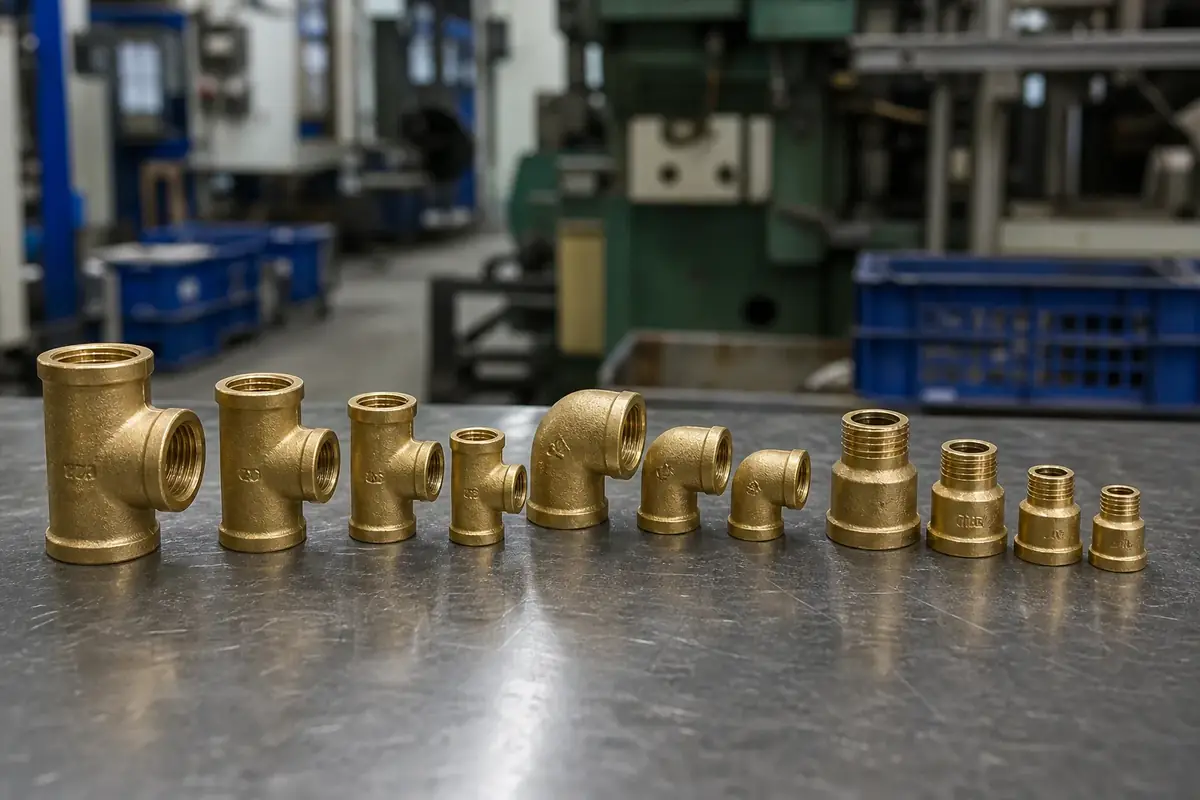
A brass tee (often searched as brass T) splits or joins flow. Equal tees keep all ports the same size; reducing tees change one leg. A 1/2 brass tee, 3/4 brass tee, or 1 brass tee must still declare thread form. Branch orientation and forging flash clean-up affect both flow and cosmetics under plating.
Smaller instrument lines may call for 1/4 brass tee or 3/8 brass tee SKUs. Treat those as the same specification discipline at smaller scale—not as “less important” threads.
Reducers and bushings
A brass reducer steps diameter while keeping the joint family consistent. The common brass reducer 3/4 to 1/2 appears in retrofit and manifold work. Confirm concentric versus eccentric needs, male/female pattern, and whether a hex bushing is acceptable for wrench access.
Y fittings and specialty branches
Y fittings split flow at shallower angles than tees for lower turbulence in some layouts. They are less common in retail packs but show up in OEM manifolds. Same rule: size, angle, and end standard before price talk.
“On fittings, the leak usually starts in the RFQ—wrong gender or wrong thread—long before it starts in the sealant.”
Sizes, threads, and transition systems
Nominal size is only half the story. BSP versus NPT, parallel versus taper, and metric threads decide whether parts assemble dry or destroy seals. Write the standard beside every SKU.
Common threaded ranges in export catalogues include 1/8, 1/4, 3/8, 1/2, 3/4, and 1 inch classes, plus metric series for EU-facing programs. Flare fittings (including 1/2, 3/8, and 5/16 flare styles) belong to a different sealing logic than tapered pipe threads—do not mix acceptance gauges.
Plastic-to-metal transitions
A CPVC brass tee and related MABT CPVC style adapters join solvent-weld plastic sockets to metal male or female threads. Spec both sides: plastic socket OD/schedule language and metal thread standard. Temperature cycling and thread sealant choice matter more here than on all-metal joints.
PVC-to-brass and other hybrid adapters follow the same discipline. Ask which side is pressure-rated for continuous duty and how the shop pressure-tests transition SKUs.
Metric and automotive-adjacent fittings
Metric brass fittings and automotive brass fittings often look similar to plumbing parts but may use different seat angles, tube OD conventions, or plating rules. If your drawing comes from a vehicle or equipment OEM, do not default to sanitary BSP assumptions.
For thread forms, gauges, and tolerance language that belong on prints, see brass component specifications, threads, and tolerance.
Adapters, unions, flanges, and end closures
Transition and service fittings create most catalogue complexity—and most wrong shipments.
Brass adapter and coupler roles
A brass adapter changes end type or standard—male to female, thread to hose, metal to plastic. Hex flats for wrenching should be large enough for field service. Bulkhead fittings need panel thickness and sealing washer notes. Barb adapters for hose need barb size matched to hose ID, not only to thread size.
Unions
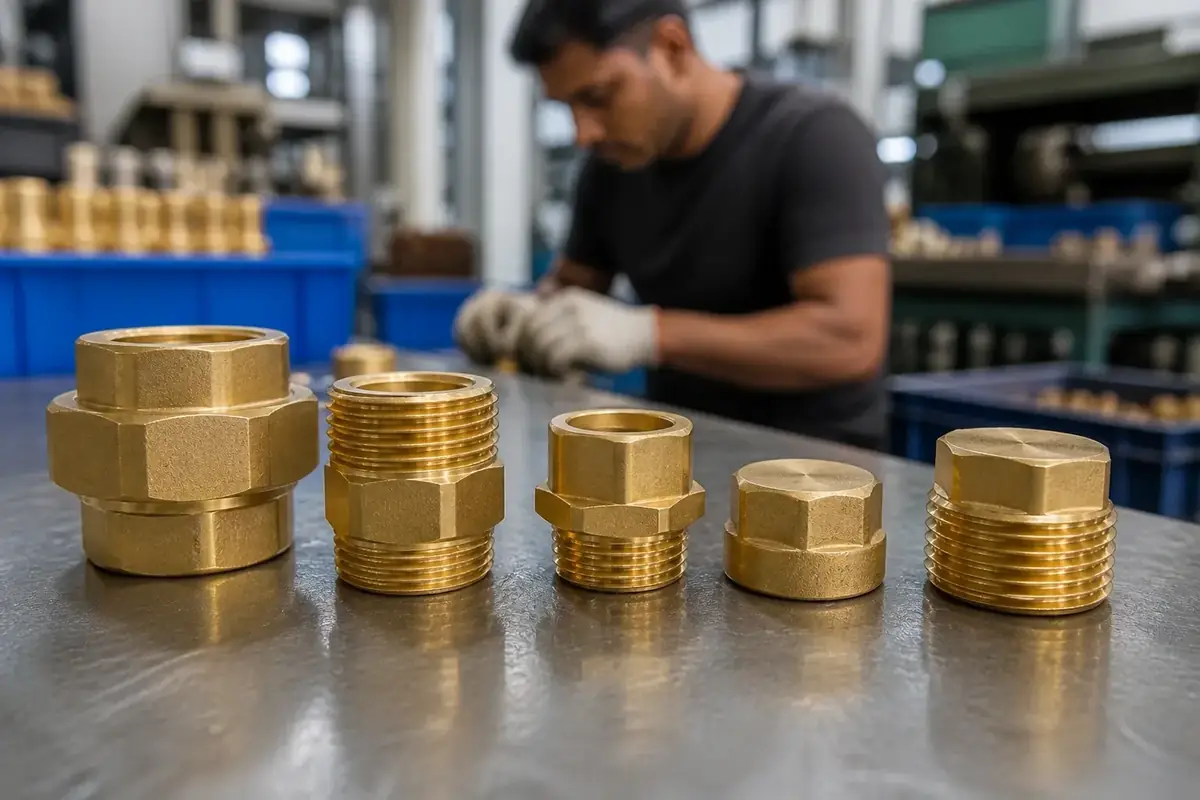
A brass union lets crews separate a line without cutting pipe. Spec seat style, nut thread, and whether the union is ground-joint or gasketed. Size callouts such as 1/2 brass union or 3/4 brass union still need the thread standard attached.
Flanges
A brass flange or toilet flange style part moves you into bolt-circle and gasket territory. Confirm facing, bolt pattern, and whether the flange is cast, forged, or machined from plate-like stock. Pressure class language should match the system, not a photo.
Caps, plugs, and cleanouts
A brass cap closes a male thread; a brass plug closes a female thread. End caps and 1/2 brass cap / 3/4 brass cap SKUs are simple—until the wrong gender ships. A cleanout plug or sewer cleanout plug is a service access piece; square or hex drive and sealing face style belong on the print. Do not treat a decorative brass tin lid language as interchangeable with a pressure plug.
Duty notes: water, gas, air, and fuel lines
Brass fittings for water lines need alloy and dezincification awareness for the destination market. Potable systems may require low-lead grades. Hot water and recirculation loops punish soft spots and poor plating adhesion differently than cold supply lines.
Gas fittings and propane-adjacent brass fittings demand stricter leak testing and often different sealant rules. Air line fittings and brass air fittings for workshops may look like plumbing SKUs but see vibration and oil mist. Fuel line fittings can involve flare seats and tube standards that plumbing buyers rarely gauge.
If valves sit next to these fittings in the same bill of materials, keep sealing duty aligned. Valve selection continues in the brass valves types guide. Pipe nipples, compression joints, and hose connectors are covered in the brass pipe, tube, and connectors guide.
How brass fittings manufacturers typically make parts
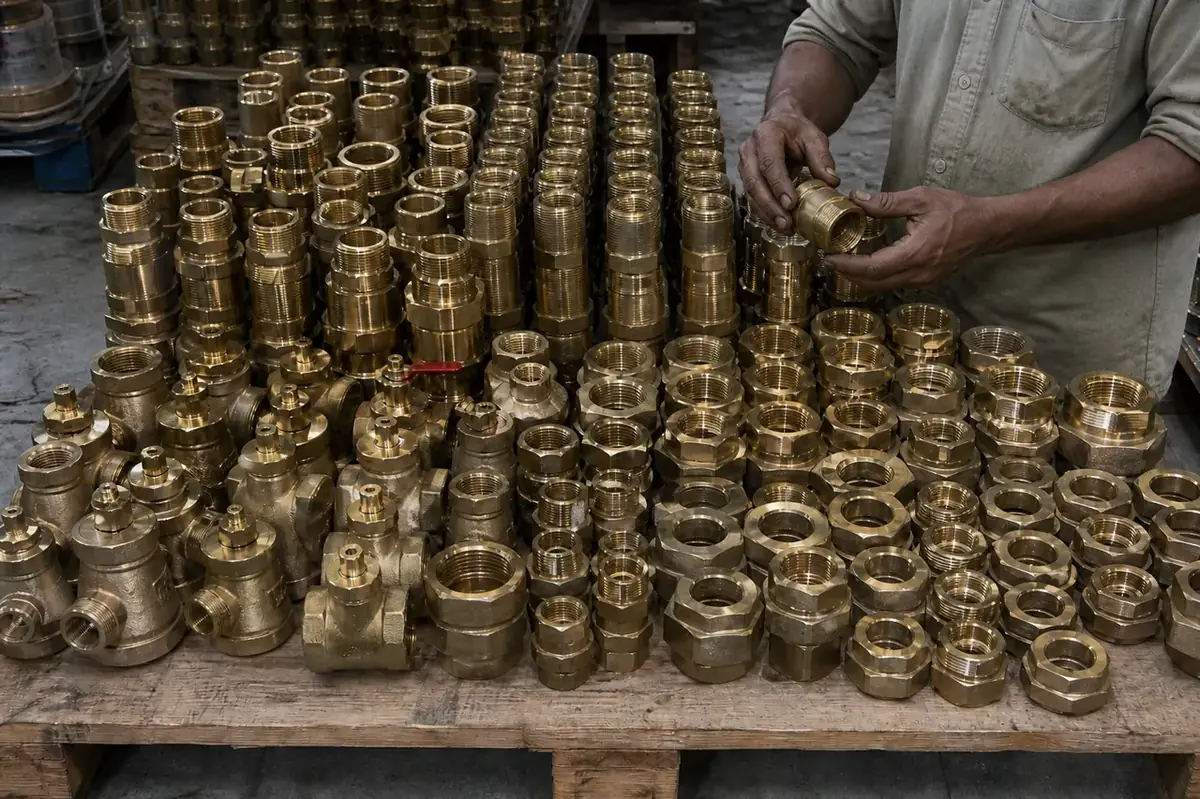
Serious brass fittings manufacturers in the Gujarat cluster rarely rely on one route. Hot forging dominates many elbows, tees, and unions because grain flow helps pressure bodies. After forging, shops machine threads, seats, and hex flats. Simpler nipples, bushes, and some adapters may be turned from extruded rod.
Casting appears for certain flanges and complex blanks, then machining restores functional faces. Porosity control matters if the part sees pressure. Plating—often nickel—follows cleaning; thickness must respect thread class limits.
Ask which route applies to your SKU. Comparing a forged tee quote to a cast blank quote without noting the difference is how “cheap” becomes porous.
Secondary operations deserve their own checklist: chasing after plating, drift drilling for branch tees, seat machining on unions, and deburr standards on bore edges that would otherwise cut O-rings. A pretty outer nickel with a sharp inner burr is still a bad fitting.
Tooling ownership should be written when dies are dedicated. Who stores the tee die, who pays for refurbishment after volume, and what happens if you move the program are commercial questions that prevent later hostage situations.
“If the forging die and the thread chaser are not in the conversation, you are still shopping on photos.”
Spec comparison table for common SKUs
Use this as a first filter when building a catalogue RFQ. Exact ratings depend on alloy, wall, and standard.
| Fitting | Typical use | Must-specify fields | Common watch-out |
|---|---|---|---|
| Brass tee | Branch on water / air lines | Equal vs reducing; thread standard | BSP/NPT mix at same nominal size |
| Brass reducer | 3/4 to 1/2 and similar steps | Male/female pattern; hex access | Wrong bushing style for space |
| Brass union | Service break in line | Seat type; nut details | Seat leak after plating build-up |
| Brass adapter | End-type or system change | Both ends fully named | Only one end specified in RFQ |
| CPVC brass tee / MABT | Plastic-to-metal transition | Socket + metal thread; duty temp | Glue-side vs thread-side QC mismatch |
| Cap / plug / cleanout | End closure or service access | Gender; drive style; seal face | Cap shipped where plug was needed |
| Brass flange | Bolted joints / closet flanges | Bolt circle; facing; alloy | Cast porosity near bolt holes |
Adjacent brass categories that confuse RFQs
Keyword clusters dump plumbing parts beside décor. Buyers should still keep the folders separate.
Brass door fittings and main door brass fittings—handles, strikes, decorative roses—are hardware programs with finish and feel standards, not pressure tests. Antique brass light fittings, a brass table lamp, vintage brass table lamps, glass and brass table lamp builds, black and brass table lamp SKUs, brass plug-in wall light parts, and antique brass outdoor wall light housings sit in lighting supply chains with wiring and heat rules of their own.
Household metalware—brass thali, brass tray, brass tray table pieces, brass ornaments, brass turtle figures, brass tree of life décor, brass oil lamp bowls, brass tile trim, and threshold strips—may share melting and polishing trades with fittings shops. They do not share sealing faces, thread gauges, or potable-water alloy paperwork.
If you need both a sanitary catalogue and a décor catalogue from the same city, issue two RFQs. Industry mapping for where brass shows up beyond plumbing continues in brass applications by industry. Tap and shower bodies that sit beside fittings on a BOM are covered in the brass taps, faucets, and showers guide.
Buyer checks before you approve samples
- Confirm alloy and any lead-free / dezincification requirement for the market.
- Gauge threads with the correct standard—do not “feel” BSP against NPT.
- Check hex size and wrench clearance on adapters and unions.
- Pressure-test or leak-test per agreed method for water or gas duty.
- Measure plating thickness where threads are near class limits.
- Approve packing that prevents nickel rub and mixed-SKU carton errors.
- Lock forging versus turned route on the sample record.
Catalogue buyers should also freeze marking: size stamp, heat/lot code if required, and bag labels. Mixed 1/2 and 3/8 bags are an expensive warehouse problem dressed as a small packing oversight.
For O-ring grooves, barb dimensions, and quick-connect style interfaces, put mating hose or tube on the sample bench. A fitting that “looks right” still fails if the barb bite length is short.
Hex engagement matters in the field. Undersized hex on a brass adapter rounds off under pipe-wrench abuse. Oversized hex can block installation in tight manifolds. Measure wrench flats on samples the way installers will—under time pressure, not only under lab calm.
If your market uses sealant paste heavily, check whether plating adhesion survives cleaning solvents used before assembly. Some bright finishes mark easily; decide if that is acceptable for contractor channels.
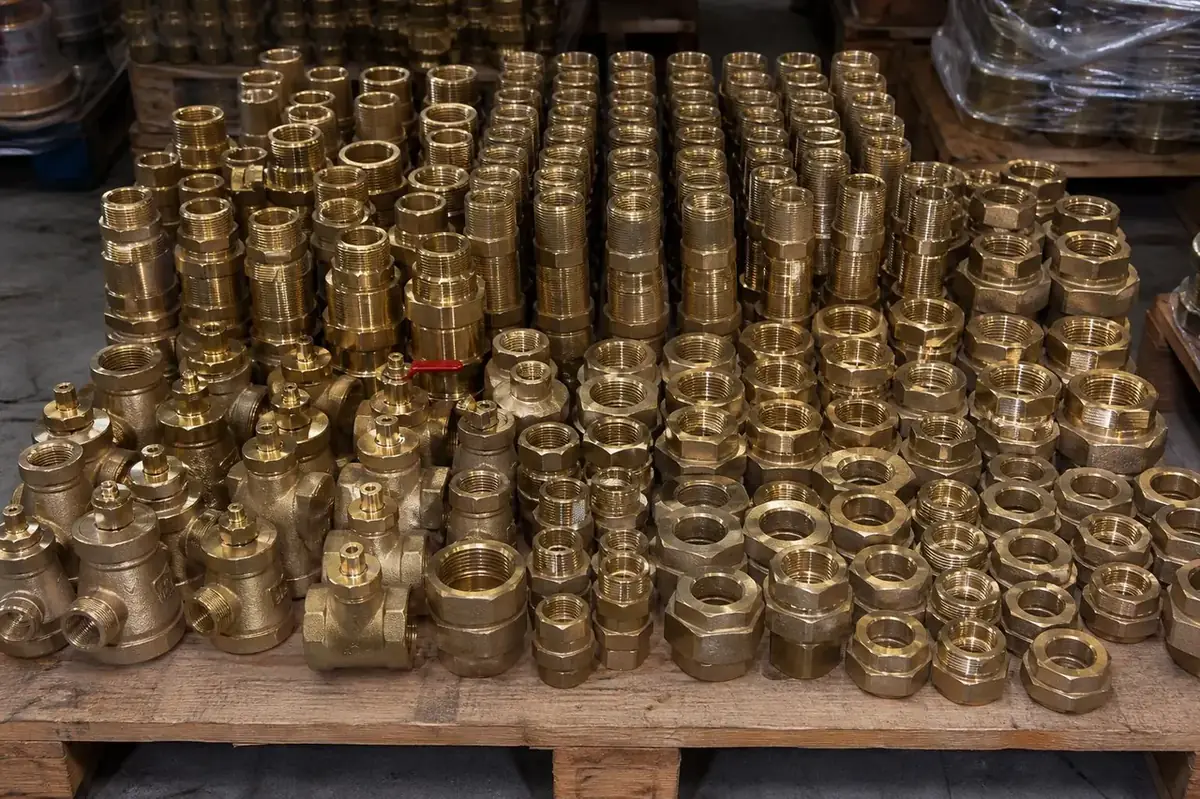
Catalogue programs vs OEM private-label fittings
Importers usually run one of two plays. Catalogue programs mix many standard SKUs—tees, elbows, reducers, caps—into container loads. OEM private-label programs freeze a shorter list with private marks, specific plating, and tighter cosmetic rules. Both can come from the same industrial belt; the RFQ discipline differs.
Catalogue work rewards clear master lists. Freeze size stamps, bag counts, barcode rules if any, and which SKUs may share inner cartons. Mixed 1/2 and 3/8 bags destroy warehouse trust faster than a slightly higher piece price. Ask shops how they prevent size mix during packing peaks.
OEM work rewards drawing control. Private logos on hex flats, unique reducer lengths, or special nickel brightness need sample boards that survive staff turnover. Photograph approved finish under agreed light. “Shinier than last year” is not a standard.
Marking and traceability sit between the two models. Some markets want size and alloy marks; others want silent cosmetics. If you need laser or stamp marks, define depth and location so threads and sealing faces stay clean. Deep stamps near roots invite stress risers and plating voids.
Pressure testing policy should match channel risk. A distributor selling brass fittings for water lines into regulated markets may need batch leak tests. A low-pressure air manifold kit may use sampling. Write the plan; do not assume the shop’s domestic habit matches your liability.
Finish sequences also diverge. Nickel over poorly cleaned forging flash telegraphs every ridge. If your brand sells “bright” elbows next to polished sanitary trims, approve flash clean-up standards on the forging, not only on the plating bath datasheet.
Lead-time planning should separate die-backed forgings from rod-turned bushes. A hex bushing might ship in weeks; a new reducing tee die may need trials. Bundle RFQs so shops can plan melt and press time, but do not pretend every line item shares one clock.
Finally, keep aftermarket spares coherent. If you sell a brass union today and a spare seat kit next year, freeze the seat geometry now. Silent seat redesigns are how “compatible” spares stop sealing.
Seasonal demand swings—monsoon plumbing rushes, construction cycles—should appear in forecasts. Forging shops batch dies; a surprise spike on reducing tees may pull capacity from elbows you also need. Share the calendar early so melt and press time can be reserved without panic overtime that skips inspection.
FAQ: brass fittings and plumbing fittings
Do decorative items belong on a plumbing RFQ?
No. Door fittings, lamps, trays, thali sets, and ornaments need separate drawings, finishes, and QC plans from pressure fittings.
What are the main brass plumbing fittings types buyers specify?
Elbows, tees, unions, reducers, adapters, caps, plugs, flanges, and plastic-to-metal transitions cover most line items. Each still needs size, end type, and standard written out.
Is a 1/2 brass tee the same across BSP and NPT markets?
No. Nominal size can match while thread form differs. Name the standard and gender every time.
When should buyers use a brass reducer 3/4 to 1/2?
When the line size steps down and you need a durable metal transition. Confirm end pattern and whether a hex bushing fits the installation space.
What is a CPVC brass tee or MABT CPVC fitting used for?
Joining CPVC plastic pipe sockets to threaded metal ends. Spec both sides and the temperature/pressure duty.
Are brass fittings for water lines always lead-free?
Not by default. Potable-water markets often need low-lead alloys. Write the rule into the RFQ.
How do brass fittings manufacturers typically make fittings?
Many pressure bodies are forged then machined; simpler shapes may be rod-turned; some blanks are cast. Ask which route applies to your SKU.
What is the difference between a brass cap, brass plug, and cleanout plug?
Caps close male ends; plugs close female ends; cleanout plugs are service access fittings with a drive feature. Gender mistakes are common when RFQs are casual.
Conclusion
Brass remains a workhorse material for plumbing and transition hardware because it machines, threads, and finishes well at catalogue volumes. The buyers who win are the ones who treat each SKU as a small engineering package: family, size, gender, standard, alloy, and test method.
Keep décor and door programs out of the same spreadsheet as pressure fittings. Then use the linked guides for valves, pipe connectors, taps, and thread specs as your BOM expands beyond elbows and tees.
When samples arrive, gauge them like production—not like gifts. That habit is worth more than another catalogue PDF.
Ready to Source Brass Fittings for OEM Lines?
Share your fittings list, thread standards, and annual volumes with a direct enquiry desk for forged and machined brass programs. Review categories or request samples through Jamnagar.net.