Brass Pipe and Tube Connectors: Sizes, Joining Methods, and Buyer Specs

Pipe runs fail at the joints more often than in the straight length. This guide maps brass pipe and tube connectors—nipples, couplers, compression bodies, flare nuts, hose barbs, and transition adapters—so buyers can write RFQs that machinists and forging shops can actually quote.
Brass pipe stock and brass pipe fittings share alloy language but not pricing logic. Lengths and walls behave like mill products; connectors behave like turned or forged piece parts. Mixing those quotes is how landed-cost sheets lie.
Elbows, tees, and valves still matter to the same BOM. Keep shape fittings and valve bodies on their hubs, and use this page for the straight connectors and joining hardware that tie systems together.
Highlights
- Name joining method first: thread, compression, flare, barb, or quick-connect.
- Every nipple needs size, length, and thread standard on both ends.
- Keep pipe-length pricing separate from connector piece pricing.
Table of contents
- Connector map: pipe, tube, and hose
- Brass nipples, couplers, and threaded pipe fittings
- Compression fittings, sleeves, and caps
- Flare nuts and flared tube joints
- Hose connectors, barbs, and garden adapters
- PVC, size-change, and mixed-system adapters
- Brass pipe stock versus connector hardware
- Joining method comparison table
- Buyer checks and packing notes
- Kits, assortments, and retail packing
- FAQ
Connector map: pipe, tube, and hose
Brass pipe connectors and a general brass connector line item are useless without the joining method. Threaded systems want male/female pipe threads. Copper tube systems often want compression or flare. Soft hose wants barbs or dedicated hose threads. Industrial quick-connects want a defined profile.
Write the mating part on the RFQ: pipe schedule or tube OD, hose ID, and regional thread. Photos of “a small yellow fitting” are not enough when 1/4 and 3/8 compression families sit in the same drawer.
Shape fittings (elbows, tees, unions) continue in the brass fittings and plumbing fittings guide. Isolation and non-return devices continue in the brass valves types guide.
Think in systems. A compression tee that feeds a hose barb adapter that feeds a quick-connect is three specification families, not one “connector.” Bundle them commercially if you like—but inspect them by joint type.
Temperature and media still apply even on “simple” nipples. Hot oil mist, potable cold water, and outdoor garden duty age seals and plating differently. Put the media on the line item when it is not obvious.
Brass nipples, couplers, and threaded pipe fittings
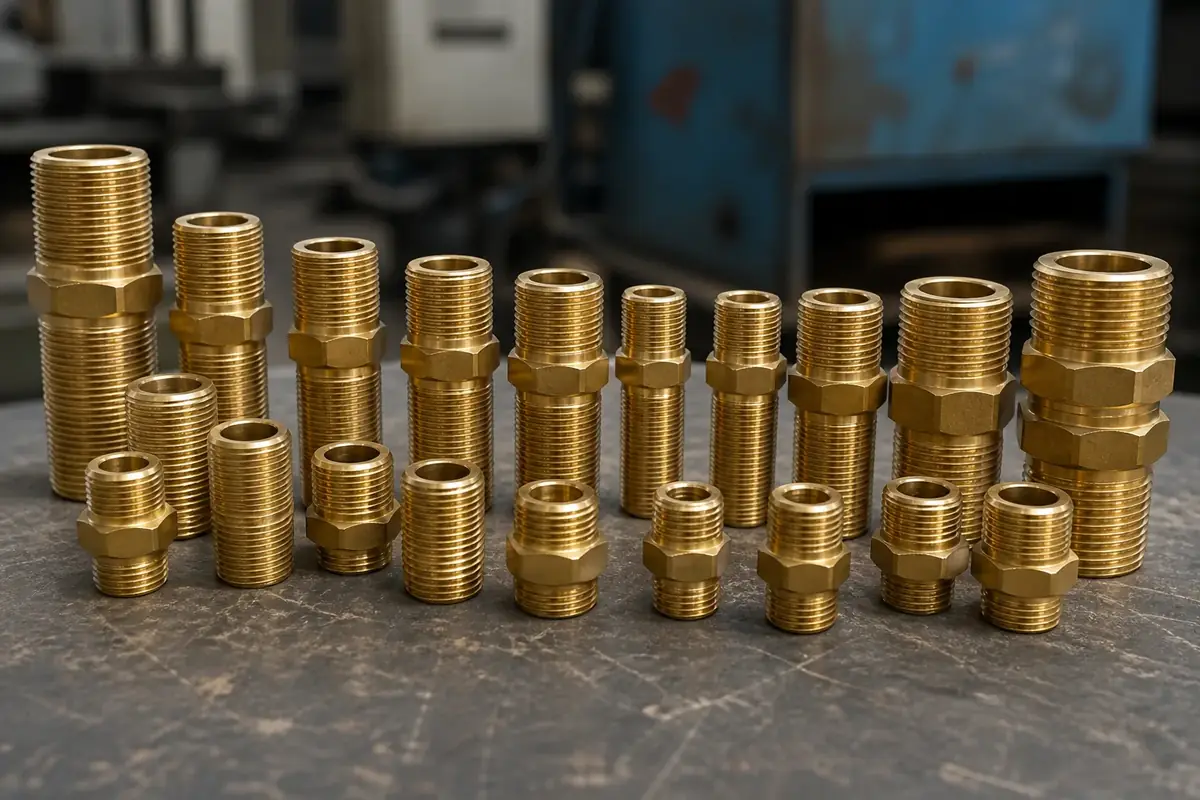
A brass nipple is a short male-to-male pipe section. Buyers search 1/2 brass nipple, 1/2 inch brass nipple, 1/4 brass nipple, 3/8 brass nipple, 3/4 brass nipple, 1 inch brass nipple, 1 brass nipple, and 2 brass nipple constantly—yet length and thread standard decide the real SKU.
A brass pipe nipple may be close or open pattern (hex in the middle versus continuous thread). Close nipples need careful wrenching strategy; hex nipples are kinder in service. Threaded brass pipe fittings also include couplers—female sleeves that join two male ends—under the brass coupler label.
What to lock on every nipple RFQ line
- Nominal size and overall length.
- Thread standard on each end (do not assume both match).
- Close, short, or long pattern; hex or running thread.
- Alloy and any lead-free requirement.
- Finish: raw, nickel, or other specified coating.
“Most ‘wrong nipple’ complaints are right size, wrong thread—or right thread, wrong length for the union that has to spin.”
Compression fittings, sleeves, and caps
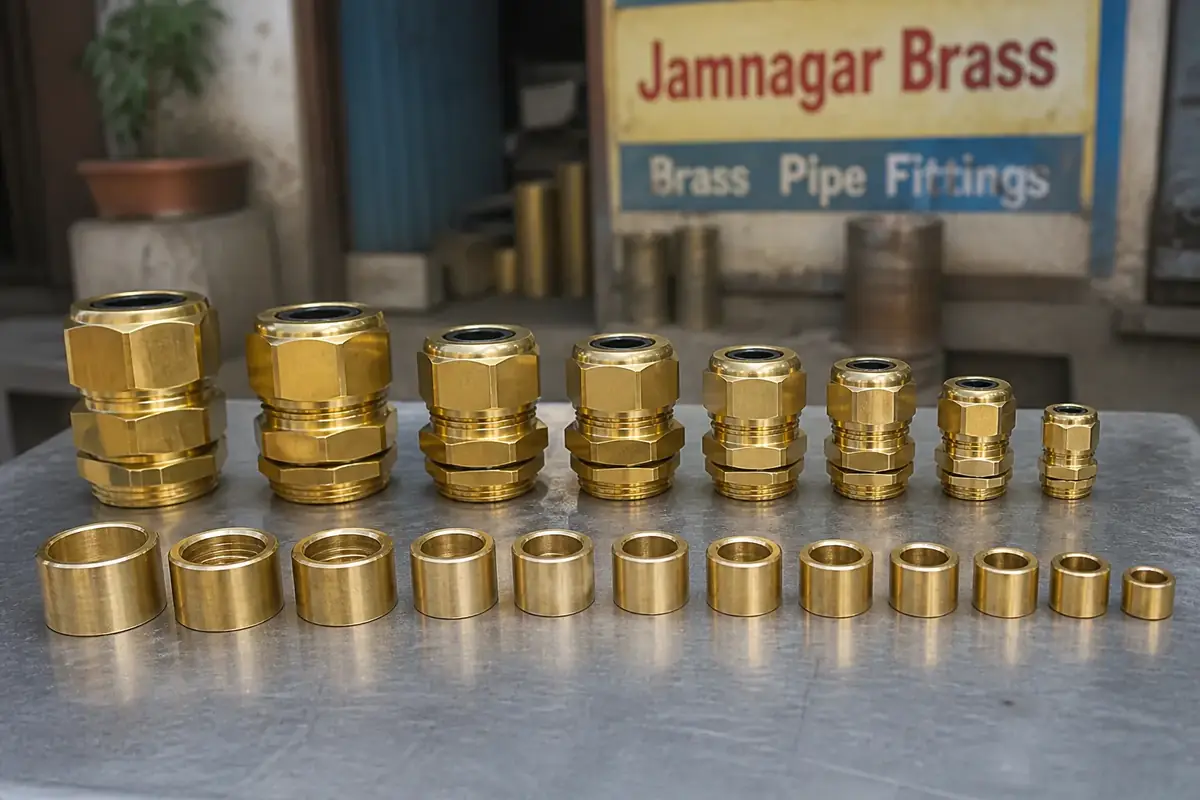
Brass compression fittings seal on tube OD with a nut and olive (ferrule). They are popular for copper tube when heat from soldering is unwanted. Call out brass compression fittings for copper pipe only when tube OD and wall match the olive design you approve.
Common instrument and appliance sizes include 1/4 compression tee, 1/4 compression cap, 3/8 compression tee, 3/8 compression cap, 3/8 compression union, and 3/8 to 1/4 compression adapter transitions. A brass compression sleeve (olive) should stay matched to the nut and body family—mixed olives are a classic leak source.
Assemblies need tube preparation notes: square cut, deburr, insertion depth. Over-tightening ruins olives; under-tightening weeps. Put torque or turn-of-nut guidance in the installer sheet if you sell retail kits.
Soft versus hard tube changes bite behaviour. If your channel mixes copper temper types, validate olives on both. A sleeve that seals annealed tube may mark harder tube differently—or fail to seal without extra turns that crack nuts.
Reuse policy should be explicit. Many compression olives are single-use in serious practice. If your retail kit implies reuse, expect leaks and blame. Print the rule.
Flare nuts and flared tube joints
Flare systems seal metal-to-metal on a formed tube end. Buyers often need a 1/2 flare nut, 1/4 flare nut, or related flare fitting bodies. Seat angle must match the tube flare standard used in that market—mixing angles is not a sealant problem you can fix in the field.
Specify nut thread, seat angle, and tube OD together. If your program also uses compression on other branches, keep SKUs and gauges separate so packing staff cannot swap lookalike nuts.
Thread and tolerance language for machined connectors continues in brass component specifications, threads, and tolerance.
Hose connectors, barbs, and garden adapters
Brass hose fittings cover a wide shelf: brass hose connector pieces, brass hose nipple threads, brass hose pipe connectors, brass hose barb fittings, and plain brass hose barb tails. Barbs need hose ID, barb diameter, ridge count, and clamp guidance. Threaded hose ends need the hose thread form used in that country.
Brass garden hose fittings and broader garden hose fittings and adapters are retail-sensitive: washer faces, knurl grip, and quick-connect profiles get judged by hand feel as much as by leak tests. Brass quick connect hose fittings are not universal—sample against the mating ends you sell.
Industrial air or water hose barbs may share machining cells with garden SKUs but need different burst and pull-off expectations. Write the duty. A garden adapter is not automatically an industrial hose nipple.
Clamp type changes required barb geometry. Worm-drive clamps forgive minor diameter error; some ear clamps do not. If you kit clamps with barbs, validate the pair. Selling barbs alone still needs a stated hose ID range on the bag.
Knurl and wrench flats on hose connectors affect perceived quality in DIY channels. Sharp knurl that cuts hands creates returns unrelated to sealing. Approve the tactile standard with real users when volume justifies it.
“If the barb looks aggressive but the hose slips at pressure, you specified theatre ridges—not engagement length.”
PVC, size-change, and mixed-system adapters
A brass to PVC adapter joins metal threads to plastic systems. Spec both ends: plastic socket or thread standard, metal thread standard, temperature, and pressure. Sealant and thread tape rules differ from all-metal joints.
Size-change adapters—such as a 3/8 to 1/4 compression adapter—need clear which side is which in bag labels. Field crews install the wrong orientation when labels only say “adapter.”
Mixed systems also appear when pipe connectors meet valves and elbows. Keep the connector RFQ explicit, then link the broader fittings list rather than dumping every shape into one vague “brass connectors” email.
Brass pipe stock versus connector hardware
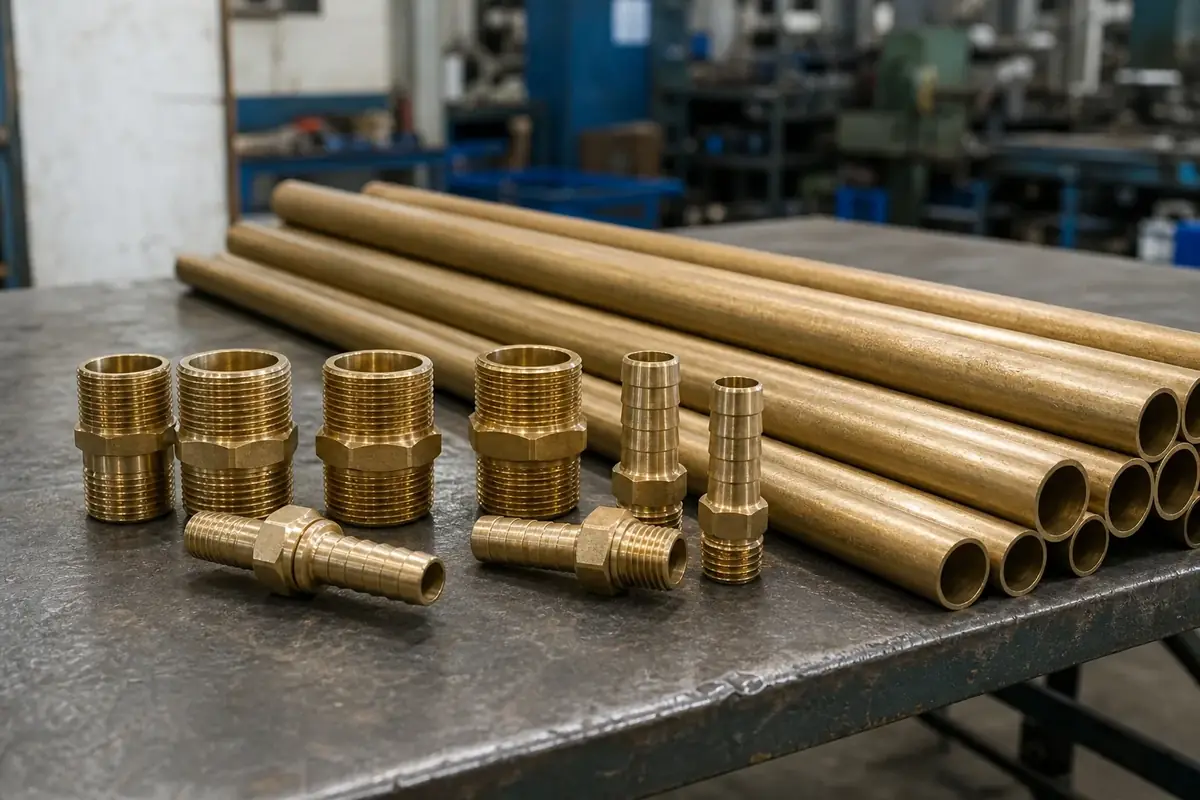
Brass pipe price discussions often mean tube or pipe sold by length—1/2 brass pipe, 3/4 brass pipe, wall thickness, temper, and cut tolerance. That is closer to mill product thinking than to a turned nipple quote.
Jamnagar’s strength for many buyers is connector machining and forging fed by local rod and billet supply. If you need mill-length pipe or related flat products, separate the enquiry. Rod and bar feedstock context sits in brass rods, bars, billets, and patti; sheet and strip in brass sheet, plate, and strips.
Do not let a cheap pipe-length number set expectations for precision hose barbs. Different machines, different scrap rates, different packing.
Cut-to-length pipe programs need their own tolerance stack: length, squareness, ID cleanliness, and end deburr. A connector shop that threads beautifully may not be the right cell for long straight lengths—and the reverse is also true.
If you buy both, keep SKU prefixes different in your ERP. Mixed descriptions are how a warehouse ships pipe when the pick ticket meant nipples.
Joining method comparison table
Use this to pick the joint family before you collect quotes.
| Method | Typical hardware | Must-specify | Watch-out |
|---|---|---|---|
| Threaded pipe | Nipple, coupler, adapter | Size, length, BSP/NPT, pattern | Mixed standards on two ends |
| Compression | Body, nut, olive/sleeve, cap, tee, union | Tube OD; matched sleeve family | Mixed olives; over-tightening |
| Flare | Flare nut, flare body | Seat angle; tube OD | Wrong angle = chronic seep |
| Hose barb | Barb fitting, hose nipple | Hose ID; barb OD; clamp | Short engagement; pull-off |
| Garden / quick-connect | Hose connector, quick coupler | Regional hose thread / profile | Cross-market non-fit |
| Plastic transition | Brass to PVC adapter | Both ends; temp/pressure | Metal rules applied to PVC side |
Buyer checks and packing notes
- Gauge threads or verify compression/flare seats with the correct standard tools.
- Measure nipple length and hex size against the assembly that must spin on.
- Pull-test or pressure-test hose barbs with the hose you actually sell.
- Keep olive/nut/body families kitted together in retail packs.
- Label both ends on reducing adapters in the bag and on the carton.
- Protect plated connectors from part-to-part rub in export cartons.
- Separate pipe-length SKUs from connector SKUs in PO lines and packing lists.
Dense brass connectors punish weak cartons. Weight adds up faster than teams expect when a mixed nipple assortment ships. Confirm carton board grade and inner bagging before ocean transit.
If plating thickness sits near thread class limits, ask for a plated-thread gauge check—not only a bright visual. Nickel that looks premium can still kill a borderline male thread.
Count accuracy deserves a metric. For high-volume nipples, weight-count correlation or automated counting beats tired manual tallies at shift end. Agree an AQL for count errors the same way you agree dimensional AQL—short counts destroy distributor trust.
Moisture and tarnish control matter for bright retail connectors even when function survives. VCI, dry packs, or simple sealed bags should match sail time. A technically perfect barb that arrives mottled still gets returned from consumer channels.

Kits, assortments, and retail packing
Many importers do not buy connectors as lonely SKUs. They buy kits: a compression assortment, a nipple length set, or garden hose fittings and adapters in a clamshell. Kit logic multiplies packing risk. One wrong olive size in a “complete” set creates a support ticket even if ninety-nine pieces are perfect.
Build kit BOMs with revision control. If a 3/8 compression union changes nut height, the blister card may no longer close. Approve packaging with the production parts, not with hand-picked samples that sit flatter.
Assortment trays of nipples look simple and fail messily. Label cavities by size and length. Weight-check finished trays if you can—missing a 2 inch nipple changes feel less than you hope, but scanners and scales catch empty slots faster than visual glances at yellow metal.
Retail garden lines need washer inclusion rules. A brass hose connector sold without the expected washer becomes a leak complaint attributed to the metal. State washer material, durometer band if relevant, and whether spares sit in the bag.
Industrial bulk packing can use polybags and count labels, but still segregate lookalikes. A 1/4 brass nipple and a short 3/8 can confuse night-shift pickers. Colour-dot stickers or separate inner cartons are low-tech insurance.
Instruction sheets earn their keep on compression and flare kits. Diagram insertion depth and “do not reuse olives” notes. Support teams would rather answer fewer calls than reprint glossy boxes.
When kits include quick-connect pieces, photograph the mating pair on the insert card. Buyers return “defective” halves that are simply the wrong regional profile. Education on the card is cheaper than return freight on dense brass.
Finally, align barcode and customs descriptions with reality. “Brass pipe” as a catch-all HS narrative for mixed connectors creates broker questions. Piece-part descriptions that match the packing list keep containers moving.
FAQ: brass pipe, tube, and connectors
Are quick connect hose fittings interchangeable worldwide?
Not reliably. Profiles differ by market. Sample against the hose ends you sell rather than assuming one pattern fits all.
What counts as brass pipe and tube connectors?
Nipples, couplers, compression fittings, flare nuts, hose barbs, hose connectors, and transition adapters that join pipe, tube, or hose. Shape fittings and valves are related but deserve their own RFQ lines.
How do buyers specify a 1/2 brass nipple correctly?
Size, length, thread standard on each end, and pattern (close/hex/long). Same nominal size with mixed threads is a different part.
When should I use brass compression fittings for copper pipe?
When the tube OD system is defined and you want a mechanical joint. Spec nut, sleeve, and body as a matched set.
What is the difference between a hose barb and a hose connector?
Barbs grip hose ID and usually need clamps. Hose connectors often use threaded or quick-connect hose ends. Spec retention method and regional hose standard.
Does brass pipe price equal connector price?
No. Pipe price is typically length-and-wall economics. Connectors are piece-priced machined or forged hardware.
Can a brass to PVC adapter replace a full metal joint?
Only within the plastic side’s duty limits. Spec both ends and temperature/pressure clearly.
What nipple sizes are common in export catalogues?
1/4, 3/8, 1/2, 3/4, 1 inch, and 2 inch classes appear often, in short and long lengths. Always attach thread and length.
Conclusion
Connectors look like small catalogue parts until a wrong olive or mixed thread stops a line. Treat each joining method as its own specification family: threaded nipples and couplers, compression sets, flare nuts, hose barbs, and plastic transitions.
Keep mill-length pipe pricing out of piece-part connector negotiations. Then sample with the tube or hose you actually ship. That is how yellow metal joints stay boring in the best way—no field drama, no carton surprises.
Expand into the fittings, valves, rod/bar, sheet, and thread-spec hubs as your BOM grows beyond straight connectors.
Ready to Source Brass Pipe Fittings & Connectors?
Share nipple lists, compression sizes, or hose barb drawings with a direct supply desk for machined and forged connectors. Browse related categories or start an RFQ on Jamnagar.net.