Brass Valves Types Guide: Ball, Gate, Check, Bibcock, and Beyond
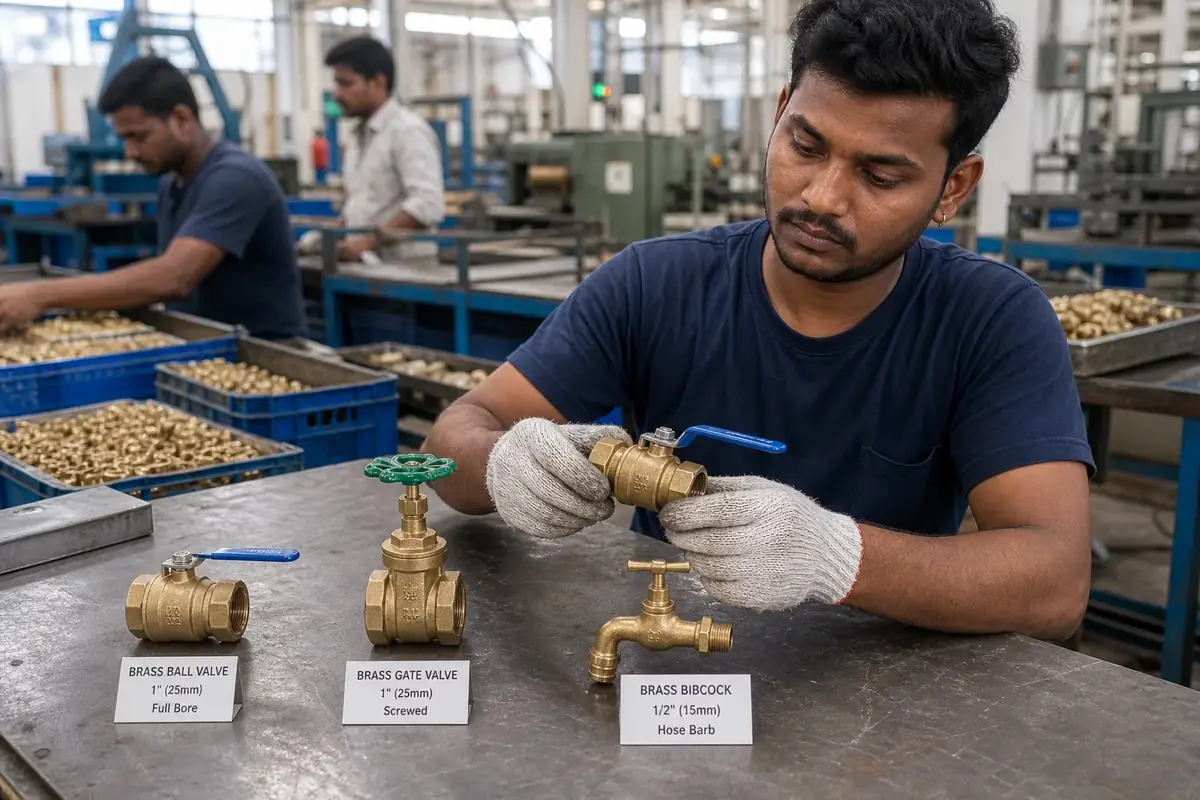
Valve catalogues look simple until a stem weeps in the field. This brass valves types guide is for buyers and engineers who need to match function, size, and test method before chasing a low line price. Copper-zinc valve bodies are common in water, utility, and light industrial programs—especially where forging and machining capacity sit close together.
Brass valves are not one product. A quarter-turn ball, a rising-stem gate, a swing check, and a hose bibcock share alloy colour and little else. Seats, packing, and acceptance tests decide whether a shipment becomes inventory or returns.
Use the sections below to shortlist by duty, then lock ends, alloy, and leak criteria. Adjacent fittings and connectors belong on linked hubs so the valve RFQ stays focused.
Highlights
- Pick function first: isolate, throttle, non-return, outdoor outlet, or tank control.
- Pair every size with end standard (threaded, compression, hose).
- Seat, stem packing, and leak-test method matter more than brochure shine.
Table of contents
- Function first: how to read a valve RFQ
- Ball valves, gate valves, and stop valves
- Check valves and non-return designs
- Bibcock, hose bib, and outdoor outlets
- Angle, float, foot, needle, PRV, and gas valves
- Sizes buyers actually call out
- How bodies are made and what to inspect
- Comparison table by valve family
- Brass valve price versus landed risk
- Assembly, spares, and aftermarket notes
- FAQ
Function first: how to read a valve RFQ
Start with the job. Isolation needs a reliable closed position. Throttling needs a design that survives partial open. Non-return needs cracking pressure and orientation. Outdoor hose outlets need packing and hose-thread details. Tank systems need float geometry.
Write media (water, air, gas), pressure, temperature, and end connections before you argue about handle colour. A brass shut off valve line without media notes invites the wrong seat compound.
If the same BOM includes elbows and nipples, keep valve acceptance separate. Fittings guidance lives in the brass fittings and plumbing fittings guide; tube and hose connectors in the pipe, tube, and connectors guide.
Cycle life expectations belong in the same early conversation. A stop valve opened twice a year is not the same duty as a manifold ball exercised daily. Shops can often meet either—but seat material and packing stacks change when you tell the truth about use.
Noise and water-hammer sensitivity also differ by design. Swing checks can slam; spring checks behave differently. If your market complains about noise, put that in the RFQ instead of discovering it after retail reviews.
Ball valves, gate valves, and stop valves
Quarter-turn ball valves dominate many modern lines because open/closed status is obvious and operation is fast. Mini ball valve 1/2 and mini ball valve 1/4 SKUs show up on appliances, manifolds, and tight utility spaces. A compression ball valve shifts the end preparation toward copper tube compression nuts rather than taper pipe threads.
A brass gate valve uses a wedge or gate to isolate. Calls for gate valve 3/4, 15mm gate valve, 28mm gate valve, and 2 brass gate valve sizes are common in regional specs. Full bore can help flow; rising versus non-rising stems change installation height.
Stop valves and general brass stop valve / brass water valve language often means isolation in domestic lines. Do not assume a stop valve is a gate or a globe until the drawing says so. Brass shower valve bodies and sink valve diverter / faucet splitter assemblies add cartridge and diverter geometry—closer to sanitary tap programs than to a plain isolation gate. See the taps, faucets, and showers guide when the control is really a mixer.
“A ball valve that seals on the bench but weeps at the stem after plating is not a bargain—it is a packing problem you paid freight for.”

Check valves and non-return designs
A brass check valve and a brass non return valve usually describe one-way flow control. Confirm whether you need a swing disc, spring-loaded poppet, or other design. A brass swing check valve or 3/4 swing check valve behaves differently from a compact spring check in pulsed lines.
Size callouts such as 2 brass check valve still need end standard and cracking-pressure expectations. Install orientation matters; some designs hate vertical reverse mounting. Ask for the shop’s leak and reverse-flow test method—not only a photo of the body.
Foot valves for pump suction combine non-return function with a strainer logic. Spec mesh, body length, and whether the foot valve must hold prime under your suction lift assumptions.
Bibcock, hose bib, and outdoor outlets
A brass bibcock, bibcock valve, or brass bib tap is the classic utility outlet. Related searches—bibcock taps, brass hose bib, 3/4 hose bibb, hose union bib tap, angle hose valve, and bibcock ball valve hybrids—point at the same buyer problem: inlet standard plus hose outlet plus handle durability.
Sillcock-style outdoor valves may add longer shanks or frost-oriented features depending on market. Even when frost features are not required, packing quality and hose-thread accuracy still decide callbacks.
Quick coupler valve interfaces and hose-union outlets should be sampled against the hose fittings you actually sell. Mismatched “almost garden” threads are a silent return generator.
Washer faces and hose union seats wear in public view. If the outlet face is rough after machining, hose washers cut early and customers blame the valve. Approve face finish the same way you approve nickel colour.
For markets with freeze risk, clarify whether you need a longer sillcock-style body or simply a standard bibcock with drain advice. Do not buy frost features you will not mark or support in instructions.

Angle, float, foot, needle, PRV, and gas valves
A brass angle valve turns the flow path 90° inside the body—common under basins and on appliance stops. Radiator programs may call brass radiator valves or antique brass radiator valves with decorative trims; treat decorative trim as a finish SKU layered on a functional valve, not as proof of sealing quality.
A brass float valve controls tank level; float arm geometry, orifice size, and seat wear dominate performance. A brass foot valve protects pump suction. A brass needle valve meters small flows—seat geometry and stem threads must stay precise after plating.
A brass pressure relief valve is a safety device, not a decorative stop. Set pressure, reseat behaviour, and marking rules belong in writing. A brass gas valve line needs media-appropriate seats, leak criteria, and often separate certification pathways from ordinary water valves. Do not bury gas duty inside a generic water RFQ.
Repair programs—washer kits, stems, and “craft valve repair” style spare parts—need interchange notes. If you sell spares, freeze dimensions from the production valve you actually ship, not from a mixed competitor sample on the bench.
Sizes buyers actually call out
Size language mixes imperial and metric. You will see brass valve 1 inch, 1/2 mini balls, 3/4 gates and hose bibbs, 15mm and 28mm gates, and 2 inch check/gate bodies in the same importer workbook. Convert carefully and always attach the end standard.
- Threaded ends: BSP, NPT, or named regional parallel/taper forms.
- Compression ends: tube OD and nut/olive system.
- Hose ends: thread form and washer face for bibcocks.
- Flanged or union ends: bolt or union seat details when used.
Never order by nominal size alone. A 3/4 valve with the wrong thread is scrap with a polished handle.
Handle and operator clearance also scale with size. A large gate handwheel needs packing space in a riser cupboard; a mini ball needs finger access beside a water heater. Include envelope sketches when the install cavity is tight—body OD alone does not tell the story.
Reducing valves and odd transitions should be called out as engineered SKUs, not improvised with bushings after the fact, if you care about flow certificates or retail simplicity.
How bodies are made and what to inspect
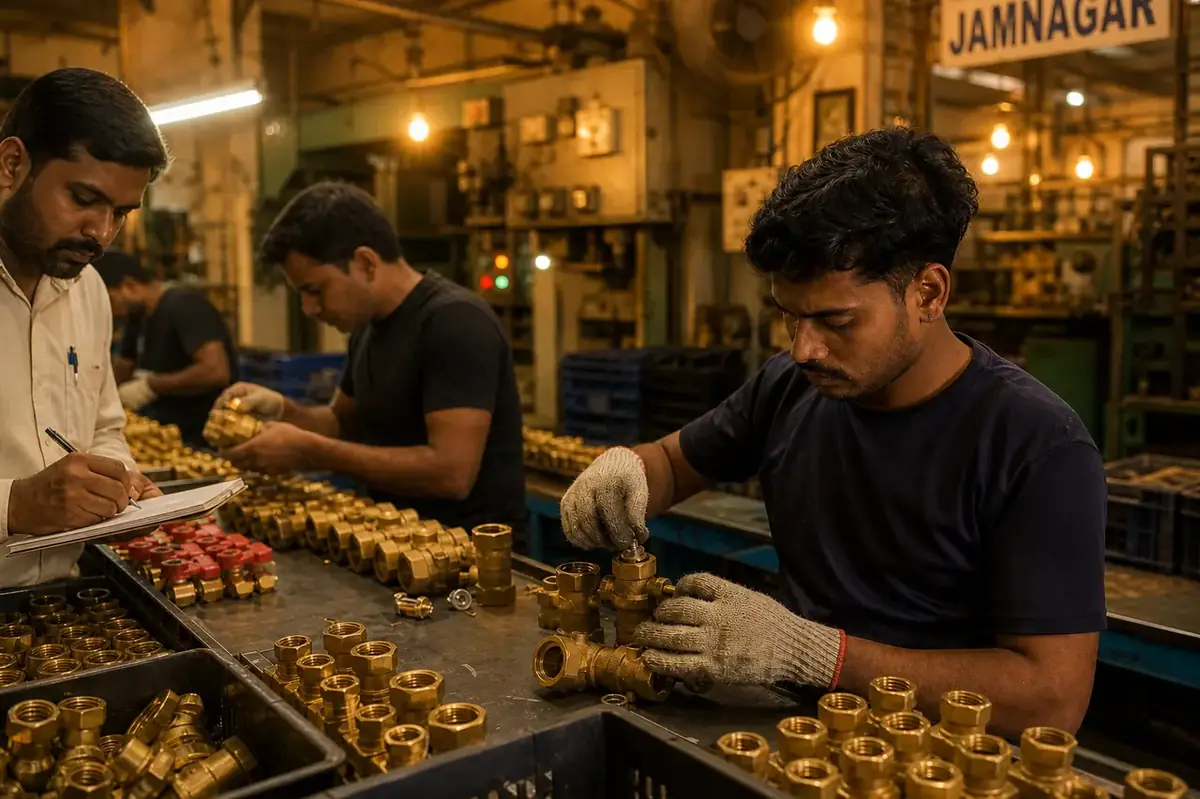
Many valve bodies start as hot forgings, then receive machining on seats, threads, and stem bores. Some smaller components are turned from rod. Caps, balls, stems, and nuts add assembly steps. Casting may appear for certain bodies; porosity near pressure galleries is a red flag.
Process detail for forged and machined routes continues in brass casting, machining, and CNC turned parts. Defect patterns—seat damage, stem leak paths, plating flakes—are catalogued in brass product defects and quality checks.
Inspection points that catch expensive failures
- Shell and seat leak tests at agreed pressure.
- Stem packing torque and weep check after cycling.
- Thread gauges on every end type in the SKU.
- Ball roundness / seat imprint where applicable.
- Handle and stem engagement under side load.
- Plating thickness versus thread class and logo fill.
- Opening/closing torque band for retail “feel” SKUs.
- Marking permanence after wipe and light abrasion.
Sampling plans should intensify after process changes—new seat mould, new packing vendor, new plating line. A clean history on an old process does not automatically bless a new one.
“If the sample was hand-lapped and production will not be, write that gap down—or it will ship inside the carton.”

Comparison table by valve family
Exact ratings vary by design and alloy. Use this as a sourcing filter, not a pressure certificate.
| Family | Primary job | Spec focus | Typical failure mode |
|---|---|---|---|
| Ball / mini ball | Fast on/off | Seat material; stem seal; end type | Stem weep; seat scratch |
| Gate / stop | Isolation | Bore; stem type; packing | Seat leak; seized stem |
| Check / NRV / swing | One-way flow | Cracking pressure; orientation | Slam noise; reverse leak |
| Bibcock / hose bib | Utility / hose outlet | Inlet + hose thread; packing | Packing drip; hose mismatch |
| Angle / radiator | 90° stop / heating | Ends; trim finish; seat | Cosmetic vs seal conflict |
| Float / foot / needle | Level, suction, metering | Orifice; mesh; stem precision | Wear at seat; debris jam |
| PRV / gas | Safety / gas control | Set pressure; media seats; marks | Wrong duty assumptions |
Brass valve price versus landed risk
Brass valve price conversations go wrong when buyers compare unfinished bodies to assembled, tested, plated valves. Ask what the number includes: seats, handles, packing, leak test, plating, and individual bagging.
A cheaper forging with hand-selected samples can lose to a slightly higher quote with routine shell tests and stable stem packing. Field warranty and port demurrage erase thin savings quickly.
For alloy notes such as CW617N-style forging grades, state the requirement instead of assuming every yellow body matches. Lock sample-to-production continuity on seals and lubricants used in assembly.
Quote comparisons should also normalise test pressure and duration. A one-second air sniff is not the same evidence as a timed shell and seat test. If two bids look far apart on price, check whether only one of them is actually testing.
Spare-parts attach rates change economics too. A slightly higher complete-valve price with stable stem geometry can beat a cheap body that forces custom packing kits every season.
Assembly, spares, and aftermarket notes
Valve programs are rarely body-only forever. Handles, glands, balls, seats, and packing kits become aftermarket SKUs whether you planned them or not. Freeze interface dimensions early: stem flats, handle spline, packing stack height, and seat OD. If production changes a stem without telling the spare-parts catalogue, field repair dies.
Assembly lubricants and seal compounds deserve a line on the router. A sample assembled with a soft grease may cycle smoothly, while a drier production compound makes stems feel harsh—or the reverse. Lock the bill of materials for consumables the same way you lock alloy.
Private-label handle colours and logo caps are cosmetic, but they interact with UV, cleaning chemicals, and warehouse heat. Approve plastics and coatings as materials, not only as Pantone swatches on a screen. Outdoor brass bibcock handles see harsher life than indoor stop valves.
Carton strategy should protect stems and handwheels. Dense brass bodies shift in transit and shear soft plastic handles if voids are large. Use partitions or bagged assemblies for retail-ready valves. Bulk industrial bodies can ship differently—but then do not expect retail shelf appearance on arrival.
Training installers reduces false failures. Compression ends overtightened, PTFE tape on flare seats, or check valves installed backward generate “defective valve” claims that are really installation errors. A one-page install note in the bag is cheaper than return logistics.
When you dual-source a brass gate valve or mini ball, keep a cross-section photo and critical ballooned drawing for both. Visual similarity is not functional equivalence. Seat angles and packing depths hide inside shiny bodies.
Warranty policies should state cycling expectations and media limits. A valve sold into cold water duty that later sees steam or aggressive cleaners will fail for reasons outside forging quality. Clear duty labels protect both importer and workshop.
If your line includes antique-style radiator trims or decorative shrouds, separate the decorative PO from the pressure-retaining assembly PO when cosmetics dominate. Polishing cells and leak-test cells optimise differently; forcing one schedule onto both creates either dull chrome or untested pretty parts.
Keep a short field-failure taxonomy with your supplier: stem weep, seat bypass, handle breakage, thread mismatch, and cosmetic reject. Shared language speeds root-cause work and stops every drip from being blamed on “bad brass.” Review that taxonomy each quarter when volumes change.
FAQ: sourcing brass valves
Should gas valves share a water-valve RFQ line?
Prefer separate lines and test criteria. Gas duty can need different seats, marking, and leak standards than general water valves.
What should buyers decide first?
Function: isolate, throttle, non-return, outdoor outlet, or tank control. Function drives body, seat, and test method before any price table matters.
When is a brass gate valve better than a ball valve?
When the duty prefers multi-turn isolation or a familiar full-bore gate in the local code culture. Ball valves win when quarter-turn clarity and speed matter more.
Are check valves and non-return valves the same?
Often in trade speech, yes—one-way flow. Still confirm disc type, cracking pressure, and orientation. Swing and spring designs are not drop-in twins.
What sizes are commonly requested?
15mm and 28mm gates, 1/2 and 1 inch shut-offs, 3/4 gates and hose bibbs, mini 1/4–1/2 balls, and larger 2 inch check/gate bodies appear often. Attach end standards every time.
Is brass valve price a safe primary metric?
No. Seats, packing, forging quality, plating, and leak tests dominate field cost. Compare inclusions, not only the number on the quote line.
What is a brass bibcock used for?
Utility and outdoor hose outlets. Spec inlet thread, hose outlet, handle, and packing expectations for the destination market.
Do mini ball valves need serious QC?
Yes. Small valves fail for the same seal and thread reasons as large ones. Gauge and leak-test them; do not skip because they look simple.
Conclusion
Brass remains a practical valve body material for many water and utility programs when forging, machining, and finishing sit in one supply belt. The sourcing edge is not yellow colour—it is clear function, honest size language, and tests that match the media.
Lock seats, stems, ends, and leak methods on the sample record. Then price becomes comparable. Use the fittings, connectors, taps, machining, and defects hubs as your BOM grows past a single isolation SKU.
If you remember one line from this guide: buy the duty, not the handle.
Ready to Source Brass Valve Bodies & Assemblies?
Send valve type, size, end standard, and test requirements to a direct desk that routes work into forging and machining cells. Compare catalogue options or request a component quote on Jamnagar.net.