Brass Recycling and Scrap Basics for Industrial Buyers

Copper-zinc alloys are born to circulate. Chips from automatic lathes, offcuts from extrusion, and sorted solids all feed new melts when chemistry is controlled. Brass recycling and scrap basics matter to buyers because feedstock discipline shows up later as machinability, plating adhesion, and compliance—not only as a sustainability slogan.
In Jamnagar, the loop is unusually short: machine shops, melt units, and billet casters often sit in the same industrial belt. That density makes recycled brass practical—if sorting is real and heats are documented.
This hub explains scrap categories, the role of brass ingots, and the questions OEMs should ask before trusting a “green” claim on a packing list.
Highlights
- Recycling quality = sorting + melt practice, not the word “recycled.”
- Chips, solids, and coated scrap are different risk classes.
- Ask for grade/heat identity when applications need traceability.
Table of contents
- Why brass recycling is industrial, not symbolic
- Scrap types shops actually sort
- Chip loops from turning floors
- Brass ingots, billets, and remelt stock
- Chemistry control for recycled brass
- Contamination risks that ruin heats
- Buyer questions on sustainability claims
- Scrap stream comparison table
- Household streams versus industrial grades
- Energy, logistics, and honest sustainability claims
- A practical buyer playbook for recycled programs
- Design choices that make recycling easier later
- Price signals in scrap markets
- Internal loops versus purchased scrap
- What to look for on a melt-yard walkthrough
- Next steps for procurement teams
- FAQ
Why brass recycling is industrial, not symbolic
Primary copper and zinc carry energy and mining footprints. Remelting clean brass typically uses less energy than starting from ore—provided collection and sorting are efficient. That is the practical case for recycled feedstock in component manufacturing.
Cluster geography amplifies the benefit. When chips travel across town instead of across oceans, logistics emissions and lead times shrink. The Jamnagar brass industry hub describes that closed-loop municipal flow at a high level.
Sustainability still needs guardrails. Uncontrolled scrap can introduce lead, iron, aluminium, or unknown coatings into a heat meant for a regulated market. Recycling without chemistry is just melting hope.
“Recycled is a process description. Grade is an acceptance description. Do not confuse the two on a PO.”
Scrap types shops actually sort
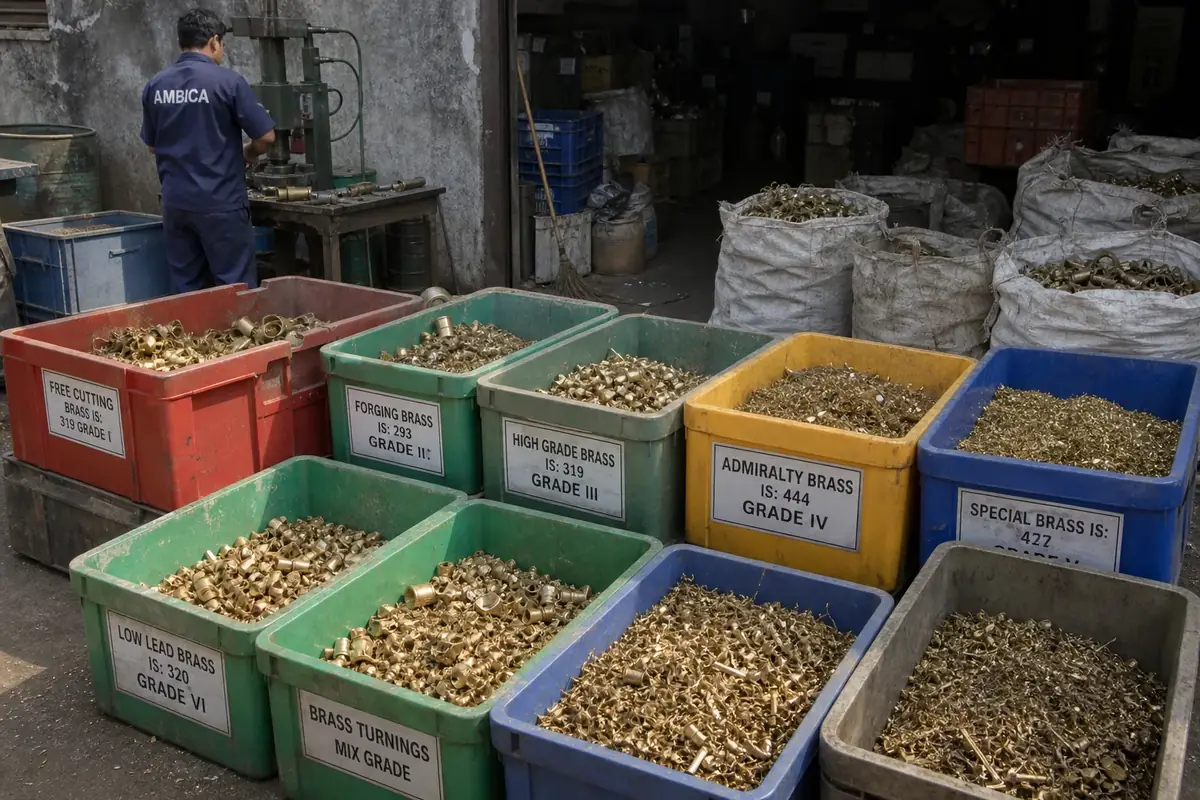
Yard language varies, but industrial practice usually separates solids, turnings, and mixed yellow metal. Solids include cutoffs, rejected castings, and clean fabricated offcuts. Turnings are machine chips with oil risk. Mixed piles may hide steel fasteners, zinc die-cast lookalikes, or bronze cousins.
- Clean solids by alloy family — highest confidence remelt input.
- Segregated chips — valuable when oil and tramp metal are controlled.
- Radiator / mixed assemblies — need dismantling; not automatic melt feed.
- Plated or painted parts — plan coatings; do not dump blindly.
- Unknown yellow metal — test or divert; do not assume brass.
Metal family differences—brass versus bronze versus copper—are summarised in brass vs bronze vs copper. Mixing them “because they look similar” is how heats go sideways.
Chip loops from turning floors
Automatic lathes generate continuous chip streams. In a disciplined shop, free-cutting grades stay in labelled bins, lead-free campaigns stay separate, and oily chips are drained or centrifuged before sale or remelt.
Tramp steel from broken tools is a silent contaminant. Magnets and visual sorting help. One steel bolt in a soft pile can seed inclusions that destroy tool life downstream.
Buyers rarely see the chip yard, but they feel it when machinability drifts mid-program. Ask whether production chips return to the same melt program that feeds your rod—or whether open-market scrap fills gaps without grade control.
Brass ingots, billets, and remelt stock
Brass ingots and related cast stock are the intermediate form after melting and casting. Mills and foundries use them as controlled feedstock for extrusion, remelt, or further casting. Calling for ingots without a grade is as vague as calling for “yellow metal.”
Billet quality shows up in extrusion and machining. Dense, well-cast stock with known chemistry supports predictable rod. Porous or mixed heats create soft spots and inclusion drama later.
For rod and bar pathways after melt, continue to brass rods, bars, billets, and patti. Grade economics are covered in brass alloys, grades, and price factors.
Chemistry control for recycled brass
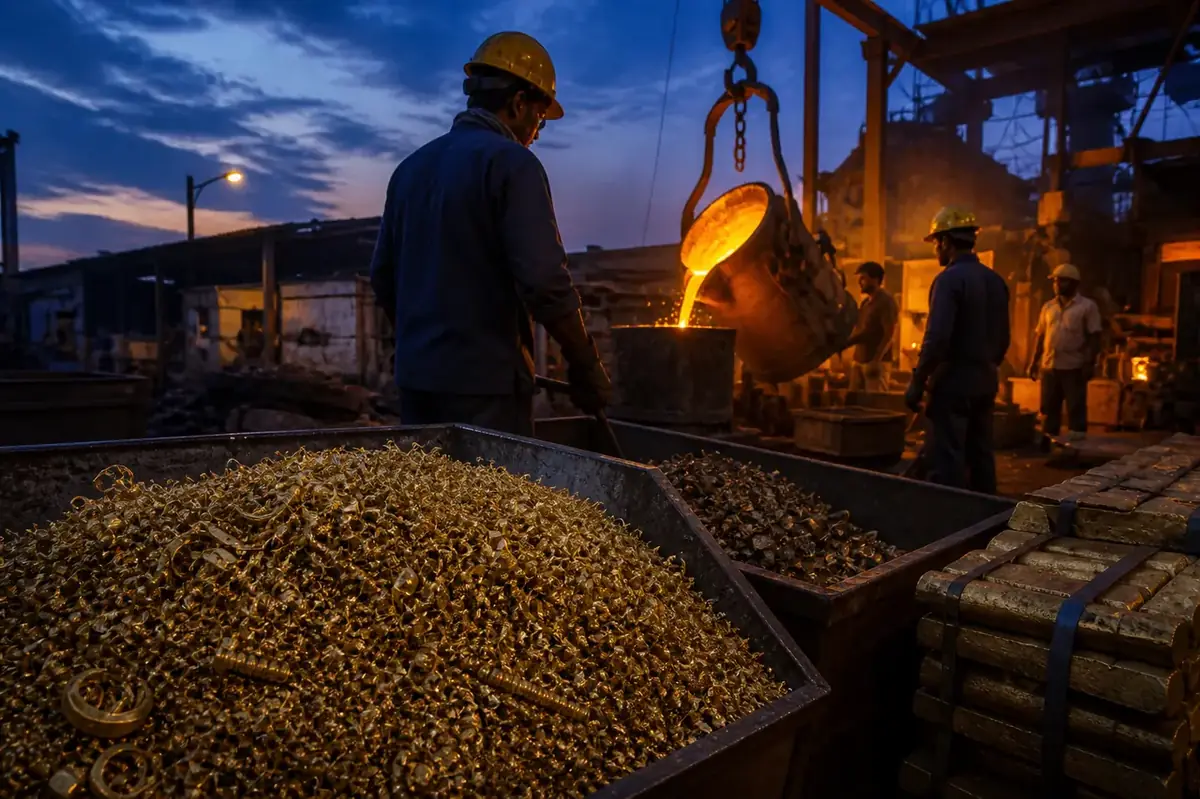
Good melt practice samples heats, adjusts copper-zinc balance, and manages intentional additions. Free-cutting grades and forging grades are not interchangeable leftovers.
Lead-free or low-lead programs need stricter scrap gates. A single mixed bin can push a heat outside destination-market rules. If your PO names a compliant grade, ask how non-compliant scrap is excluded—not only how much scrap is reused.
Documentation can be pragmatic: heat tickets, spectro results on critical lots, and clear rules for remelted turnings. Paperwork without yard discipline is theatre; yard discipline without paperwork is hard to audit.
“The shortest path between a dirty chip pile and a failed export lot is an undocumented remelt.”
Contamination risks that ruin heats
- Ferrous tramp — tools, screws, and mixed hardware.
- Aluminium and zinc die-cast lookalikes — wrong density and melt behaviour.
- Oil and moisture — fumes, porosity risk, messy chemistry.
- Heavy plating / paint / lacquer — coating elements and residues.
- Soldered assemblies — tin and other additions in unpredictable amounts.
- Cross-grade brass mixes — leaded chips into lead-free campaigns.
Prevention is boring: labelled bins, training, and refusal of mystery drums. Recovery after a bad heat is expensive.
Buyer questions on sustainability claims
When a quotation mentions recycled content, ask concrete questions:
- Which scrap streams feed this grade—internal chips, purchased solids, mixed?
- How are heats identified on rod or casting lots?
- What spectro or certificate practice applies to our SKUs?
- How are coated and unknown scraps excluded?
- Do lead-free or drinking-water rules change the scrap gate?
- Will production heats match the sample heat family?
Honest answers beat vague percentages. A shop that can describe its bins is usually safer than one that only prints a green logo.

Scrap stream comparison table
| Stream | Typical use | Main risk | Buyer ask |
|---|---|---|---|
| Clean solids | High-confidence remelt | Mis-sorted alloy | How is family verified? |
| Segregated chips | Closed shop loops | Oil, tramp steel | Drain and magnet practice? |
| Mixed yellow | Lower-grade melts only if sorted | Bronze/steel contamination | Is it excluded from our grade? |
| Coated parts | Special handling | Plating/paint residues | Separate stream? |
| Ingots / billets | Extrusion & remelt feed | Unknown heat origin | Grade + heat ID available? |
Household streams versus industrial grades
Utensils and decorative household scrap sometimes enter general yards. Alloys, solders, and food-contact expectations differ from industrial free-cutting rod programs. Keep streams separate in thinking even when yards look similar from the gate.
If your product family is cookware or utensils, treat material selection as its own topic—see brass cookware and utensils buying guide—rather than assuming industrial remelt rules automatically apply.
The shared lesson across families: recycled brass is only as good as the gate that feeds the furnace.
Energy, logistics, and what “sustainable” can honestly mean
Most serious claims rest on three pillars: high recycled input where chemistry allows, short local loops that avoid shipping scrap worldwide for no reason, and process yields that scrap less metal into landfill-bound forms.
Avoid fake precision. Exact global averages for “X% energy saved” vary by furnace, scrap mix, and allocation method. Prefer process descriptions you can audit over impressive round numbers you cannot.
Packaging and plating chemistry also sit in the sustainability conversation. A beautifully recycled melt wrapped in wasteful, non-recyclable packing is a half-finished story. Align packing specs with the same seriousness as melt specs.
For OEMs publishing ESG language, keep engineering and marketing aligned. If the factory cannot support a recycled-content percentage with heat records, do not print the percentage.
A practical buyer playbook for recycled programs
Start with grade. Decide the alloy and compliance needs first, then ask how recycled streams can feed that grade. Reversing the order—demanding maximum recycled content before naming chemistry—creates conflict.
Pilot one SKU family. Compare machinability, plating, and dimensional stability against your historical virgin or mixed baseline. Expand only after the pilot survives production reality.
Mark POs with heat/lot expectations. If rod is extruded from brass ingots of known heats, keep that chain visible on packing lists when your auditors will ask later.
Review scrap gates annually. Shops change suppliers. A good chip program last year can drift if a new mixed yard enters the melt without updated controls.
Train receiving teams to spot symptoms of dirty feedstock: odd chip colour, sudden tool breakage waves, blister clusters after plating. Early signals beat late laboratory dramas.
Design choices that make recycling easier later
Assemblies that mix brass with steel fasteners permanently invite contamination when products return as scrap. Design for disassembly where take-back or circular programs matter.
Minimise mystery coatings on parts destined for closed-loop remelt inside your own supply base. If lacquer is required for shelf life, document it so end-of-life handlers are not guessing.
Standardise alloys across a product family when marketing allows. Fewer alloy families mean cleaner chip bins on the shop floor and simpler remelt recipes.
These design habits will not appear on a scrap invoice, but they decide whether next decade’s recycled stream stays usable.
Price signals in scrap markets
Scrap values move with copper and zinc markets and with local demand for clean turnings versus mixed solids. Shops feel those swings in rod cost even when your PO is priced per piece.
Clean, segregated chips usually command better treatment—and better melt discipline—than mystery drums. Paying slightly more attention to bin culture often costs less than fighting inclusion defects later.
When commodity spikes hit, pressure rises to stretch scrap mixes. That is exactly when your grade and heat documentation questions matter most. Sustainability claims under cost pressure need more auditing, not less.
Long-term agreements that ignore scrap market reality tend to break. Build review clauses that let chemistry discipline stay intact when prices move.
Internal loops versus purchased scrap
Internal chips from your own SKU family are the easiest recycled story to defend: known alloy, known oil practice, known tramp risk. Purchased open-market scrap can still be excellent when yards sort well—but it needs stronger incoming melt controls.
Ask suppliers what percentage of a typical heat is internal return versus purchased. Exact percentages vary; the answer quality matters more than a polished number.
If a shop outgrows its internal chip supply, new scrap sources should trigger a capability review for sensitive grades. Silent source changes are a classic path from stable machining to mysterious tool wear.
For extrusion feedstock, prefer brass ingots or billets with identity over anonymous remelt cakes when your application is intolerant of surprises.
What to look for on a melt-yard walkthrough
Labels on bins that match reality. Separate areas for coated scrap. Drained chip containers. Magnets in use. Spectrometer or sampling practice that staff can explain without a script.
Watch how rejects re-enter the loop. A rejected plated lot dumped into a clean solid bin is a process failure wearing a recycling halo.
Ask who can stop a heat. If nobody on the floor feels authorised to hold a suspicious melt, paperwork will not save you.
Photograph the yard layout for your files—not for social media. Your future self will thank you when a new purchasing manager asks why this supplier was approved for recycled brass programs.
Next steps for procurement teams
Add three lines to your next brass RFQ: allowed scrap streams, heat identity expectation, and coated-scrap exclusion rule. Those lines do more for real sustainability than a paragraph of adjectives.
Pair material questions with alloy grade notes so planners are not forced to choose between recycled content and compliance. Done well, brass recycling and scrap basics become part of normal sourcing hygiene—not a separate green project that fades after the brochure is printed.
FAQ: recycling, scrap, and sustainability
Are cookware and industrial scrap the same melt category?
Often no. Different alloys and contaminants appear. Keep household and industrial thinking separate.
What are brass recycling and scrap basics buyers should know?
Sort streams, control chemistry, and document heats. Recycling works when bins and melt practice are real—not when the brochure is green.
Is recycled brass lower quality than virgin feedstock?
Not by definition. Clean, controlled recycled brass can meet commercial grades. Contamination is the enemy, not reuse.
What role do brass ingots play in the supply chain?
They are intermediate cast stock for extrusion or remelt. Specify grade and heat identity when traceability matters.
How should machine shops handle brass chips for remelt?
Segregate alloys, manage oil, remove tramp metal, and keep lead-free campaigns isolated. Clean chips are feedstock; mixed piles are risk.
Can plated or lacquered scrap go straight into melt?
Not casually. Coatings need planned handling. Treat coated scrap as a separate stream.
How does recycling connect to Jamnagar’s cluster advantage?
Short chip-to-melt distances speed feedback and reuse. Advantage still depends on sorting and documentation.
What should OEMs ask suppliers about sustainable brass claims?
Ask about scrap streams, heat identity, exclusion rules for dirty scrap, and compliance gates for your market.
Conclusion
Brass wants to be recycled. Industry succeeds when scrap is sorted, heats are controlled, and brass ingots or rod carry grade identity into machining. Treat sustainability as process discipline—bins, chemistry, documentation—and recycled material becomes an advantage instead of a gamble.
If material pedigree or alloy questions sit on your next RFQ, take them to a supply desk that can discuss feedstock as clearly as piece price.
Questions on Alloy or Recycled Feedstock?
Ask material and grade questions tied to your drawings through the Jamnagar supply desk on Jamnagar.net.