Types of Brass Products Glossary: Families Buyers Actually Source
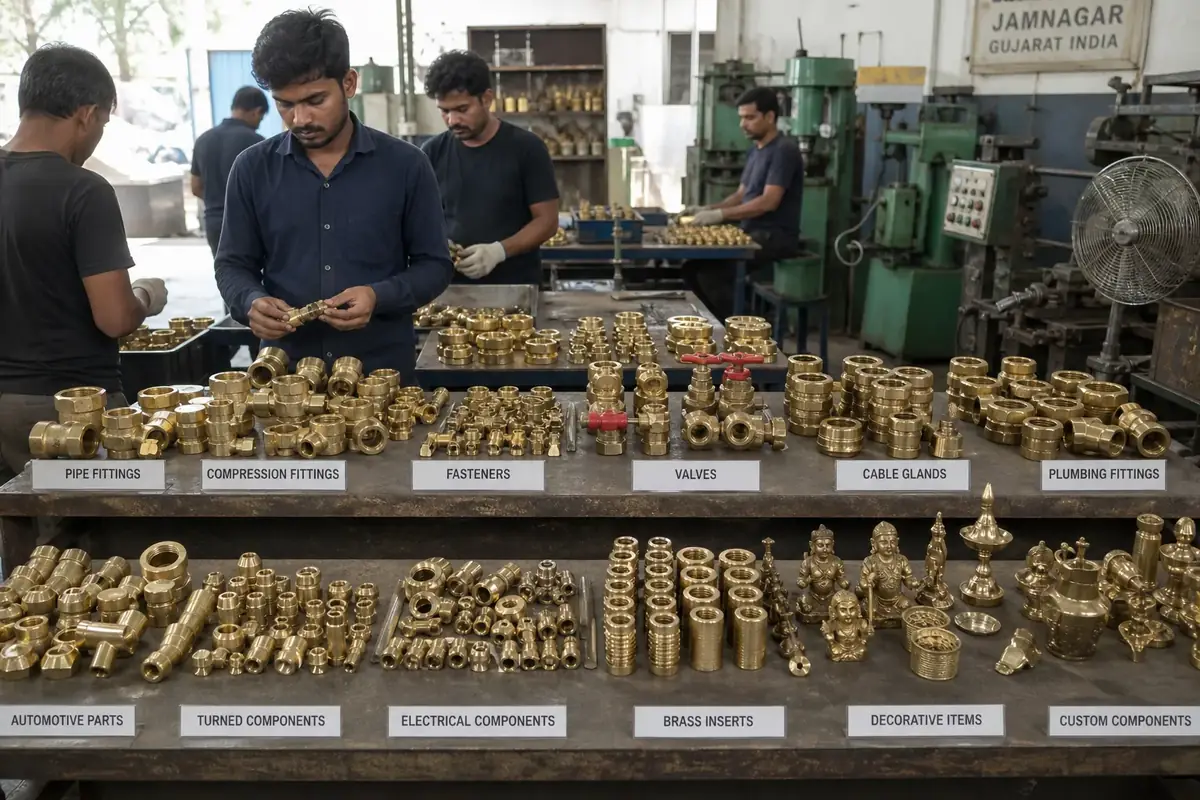
Search engines throw every yellow-metal phrase into one bucket. Workshops do not. A usable types of brass products glossary sorts brass items and brassware into families that share process, inspection, and packing logic—so a plumbing elbow and a shelf figurine stop competing for the same quote template.
This page is a catch-all navigator for jamnagar.info. It will not list every motif ever cast. It will tell you which family your need belongs to, which specialised hub to open next, and how to handle odd search phrases that do not map cleanly to factory SKUs.
For cluster context, keep the Jamnagar brass industry hub nearby. For shortlisting shops, use the brass parts manufacturer buyer guide.
Highlights
- Start with family (fluid, electrical, hardware, décor, blanks), not motif name.
- Brassware often leans household/décor; industrial parts need tighter specs.
- Odd search phrases deserve clarification before production RFQs.
Table of contents
- How to read this glossary
- Fluid and sanitary hardware
- Electrical and lighting hardware
- Fasteners, inserts, bushings
- Door, furniture, and architectural parts
- Décor, gifts, and household brassware
- Rod, sheet, blanks, and allied forms
- Specialty and ambiguous search phrases
- Family-to-hub map
- Naming habits that keep RFQs searchable
- A simple path when you only know the photo
- What this glossary deliberately does not do
- Alloy notes that cut across families
- FAQ
How to read this glossary
Each section names a product family, typical parts, and the first specification that matters. Use it as a sorting tray. When a phrase could mean two families, describe function: “seals water,” “carries current,” “sits on a shelf,” or “gets engraved later.”
Jamnagar’s strength is breadth. That breadth only helps if your RFQ lands in the right cell—cam turning, forging, casting, polishing, or blanking.
Think of brassware and industrial hardware as neighbouring cities, not synonyms. You can travel between them in one sourcing trip, but you still need the right address. This glossary is the street map before you knock on a workshop door.
Students and new buyers can skim family headers first, then open linked hubs for depth. Experienced importers can use the ambiguous-phrase section when a customer email arrives with lifestyle copy instead of a drawing.
“If the category is unclear, the cheapest quote is usually the wrong process wearing a confident smile.”
Fluid and sanitary hardware
This family covers plumbing fittings, valve components, adapters, compression parts, and sanitary bodies. Threads, sealing faces, and alloy compliance dominate. Appearance finish is secondary unless the part is customer-facing in a vanity setting.
Deep dive: brass fittings and plumbing fittings guide. Do not RFQ these parts with giftware polish language alone.
Buyers sometimes arrive from décor searches because a faucet looks “brassy.” Keep sanitary functional parts in this family even when the visible finish is antique or polished. Leak duty still rules the quote.
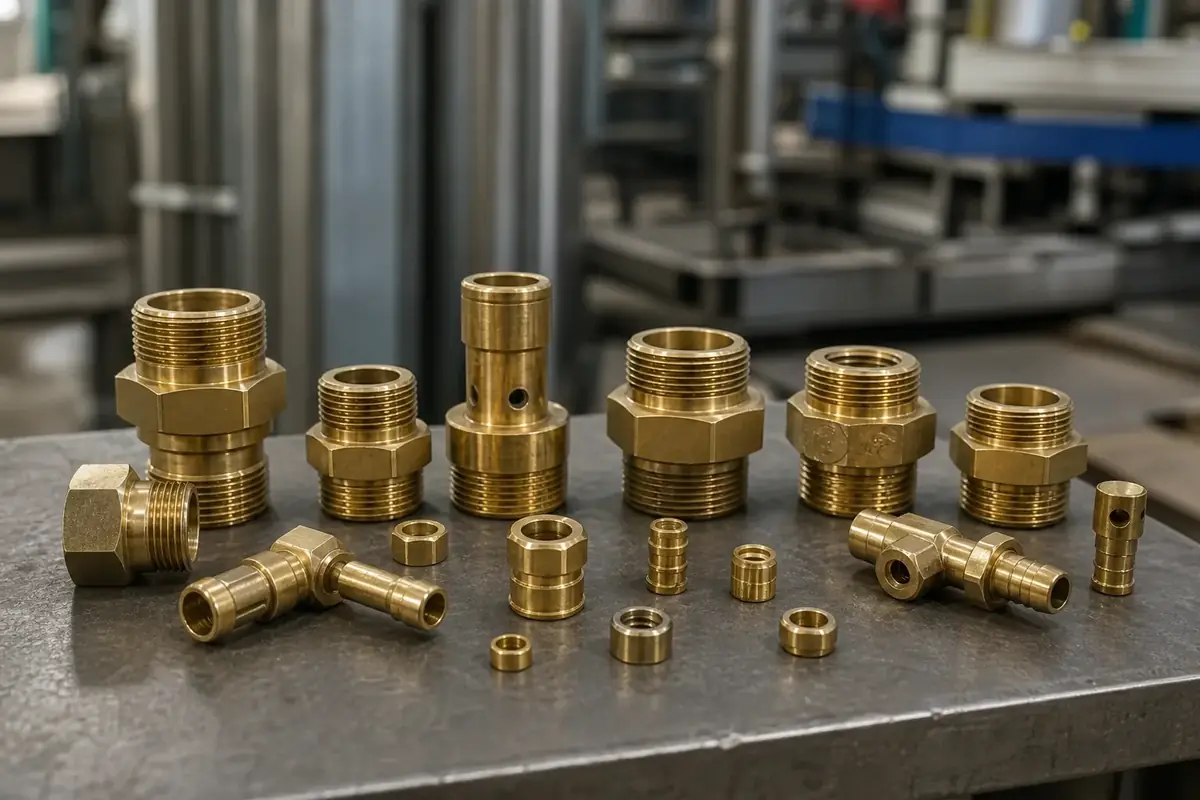
Related industrial fluid adapters for machines and vehicles belong here too when sealing matters. The photo may look like a simple hex nipple; the RFQ still needs thread standard and pressure expectation.
Glossary cues
- Elbow, nipple, union, coupling, adaptor.
- Valve body, cartridge housing, gland nut (fluid sense).
- BSP / NPT / metric thread callouts.
Electrical and lighting hardware
Glands, terminals, neutral links, lamp holders, conduit fittings, and enclosure hardware sit here. Conductivity, sealing, and thread integrity matter. Visible lighting hardware adds finish matching across sets.
If your “brass item” is really a current path or cable entry part, keep it out of décor assortments in packing and QC plans.
Lighting cups, check rings, and decorative canopy hardware blur into décor visually. Sort by whether the part must meet electrical assembly standards. Dual-duty parts need both finish masters and functional gauges.
Panel builders should state plating exclusion zones where bare brass or tin is required for contact. A pretty nickel coat in the wrong place is a functional defect, not a bonus.
Fasteners, inserts, bushings
Screws, anchors, threaded inserts for plastics, collars, spacers, and bushings are high-volume turned citizens of the cluster. Knurl patterns, thread class, and concentricity define quality more than shine.
These brass items often look plain in photos and fail loudly in assemblies. Treat drawings as mandatory.
Insert programs should state installation method—moulded-in, heat-stake, ultrasonic—and pilot hole guidance. Bushings should state ID/OD tolerance and whether oil grooves or flanges exist. Collars need set-screw notes if they clamp shafts.
Fastener finishes (plain, nickel, tin) change both corrosion behaviour and thread fit after coating. Call plating thickness when classes are tight. Bag and tag mixed lengths; bulk bins create expensive sorting later.
Custom turned pins and adapters that look like fasteners still belong in this engineering family when the print carries concentricity and hardness expectations. Do not move them into giftware QC just because the photo is shiny.
Door, furniture, and architectural parts
Handles, knobs, hinges, escutcheons, pulls, and related furniture hardware balance wear with finish. Architectural letters, large numerals, and oversized ornamental pieces sometimes get nicknamed giant brass in casual speech—always replace that nickname with height, depth, mounting method, and hollow/solid notes.
Hand traffic and batch colour control matter. A hinge pin fit is not a figurine polish problem.
Furniture OEMs often need matching finishes across knobs, pulls, and lighting-adjacent accents in one collection. Approve a finish master that spans the set. Door programs care about backset compatibility and screw patterns as much as colour.
Exterior architectural brass sees weather. Ask whether lacquer, living finish, or marine-aware alloy notes apply. Indoor hardware care routines do not automatically transfer to coastal entry doors.
Large letters and logos need mounting engineering: stud patterns, standoff lengths, and wind load assumptions for outdoor signs. “Giant” without those notes is only a photo brief.
Décor, gifts, and household brassware
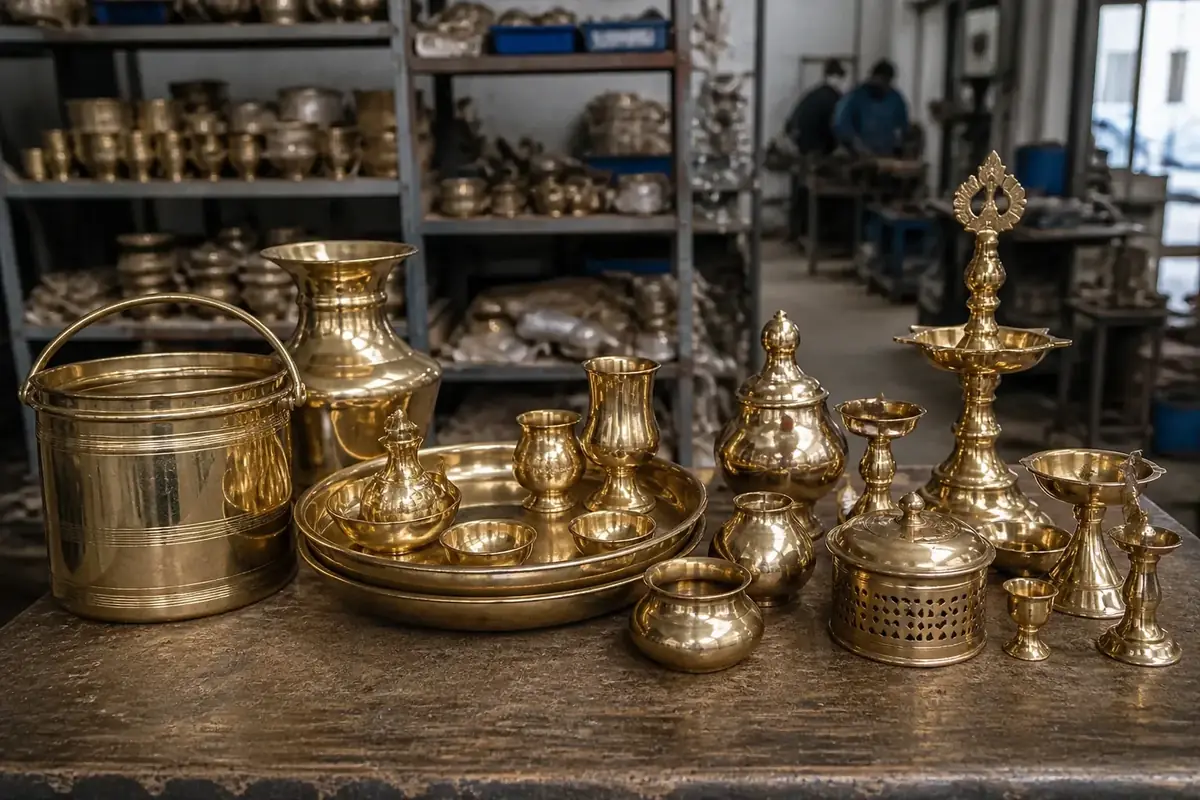
Brassware in trade talk often means household and decorative goods: trays, planters, vases, figurines, boxes, and showpieces. Home décor programs live here. Gift assortments and return gifts do too.
Continue with brass home décor mirrors, trays, and planters for living-space products. Religious and ritual forms deserve their own checklist—do not assume décor packing fits pooja SKUs.
Fashion-adjacent searches appear in this neighbourhood too. Phrases like coral and brass or bindle and brass often describe jewellery or lifestyle aesthetics that mix materials—not a single factory SKU name. Ask whether you need metal components, finished fashion goods, or only a colour/finish reference.
Household-adjacent odd terms
- Brass bank — commonly a coin bank / piggy-bank style gift, not a financial product.
- Brass makeup — usually cosmetic packaging accents or makeup-adjacent accessories in brass tone; confirm skin-contact expectations.
- Brass paper — sometimes means brass-coloured paper goods, sometimes thin shim/foil stock; clarify sheet metal versus stationery.
Rod, sheet, blanks, and allied forms
Not every buyer wants a finished consumer SKU. Extruded rod, hex bar, discs, plates, wire, and chain feed other factories. Semi-finished forms need thickness, temper, and edge notes.
Brass rims may mean wheel-adjacent trim, lamp rims, clock bezels, or luggage-style frames—geometry decides the cell. Brass saddle language can mean saddle hardware, musical instrument parts, or niche fittings; send a photo. A brass pocket band is typically a small formed band or clip-style component—confirm dimensions rather than assuming a standard catalogue item.
Rod buyers should specify diameter, tolerance, and alloy grade—not only “yellow bar.” Sheet and plate buyers should specify temper and surface. Wire and chain buyers should specify diameter, link style, and whether the form is structural or decorative.
Semi-finished exports need packing that protects edges and polish without trapping moisture. Bare bright plate stacked without interleave arrives scratched; overwrapped damp plate arrives spotted. Say which surface is cosmetic.
If your plant will machine blanks further, tell the supplier the next process. Annealed discs for stamping differ from hard discs meant only for engraving faces. That one sentence prevents a quiet metallurgy mismatch.
Specialty and ambiguous search phrases
Catch-all hubs attract messy queries. Treat them as clarification prompts, not automatic production orders.
Brass balance may mean weighing-scale beams or balance hardware in traditional instruments—or a metaphorical retail phrase. Ask for the mechanism. Paver block price per brass usually mixes construction paving language with a metal query; paving blocks and brass components are different supply chains. Do not force a brass workshop to quote concrete products.
When a search is aesthetic (“coral and brass,” “bindle and brass”), translate it into finish, alloy tone, and product family before you request samples. Ambiguity is cheap to resolve in email and expensive to resolve in a container.
Musical and equestrian niches produce more ambiguous nouns. A saddle-related brass part might be a decorative concho-style accent or a functional buckle component. Instrument “rims” and bands need maker drawings. Pocket bands and small clips need OD/ID and temper. Send geometry early.
If the query is clearly not metal components—stationery “brass paper,” pure fashion editorial, or paving materials—say so and redirect. Educational hubs help most when they refuse to pretend every string is a machinable SKU.
“Unclear category is not a sourcing strategy—it is a request for a conversation.”
Family-to-hub map
| Family | Typical brass items | First lock | Next hub |
|---|---|---|---|
| Fluid / sanitary | Fittings, valve parts | Thread + alloy | Plumbing fittings guide |
| Electrical / lighting | Glands, terminals, holders | Duty + seal | Lighting / electrical guides |
| Engineering turned | Inserts, bushings, fasteners | Drawing + tolerance | Manufacturer buyer guide |
| Architectural / furniture | Handles, hinges, letters | Finish + wear | Door / furniture hubs |
| Brassware / décor | Trays, planters, gifts | Size + finish | Home décor hub |
| Semi-finished | Rod, discs, plates, wire | Temper + thickness | Custom / alloys hubs |
Naming habits that keep RFQs searchable
Inside your own company, pick stable family names: “sanitary fitting,” “cable gland,” “door pull,” “planter,” “engraving plate,” “coin blank.” Then add the SKU code. Mixing marketing poetry into the ERP description (“golden coral vibe rim”) makes reorder impossible six months later.
Suppliers mirror your language. If every email says only “brass items,” you will receive optimistic interpretations. If every email names the family and the critical spec, quotes tighten. Glossary discipline is operational, not academic.
When translating from local languages or retail slang into English RFQs, keep both terms once for clarity, then standardise. Example: note that a customer said “brass bank” meaning coin bank, then code the line as “coin bank – cast brass – antique finish.”
A simple path when you only know the photo
Start with function: Does it carry fluid, carry current, fasten something, get touched as hardware, sit as décor, or feed another process as a blank? That question alone removes half the wrong workshops.
Next, name size and whether threads exist. Threads push you toward machining standards. No threads plus organic shape often means casting and finishing. Flat stock suggests blanking or plate work. Hollow large forms suggest fabricated or cast décor with packing complexity.
Finally, open the specialised hub linked in the family map—or send the photo with your function sentence to a sourcing desk for category guidance. Guessing the HS code before guessing the family is backwards.
What this glossary deliberately does not do
It does not rank manufacturers, invent certificates, or turn every search string into a fake SKU. Some queries are lifestyle copy. Some are mis-typed construction terms. Some belong to musical instruments or apparel hardware outside Jamnagar’s usual export mix.
It also does not replace drawings. A glossary orients. Acceptance still needs dimensions, alloy, finish, and packing notes. Treat this page as the index card at the front of the filing cabinet—not the engineering vault.
If you need depth on alloys, fittings, décor, or manufacturer selection, follow the outbound hubs rather than padding this catch-all with duplicate essays.
Alloy notes that cut across families
Product type does not replace alloy choice. Free-cutting rod grades dominate turned hardware. Forging and casting chemistries suit bodies and décor blanks. Lead-free or dezincification-resistant notes appear when markets demand them.
Price talk without grade talk is incomplete. Orient with brass alloys, grades, and price factors once the family is clear.
Remember: the glossary names the shelf. The alloy note names the melt. You need both for a serious PO.

FAQ: brass products glossary
How should importers use this glossary with suppliers?
Name the family, open the specialised hub, then send a drawing or size/finish ladder. Catch-all searches alone do not make work instructions.
What is a types of brass products glossary useful for?
It maps brass items into families so RFQs reach the right process cell—fittings, fasteners, electrical hardware, décor, or blanks—instead of a generic brass inbox.
What does brassware usually include?
Often household and decorative copper-zinc goods—vessels, trays, figurines, and related merchandise—though some sellers stretch the word to any brass goods.
Are all brass items made the same way in Jamnagar?
No. Turning, forging, casting, stamping, and polishing live in different cells. Shared alloy language does not mean shared capability.
What if my search term does not match a clear family?
Describe function, size, and attach a photo or drawing. Odd phrases can mean fashion mixes, scale hardware, or unrelated materials.
Where do plumbing fittings sit in this glossary?
Under fluid-system hardware. They need thread and alloy notes, not gift-finish assumptions.
How are alloys related to product types?
Duty drives chemistry. Free-cutting for volume turning, other grades for forging, casting, or compliance markets.
Is giant brass a real category?
It is informal language for oversized statues, letters, or vessels. Replace it with dimensions and construction notes.
Conclusion
A glossary earns its keep when it reduces confusion. Sort brassware and industrial brass items by family, lock the first specification that family cares about, then move into the hub that owns the detail.
Jamnagar can make many types of brass products. Your job is to name which type you mean before metal and finish labour begin.
If the category still feels fuzzy, describe the job the part must do—that sentence is the real glossary entry.
Category Unclear? Get Guided to the Right Line
If your brass search sits between fittings, hardware, and décor, ask for category guidance and catalogue pathways on Jamnagar.net.